
2027 Tax Engine Update
The IRS and nearly a dozen states just released new numbers for 2027. We updated our tax engine to match.
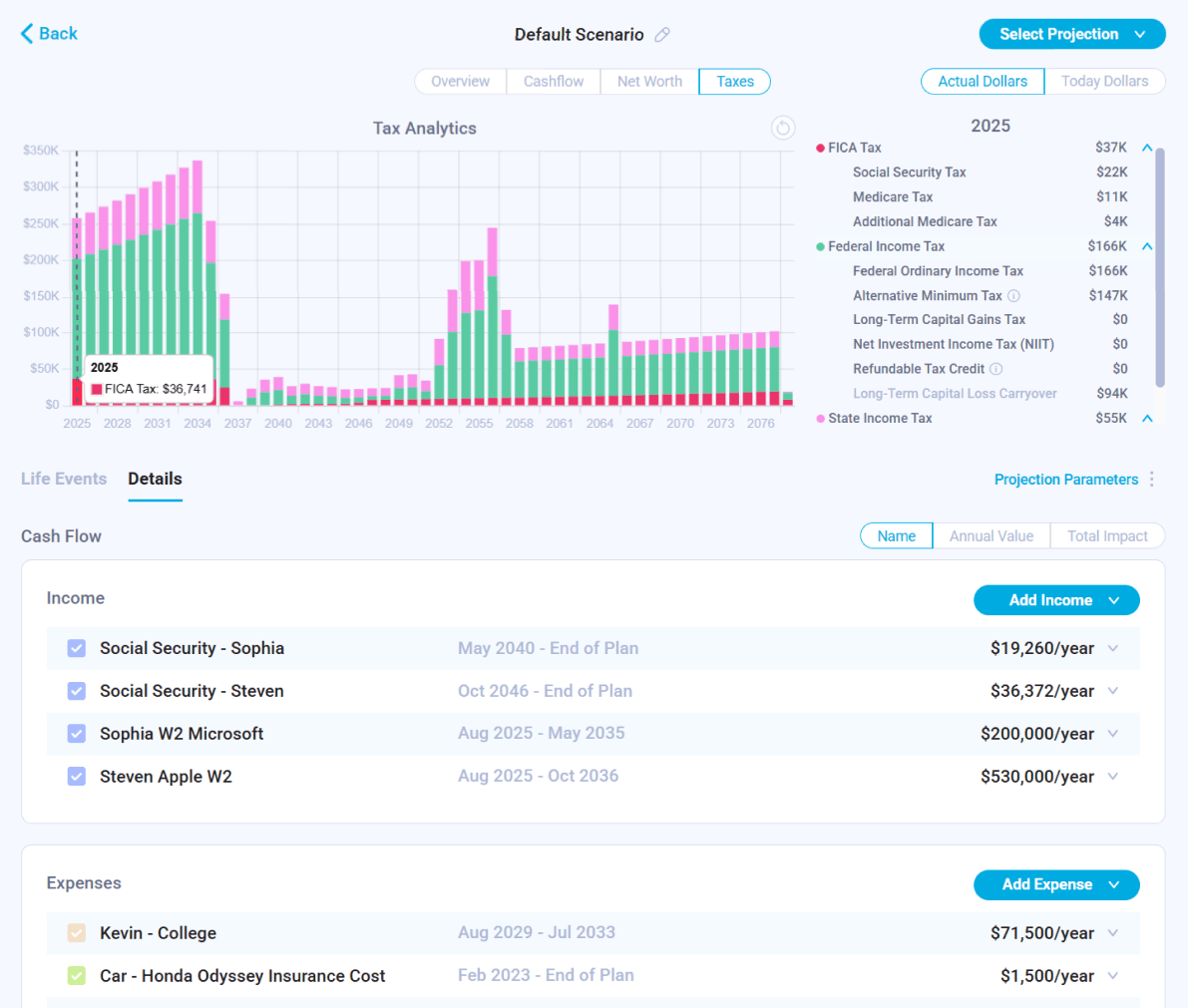
Every fall, the IRS and state governments release new tax brackets, deductions, and credits for the coming year. Those numbers power every tax estimate you see in Nauma.
This year's release was bigger than usual: a new federal revenue procedure, a voter-approved overhaul in Colorado, a multi-bracket rewrite in Maryland, and real changes in close to a dozen other states. We've gone through all of it and brought Nauma's tax engine current for tax year 2027. Here's what changed, and how it flows into your plan.
How Nauma's Tax Engine Works
Every tax estimate in Nauma, from this year's bill to a projection decades out, comes from the same engine. For each tax year, we maintain:
- Federal: income brackets, capital gains brackets, the standard deduction, AMT, the Child Tax Credit, and Social Security limits, one schedule per filing status.
- State: each state's bracket structure, deductions, exemptions, and items like retirement-income exclusions or capital-gains surcharges.
- Local: county-level rates, like Maryland's, layered on top of the state calculation.
- Program-specific: ACA poverty-level tables and Medicare IRMAA brackets.
Most figures are inflation-indexed and move every year; a smaller set only changes when lawmakers act. A multi-year projection in Nauma pulls the right parameters for each year, so keeping every year's data current, not just this year's, matters.
The Federal Baseline for 2027
The IRS's Revenue Procedure 2026-35 (released November 5, 2026) sets the federal numbers for 2027. The key inflation-adjusted figures, for married filing jointly:
| Federal parameter (MFJ) | 2026 | 2027 |
|---|---|---|
| Top ordinary bracket threshold | $768,700 | $793,650 |
| Standard deduction | $32,200 | $33,200 |
| AMT exemption | $140,200 | $144,700 |
| AMT phaseout threshold | $1,000,000 | $1,031,900 |
| AMT 28% breakpoint | $244,500 | $252,500 |
| Child Tax Credit, per child | $2,200 | $2,300 |
| Social Security wage base | $184,500 | $192,300 |
| SALT itemized deduction cap | $40,000 | $40,804 |
And the married-filing-jointly ordinary-income bracket ceilings, which shift every year with inflation:
| Rate | 2026 ceiling | 2027 ceiling |
|---|---|---|
| 10% | $24,800 | $25,600 |
| 12% | $100,800 | $104,050 |
| 22% | $211,400 | $218,250 |
| 24% | $403,550 | $416,650 |
| 32% | $512,450 | $529,100 |
| 35% | $768,700 | $793,650 |
| 37% | over $768,700 | over $793,650 |
Long-term capital gains brackets are inflation-indexed too, and they move on their own schedule rather than tracking the ordinary brackets exactly. Here's the before-and-after for married filing jointly:
| Rate | 2026 ceiling (Before) | 2027 ceiling (After) |
|---|---|---|
| 0% | $98,900 | $102,100 |
| 15% | $613,700 | $633,600 |
| 20% | over $613,700 | over $633,600 |
The State Headlines
State tax law doesn't move on the federal calendar, so 2027 brought a mix of routine inflation adjustments and genuine legislative change. Here's what's worth knowing.
California. California's Franchise Tax Board runs noticeably behind most other states: full 2026 figures aren't expected until December 2026, and 2027's aren't due until December 2027. So for now, Nauma carries forward the most recently confirmed bracket figures (FTB's 2025 Personal Income Tax Booklet) as the placeholder in both the 2026 and 2027 files. For married filing jointly, those brackets look like this:
| Rate | 2024 ceiling | 2025 ceiling (current placeholder) |
|---|---|---|
| 1% | $21,512 | $22,158 |
| 2% | $50,998 | $52,528 |
| 4% | $80,490 | $82,904 |
| 6% | $111,732 | $115,084 |
| 8% | $141,212 | $145,448 |
| 9.3% | $721,318 | $742,958 |
| 10.3% | $865,574 | $891,542 |
| 11.3% | $1,442,628 | $1,485,906 |
| 12.3% | over $1,442,628 | over $1,485,906 |
Colorado. Voters passed Amendment 87 on November 3, 2026, replacing the state's flat 4.4% income tax with a graduated structure, starting in 2027 only:
| Income level | Rate through 2026 | Rate starting 2027 |
|---|---|---|
| $25,000 | 4.4% | 3.7% |
| $100,000 | 4.4% | 4.2% |
| $500,000 | 4.4% | 4.4% (unchanged) |
| $750,000 | 4.4% | 7.4% |
| $1,000,000+ | 4.4% | 8.4% |
Notably, the new brackets apply identically to single and joint filers: there's no doubling of thresholds for couples.
Maryland. HB 352 (Ch. 604, Acts of 2025) adds two new top brackets above the old 5.75% ceiling: 6.25% on income from $500,001–$1,000,000, and 6.5% above $1,000,000. The standard deduction also moves from a sliding 15%-of-AGI formula to a flat $3,400 (single/MFS) or $6,800 (MFJ/HOH).
New York. New York doesn't inflation-index its brackets, but a multi-year legislated rate cut (Ch. 59, Laws of 2025) continues to phase in. The bottom five brackets drop again in 2027, continuing through 2032:
| Bracket | 2025 | 2026 | 2027 |
|---|---|---|---|
| 1st | 4.0% | 3.9% | 3.8% |
| 2nd | 4.5% | 4.4% | 4.3% |
| 3rd | 5.25% | 5.15% | 5.05% |
North Carolina. A fixed statutory schedule (S.L. 2026-41) replaces the old revenue-trigger mechanism, bringing the flat rate down from 3.99% to 3.49% for 2027–2029.
Iowa. Iowa now conforms to federal taxable income (effective since tax year 2023), so it has no standard deduction schedule of its own. For a single filer with $50,000 in W-2 income, that moves taxable income from $44,550 to $34,250, and the tax bill from $1,692.90 to $1,301.50.
Arkansas. The top individual rate drops from 3.9% to 3.7% (SB1/Act 1, 2026 1st Extraordinary Session), with every low-income bracket ceiling shifted upward too.
Georgia. The standard deduction rises to $15,000 (single/HOH/MFS) and $30,000 (MFJ) under HB 463, and the flat income tax rate ticks down to 4.99%.
Minnesota. Brackets and the standard deduction both move with inflation every year; for 2027 the single bracket thresholds land at $33,310 / $109,430 / $203,150, with a standard deduction of $15,300 (single) and $30,600 (MFJ).
Connecticut. The Social Security income exemption now applies at 100% of benefits regardless of AGI (previously 75% above a certain income threshold), per PA 26-68.
Washington. No 2027 changes to the capital gains surcharge, but worth flagging: the state's planned first-ever income tax (ESSB 6346), set to begin in 2028, is now confirmed, enacted law rather than a speculative placeholder.
Beyond Income Tax: ACA and Medicare
Two numbers that drive a lot of retirement and early-retirement planning in Nauma also got refreshed:
- ACA Federal Poverty Level. HHS hasn't published 2027 figures yet, so we carry forward the confirmed 2026 value, $15,960 for a one-person household in the contiguous US, as a clearly flagged placeholder.
- Medicare IRMAA brackets. The 2026 base Part B premium is $202.90/month, up from $185.00 in 2025, and the MAGI thresholds that trigger each surcharge tier moved accordingly.
What This Means for You
If you're running projections in Nauma, you don't need to do anything: the engine automatically applies the correct year's parameters at every point in your plan, whether that's your 2027 return or a bracket 25 years out. Where a state or agency hasn't published final 2027 numbers yet, we carry forward the most recent confirmed figures as a clearly flagged placeholder rather than guess, and we'll swap in the real numbers the moment they're released.
Tax law is one of the few inputs to a financial plan that changes every single year, for every filer, in every state. Keeping that layer current, line by line, state by state, is exactly the kind of work that keeps the rest of your plan trustworthy.
Frequently Asked Questions
See Your 2027 Tax Picture, Automatically
Nauma keeps every federal, state, and local tax parameter current year over year, so your projections reflect the latest law without any manual updates.
Get Started for Free