'%3e%3cpath%20d='M136%2043.0521C135.893%2043.4991%20131.298%2041.3697%20123.51%2041.5186C120.787%2041.5712%20109.626%2040.8001%20104.06%2049.4228C101.316%2053.664%20102.266%2056.2491%20100.601%2061.5769C95.2065%2078.8661%2087.7394%2075.1856%2062.5302%2088.5228C54.5058%2092.764%2045.1595%20101.562%2043.5589%20103.087C31.9403%20114.163%2025.1664%20123.189%2025.1521%20123.171C25.1378%20123.162%2034.1912%20104.357%2047.7676%2082.7655C60.6795%2062.2429%2063.8235%2070.0769%2079.7722%2049.1336C81.7015%2046.6011%2084.8526%2037.6805%2089.683%2036.1032C93.6345%2034.815%2098.6148%2036.6114%20100.065%2038.5568C101.044%2039.8712%20101.459%2040.765%20103.831%2040.4408C110.048%2039.5996%20113.613%2039.8625%20115.492%2039.7748C116.95%2039.7047%20119.751%2039.915%20120.509%2039.9939C130.419%2040.9753%20136.15%2042.4563%20136.007%2043.0434L136%2043.0521Z'%20fill='%23127398'/%3e%3cpath%20d='M22.1867%2043.6392C30.3968%2055.0923%2031.5544%2062.348%2040.6506%2068.6923C45.9954%2072.4253%2053.4839%2075.4134%2058.2928%2075.5361C61.9084%2075.6325%2063.7305%2075.2557%2064.6023%2074.949C64.8524%2074.8614%2065.1025%2074.8351%2065.3597%2074.8263L76.0636%2070.6727C76.8068%2066.8871%2076.1637%2063.4784%2076.1065%2063.1892C75.0561%2058.0103%2072.3337%2053.3835%2070.5402%2051.2542C55.4561%2033.3428%2055.8062%2034.298%2046.5814%2028.0237C26.7884%2014.5902%20-1.22192%2021.3464%200.0428309%2022.0562C0.55016%2022.3454%2010.2394%2026.9634%2022.1867%2043.6392Z'%20fill='%23127398'/%3e%3cpath%20d='M79.8366%2044.0161C81.33%2046.4784%2083.4093%2051.5784%2083.7666%2056.8975C83.7952%2057.3094%2084.1667%2064.0393%2080.4654%2068.4733C78.5004%2070.8217%2076.2281%2071.5403%2075.585%2071.7506C61.487%2076.5264%2028.4319%20116.196%2023.3515%20133.494C23.2229%20133.941%2022.6227%20136.026%2022.5655%20136C22.3797%20135.921%2023.5373%20120.753%2028.925%20106.303C28.925%20106.303%2033.7196%2090.5295%2046.7387%2073.9326C49.1896%2070.8042%2052.8052%2067.0362%2052.8052%2067.0362C54.2414%2065.1434%2059.8006%2068.3068%2066.1887%2068.482C69.9401%2068.5872%2073.2198%2067.6846%2073.2055%2067.3604C73.2055%2067.2377%2073.0698%2067.0712%2072.8911%2066.9047C72.3195%2066.3702%2071.5907%2066.1423%2070.8761%2066.2475C69.9758%2066.379%2068.1323%2066.3877%2064.5738%2065.5903C59.8435%2064.5212%2052.8481%2060.096%2048.0534%2055.364C39.9076%2047.3109%2039.7147%2039.9238%2033.1051%2026.9985C23.4944%208.17586%2014.0767%201.32328%2014.0767%201.32328C17.285%20-1.64734%2041.451%20-0.788575%2059.229%2016.3692C67.5177%2024.3697%2067.2962%2023.3619%2079.8366%2044.0073V44.0161Z'%20fill='%23EF9920'/%3e%3c/g%3e%3cdefs%3e%3cclipPath%20id='clip0_882_3310'%3e%3crect%20width='136'%20height='136'%20fill='white'/%3e%3c/clipPath%3e%3c/defs%3e%3c/svg%3e)
Equity Compensation & Taxes: What Tech Workers in Private Companies Need to Know
When Each Tax Event Occurs, What You Owe, and Why California Makes Every Calculation Harder
Private company equity compensation creates tax events that are different from everything else on your return. They are large, often illiquid, sometimes unexpected, and — for California residents — subject to some of the highest marginal rates in the country with none of the preferential treatment that applies in other states. The tax bill from a single ISO exercise or RSU settlement at IPO can exceed your annual salary. Yet most employees encounter these events without having planned for them, because the complexity is real and the information is scattered.
This guide covers the full tax lifecycle of every major form of private company equity compensation — RSAs, stock options (ISOs and NSOs), and RSUs — in the sequence that a tech worker is likely to encounter them. It is built to be read before a taxable event, not after.
How Equity Income Is Taxed: The Framework
All forms of private company equity compensation eventually produce one or more of three types of income for tax purposes:
Ordinary income. Taxed at your marginal federal rate (up to 37% in 2026) and California state rate (up to 13.3%). This is the same rate as your salary. Equity events that produce ordinary income include: RSA vesting without an 83(b) election, NSO exercise on the spread, ISO exercise on the spread in California (though not federally), and RSU delivery at settlement.
Long-term capital gain. Federally taxed at preferential rates of 0%, 15%, or 20% depending on income, plus 3.8% Net Investment Income Tax (NIIT) above certain thresholds. In California, taxed at ordinary income rates — there is no preferential state capital gains rate. Long-term capital gain applies to appreciation above the FMV at the taxable delivery date, when shares are held more than one year after that date.
Alternative Minimum Tax (AMT) preference item. ISO exercise at the federal level creates an AMT preference item — it is added to your AMT income calculation even though it is not regular ordinary income. If your total AMT income exceeds the AMT exemption, you pay AMT (26% or 28% on the excess) instead of regular tax. California has a separate AMT at 7%.
Understanding which type of income each equity event creates — and when — determines your entire tax planning strategy. See Ordinary Income Taxes, Capital Gains Taxes, and Alternative Minimum Tax (AMT) for the underlying frameworks.
RSA Taxation: Two Paths Determined by One 30-Day Decision
The tax treatment of a Restricted Stock Award is determined almost entirely by whether you file an 83(b) election within 30 days of the grant date. The two paths diverge dramatically over time.
Path 1 — With 83(b) election (the preferred path at early stage):
You elect to recognize income now, based on the FMV at grant. At pre-seed stage, this FMV is typically near zero — $0.0001 per share — making the taxable income from the election negligible. You pay ordinary income tax on that small amount today. All future appreciation from the grant date forward is capital gain. If you hold the shares for more than one year from the grant date, it is long-term capital gain — taxed federally at 0–20%, plus NIIT. If the company qualifies for QSBS (Section 1202), federal gains may be partially or fully excluded at sale. For RSA shares issued on or before July 4, 2025: up to $10M (or 10x adjusted basis) excluded after a 5-year hold. For shares issued after July 4, 2025 (post-OBBBA rules): the per-issuer cap rises to $15M, the gross asset threshold increases to $75M, and a graduated schedule applies — 50% exclusion after 3 years, 75% after 4 years, 100% after 5 years (note: unexcluded gain on 3- or 4-year exits is taxed at 28%, not the standard long-term capital gains rate).
Path 2 — Without 83(b) election (the default rule):
At each vesting date, the FMV of the vesting shares is ordinary income. At a fast-growing startup, FMV rises with each funding round. An employee who receives 100,000 RSA shares at $0.10 per share and vests them when the 409A FMV has risen to $8.00 owes ordinary income tax on $800,000 — over four years, in amounts that depend on the FMV at each vesting date. In California, that is up to $106,400 in state tax alone on the full vest. On shares that cannot be sold.
The mechanics of filing the election — IRS Form 15620, 30-day hard deadline, Certified Mail documentation — are covered in detail at 83(b) Election: What It Is and Why It Matters.
California note: California conforms to the federal 83(b) election. Filing reduces future California ordinary income at vesting, just as it does federally. However, California does not conform to QSBS — gains excluded at the federal level remain fully taxable at the state level. See Qualified Small Business Stock (QSBS).
ISO Taxation: Four Events, Two Holding Periods, One California Trap
Incentive Stock Options involve four distinct events, each with different tax treatment at the federal level. California collapses most of this structure.
Grant date. No tax event at any level. The option grant itself creates no income.
Vesting date. No tax event for ISOs. Vesting makes options exercisable but creates no income.
Exercise date — federal treatment. No ordinary income recognized. However, the spread between your strike price and the 409A FMV at exercise is an AMT preference item. For 2026, AMT applies at 26% on AMT taxable income up to $244,500 and 28% above that threshold, after the AMT exemption. The 2026 AMT exemption is $90,100 for single filers and $140,200 for married filing jointly. Important 2026 change: the exemption phase-out thresholds were tightened by OBBBA — the exemption now begins to disappear at $500,000 AMTI for single filers (down from $626,350 in 2025) and phases out twice as fast (50 cents per dollar, up from 25 cents). For high-income tech employees, this means AMT can hit at meaningfully lower income levels than in prior years. Whether you actually owe AMT depends on your total income picture. A large ISO exercise in a year with otherwise modest income may generate little or no AMT. Exercising a block of ISOs with a large spread can generate a six-figure AMT bill on shares you cannot sell.
If you pay AMT in the year of exercise, you receive an AMT credit that can offset future regular tax. The credit recovers over time but does not eliminate the cash flow problem of owing tax in cash on illiquid stock.
Exercise date — California treatment. California does not conform to the federal ISO tax preference. The spread at exercise — the same amount that is only an AMT item federally — is ordinary income in California, subject to state tax at rates up to 13.3%. For a California resident exercising ISOs with a $200,000 spread, the California tax bill at exercise is up to $26,600 — due in the year of exercise, in cash, on shares that may not be saleable for years.
This is the California ISO trap: the federal advantage of ISOs (deferral of ordinary income until sale) simply does not exist at the state level. California residents owe state tax at exercise regardless of how long they hold the shares afterward.
Sale date — qualifying disposition. If you sell shares more than 2 years after the grant date AND more than 1 year after the exercise date, the entire gain from strike price to sale price is long-term capital gain federally — 0%, 15%, or 20% plus NIIT. In California, that same gain is taxed at ordinary income rates, because California has no preferential capital gains rate.
Sale date — disqualifying disposition. If you sell before either holding period is met, the spread at exercise becomes ordinary income federally — added to your W-2 — in the year of sale. This retroactively eliminates the ISO tax advantage. The most common disqualifying disposition: selling at IPO in the same calendar year you exercised. If you exercise ISOs in February and the company IPOs in September, selling at IPO is likely a disqualifying disposition.
For the full ISO tax analysis and holding period calculations, see Incentive Stock Options (ISO) in Private Companies.
NSO Taxation: Simpler, But No Less Expensive
Non-Qualified Stock Options have straightforward tax treatment that applies consistently at both the federal and California levels — making them in some ways easier to plan for than ISOs, even if the federal rate is higher.
At exercise: The spread (FMV at exercise minus strike price) is ordinary income in the year of exercise. For employees, it is added to W-2 wages and subject to federal income tax, Social Security, Medicare, and California income tax. For non-employees (contractors, advisors), it is reported on a 1099-NEC and subject to self-employment tax in addition to ordinary income tax.
Your employer withholds taxes at exercise for NSOs — typically by withholding shares equal to the estimated tax. Verify that this mechanism is in place before exercise; if the company requires cash payment for withholding, you need to fund it from other sources.
After exercise: Your cost basis equals the FMV at exercise. Appreciation above that basis from exercise date to sale date is capital gain — short-term if sold within one year, long-term if held more than one year. In California, both rates equal ordinary income rates.
The cash flow math for California residents: A California resident exercising NSOs with a $300,000 spread faces approximately $111,000 in combined federal (37%) and California (13.3%) ordinary income tax on the spread alone — roughly $37,000 of which is California tax. This is owed in the year of exercise regardless of when the shares are sold.
For the full NSO tax analysis and comparison to ISO treatment, see Non-Qualified Stock Options (NSO) in Private Companies.
Early Exercise: Shifting the Tax Event to Near Zero
For employees at companies that allow early exercise, exercising stock options before vesting — when the spread between the strike price and the 409A FMV is near zero — is one of the most effective tax planning strategies available.
When you early-exercise and the spread is $0 (because FMV equals the strike price at a well-managed company with a current 409A), the taxable income at exercise is also $0. The 83(b) election filed within 30 days of exercise confirms this treatment and starts the clock on both the capital gains holding period and the QSBS holding period.
Future appreciation — from the $0 spread at exercise to wherever the company's stock ends up at exit — is then capital gain, not ordinary income. For ISOs, the AMT preference item at exercise is $0. For NSOs, the ordinary income at exercise is $0. In both cases, California ordinary income at exercise is $0.
The strategy requires: the company allows early exercise, the spread is genuinely near zero, you can fund the exercise price, and you file the 83(b) election within 30 days. All four conditions must be present.
See Early Exercise of Stock Options for the full mechanics and the risk assessment — including what happens if the company fails after you have paid for unvested shares.
RSU Taxation in Private Companies: Deferred Until Delivery
Double-trigger RSUs at private companies are structured specifically to defer the tax event until a liquidity event occurs — solving the cash flow problem that would result from taxing employees at each time-based vest date when shares are illiquid.
At time-based vesting: No tax event. Nothing happens from a tax perspective when RSUs time-vest under a double-trigger structure.
At delivery (both triggers satisfied): Ordinary income equal to the FMV at delivery is recognized. For an IPO settlement, the FMV is typically the IPO price or the first-day closing price, depending on the plan. This ordinary income is:
- Subject to federal income tax at marginal rates (up to 37%)
- Subject to California income tax at marginal rates (up to 13.3%)
- Subject to FICA (Social Security up to the wage base, Medicare, Additional Medicare Tax above $200,000/$250,000)
- Withheld by the company through share withholding or sell-to-cover
After delivery: Your cost basis equals the FMV at delivery. Any appreciation or decline from that point is capital gain or loss. At IPO, a 180-day lock-up period typically prevents immediate sale — meaning you owe taxes on the IPO-day FMV but cannot sell shares to fund the payment. If the stock declines during the lock-up, you may owe more in taxes than the shares are eventually worth.
The IPO tax spike. For employees with large RSU grants settling at IPO, the delivery event can create $500,000 or more of ordinary income in a single tax year. Combined with W-2 salary and other income, this commonly pushes employees into the top federal bracket for that year and generates an unexpectedly large California tax bill. Planning before the IPO — including estimated quarterly payments, timing of additional exercises or sales, and potential charitable giving — requires modeling the full income picture for the year.
Single-trigger RSU exception. If your company uses single-trigger RSUs (unusual at private companies), income is recognized at each time-based vest date, not at a liquidity event. The tax mechanics are the same — ordinary income at FMV on the vest date — but the timing problem is severe: you owe taxes in cash on each vest with no ability to sell. See RSU in Private Companies: How They Work and Why They're Different and Double-Trigger RSU: The Complete Guide.
The California Tax Map: Every Equity Event
For California residents, the following table summarizes the state tax treatment of each equity event — and how it differs from the federal treatment:
| Event | Federal Treatment | California Treatment |
|---|---|---|
| RSA grant (with 83(b)) | Ordinary income on FMV at grant (typically near zero) | Same — conforms to 83(b) |
| RSA vesting (without 83(b)) | Ordinary income on FMV at vest | Same — ordinary income |
| ISO exercise | AMT preference item only | Ordinary income at full state rate |
| ISO sale — qualifying disposition | Long-term capital gain (0–20% + NIIT) | Ordinary income (no CG preference) |
| ISO sale — disqualifying disposition | Ordinary income on spread; CG on additional appreciation | Ordinary income on everything |
| NSO exercise | Ordinary income on spread | Same — ordinary income |
| NSO sale (1+ year hold) | Long-term capital gain on appreciation | Ordinary income on appreciation |
| RSU delivery at liquidity event | Ordinary income on FMV at delivery | Same — ordinary income |
| RSU appreciation post-delivery | Long-term capital gain (1+ year hold) | Ordinary income |
| QSBS exclusion at sale (shares issued ≤ July 4, 2025) | Up to 100% excluded (up to $10M or 10x basis) after 5-year hold | Does not apply — fully taxable |
| QSBS exclusion at sale (shares issued after July 4, 2025) | Graduated: 50% (3yr) / 75% (4yr) / 100% (5yr); cap $15M or 10x basis; unexcluded gain taxed at 28% | Does not apply — fully taxable |
| ISO exercise — state AMT | Not applicable (federal AMT only) | 7% CA AMT on spread, separate from and independent of federal AMT |
| Early exercise at $0 spread | No income event | No income event |
The pattern is consistent: California taxes all equity income as ordinary income. The federal capital gains preference, the federal ISO deferral at exercise, and the federal QSBS exclusion all provide meaningful federal savings that California does not replicate.
The Most Common Tax Mistakes — and How to Avoid Them
Missing the 83(b) deadline. The 30-day window from RSA grant date or early exercise date is absolute. Employees who miss it lose the ability to lock in near-zero FMV as their tax basis and face ordinary income at each future vesting date. Set a calendar reminder the day you sign your grant agreement. File immediately. See 83(b) Election: What It Is and Why It Matters.
Exercising ISOs without modeling AMT. The AMT calculation is not intuitive. Employees who exercise a large ISO block in a year with high other income are often surprised to find that AMT exceeds their regular tax by tens of thousands of dollars. Always model the AMT impact before exercising. Spreading exercises across multiple tax years — each year staying below the AMT crossover point — is a standard mitigation strategy. See Alternative Minimum Tax (AMT).
Selling ISOs before the qualifying disposition period. Selling ISO shares within one year of exercise (or two years of grant) is a disqualifying disposition that converts the gain into ordinary income retroactively. Employees who sell at IPO in the same calendar year they exercised often discover this after filing — when their W-2 shows additional wages they did not expect. Track your ISO exercise dates and sale dates carefully.
Not planning for the IPO tax spike. RSU delivery at IPO can create enormous ordinary income in a single year. Without estimated tax payments in the IPO year, employees face underpayment penalties in addition to the large tax bill. Start planning at least 6 months before an anticipated IPO.
Assuming PTEP gives indefinite time. Vested options that are not exercised within the PTEP are permanently forfeited. Many employees who leave a company intend to "exercise later when they have the cash" and then miss the 90-day window. Know your PTEP for every grant. If you are leaving, count the days immediately. See Post-Termination Exercise Period (PTEP).
Not accounting for California's treatment of RSA and ISO income. California residents regularly underestimate their state tax liability because they apply the federal ISO or QSBS rules to their California return. The state does not conform. Model California taxes separately for every equity event.
Working With a Tax Advisor on Equity Events
Private company equity taxation is complex enough that DIY tax preparation — even with sophisticated software — frequently produces errors or missed opportunities. Key moments to consult a qualified tax advisor:
Before accepting an offer with a meaningful equity grant. The structure of the grant (RSA vs. options vs. RSUs, ISO vs. NSO, single vs. double trigger) determines your entire tax path. Understanding this before you sign allows you to negotiate more informed terms.
Before the 83(b) deadline. If you have 20 days remaining and have not yet decided whether to file, get advice in the next 48 hours — not eventually. See 83(b) Election: What It Is and Why It Matters.
Before any ISO exercise with a spread above $50,000. The AMT math is complex and depends on your full income picture. A tax advisor can calculate your exact AMT crossover point and recommend an exercise strategy that avoids or minimizes AMT.
In the calendar year before an anticipated IPO. RSU delivery at IPO creates large ordinary income that should be planned for — including estimated payments, potential charitable giving, and timing of any other income events in that year.
After leaving a company with vested options. The PTEP clock has started. The tax math at exercise under the deadline is complex. Get advice quickly, not after the window closes.
This article is for educational purposes only and does not constitute tax, legal, or financial advice. Private company equity taxation is complex, fact-specific, and changes annually. Always consult a qualified tax advisor — ideally one with specific experience in equity compensation — before any taxable event.
Frequently Asked Questions
Model Every Equity Tax Event Before It Happens
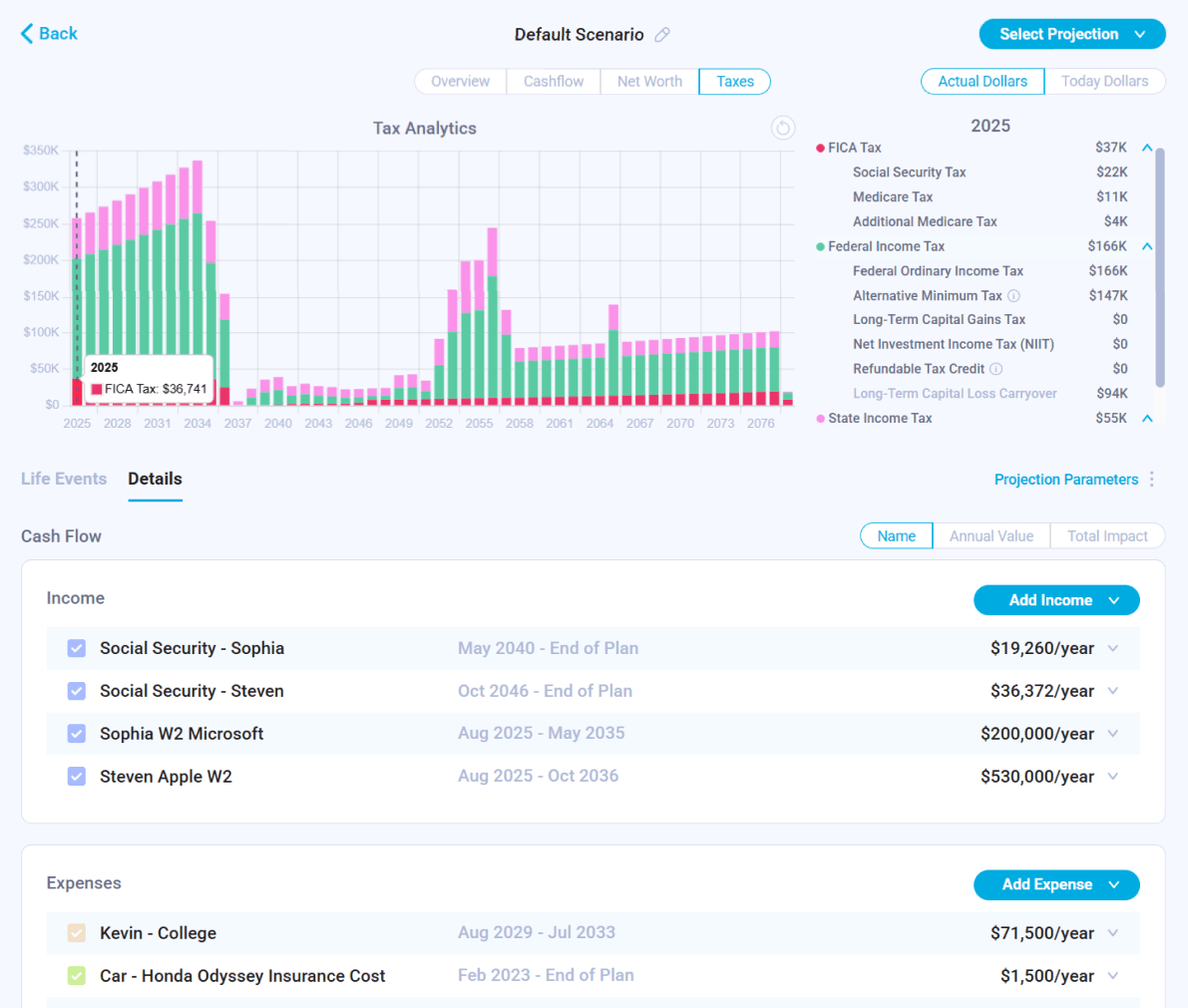
Nauma models your RSAs, stock options, and RSUs alongside your salary, investment accounts, and California tax situation — so you can see exactly what you will owe at every taxable event and plan before the bill arrives.
Get Started for Free