'%3e%3cpath%20d='M136%2043.0521C135.893%2043.4991%20131.298%2041.3697%20123.51%2041.5186C120.787%2041.5712%20109.626%2040.8001%20104.06%2049.4228C101.316%2053.664%20102.266%2056.2491%20100.601%2061.5769C95.2065%2078.8661%2087.7394%2075.1856%2062.5302%2088.5228C54.5058%2092.764%2045.1595%20101.562%2043.5589%20103.087C31.9403%20114.163%2025.1664%20123.189%2025.1521%20123.171C25.1378%20123.162%2034.1912%20104.357%2047.7676%2082.7655C60.6795%2062.2429%2063.8235%2070.0769%2079.7722%2049.1336C81.7015%2046.6011%2084.8526%2037.6805%2089.683%2036.1032C93.6345%2034.815%2098.6148%2036.6114%20100.065%2038.5568C101.044%2039.8712%20101.459%2040.765%20103.831%2040.4408C110.048%2039.5996%20113.613%2039.8625%20115.492%2039.7748C116.95%2039.7047%20119.751%2039.915%20120.509%2039.9939C130.419%2040.9753%20136.15%2042.4563%20136.007%2043.0434L136%2043.0521Z'%20fill='%23127398'/%3e%3cpath%20d='M22.1867%2043.6392C30.3968%2055.0923%2031.5544%2062.348%2040.6506%2068.6923C45.9954%2072.4253%2053.4839%2075.4134%2058.2928%2075.5361C61.9084%2075.6325%2063.7305%2075.2557%2064.6023%2074.949C64.8524%2074.8614%2065.1025%2074.8351%2065.3597%2074.8263L76.0636%2070.6727C76.8068%2066.8871%2076.1637%2063.4784%2076.1065%2063.1892C75.0561%2058.0103%2072.3337%2053.3835%2070.5402%2051.2542C55.4561%2033.3428%2055.8062%2034.298%2046.5814%2028.0237C26.7884%2014.5902%20-1.22192%2021.3464%200.0428309%2022.0562C0.55016%2022.3454%2010.2394%2026.9634%2022.1867%2043.6392Z'%20fill='%23127398'/%3e%3cpath%20d='M79.8366%2044.0161C81.33%2046.4784%2083.4093%2051.5784%2083.7666%2056.8975C83.7952%2057.3094%2084.1667%2064.0393%2080.4654%2068.4733C78.5004%2070.8217%2076.2281%2071.5403%2075.585%2071.7506C61.487%2076.5264%2028.4319%20116.196%2023.3515%20133.494C23.2229%20133.941%2022.6227%20136.026%2022.5655%20136C22.3797%20135.921%2023.5373%20120.753%2028.925%20106.303C28.925%20106.303%2033.7196%2090.5295%2046.7387%2073.9326C49.1896%2070.8042%2052.8052%2067.0362%2052.8052%2067.0362C54.2414%2065.1434%2059.8006%2068.3068%2066.1887%2068.482C69.9401%2068.5872%2073.2198%2067.6846%2073.2055%2067.3604C73.2055%2067.2377%2073.0698%2067.0712%2072.8911%2066.9047C72.3195%2066.3702%2071.5907%2066.1423%2070.8761%2066.2475C69.9758%2066.379%2068.1323%2066.3877%2064.5738%2065.5903C59.8435%2064.5212%2052.8481%2060.096%2048.0534%2055.364C39.9076%2047.3109%2039.7147%2039.9238%2033.1051%2026.9985C23.4944%208.17586%2014.0767%201.32328%2014.0767%201.32328C17.285%20-1.64734%2041.451%20-0.788575%2059.229%2016.3692C67.5177%2024.3697%2067.2962%2023.3619%2079.8366%2044.0073V44.0161Z'%20fill='%23EF9920'/%3e%3c/g%3e%3cdefs%3e%3cclipPath%20id='clip0_882_3310'%3e%3crect%20width='136'%20height='136'%20fill='white'/%3e%3c/clipPath%3e%3c/defs%3e%3c/svg%3e)
How to Set Financial Goals for Retirement
Retirement Planning Starts With Knowing What You're Actually Planning For
Most retirement planning conversations begin with a number: how much do you need to retire? The 4% rule suggests 25 times your annual expenses. A financial planner might say $3 million. A retirement calculator produces a target date. These answers feel concrete, but they are built on a question that most people never answer with any precision: what exactly are you planning to fund?
"Retirement" is not a financial goal. It is a life transition. The financial goals are what comes after — the specific things you want your money to do, for how long, and under what circumstances. A tech worker who wants to retire at 47 and spend $90,000 per year in San Jose has fundamentally different financial requirements than one who wants to retire at 55, travel internationally for a decade, then downshift to $70,000 per year in Portugal. Both might describe themselves as "planning for retirement." Neither is actually planning the same thing.
This guide walks through the process of translating retirement intentions into specific, measurable financial goals — and connecting those goals to projections that can tell you whether you're on track.
Why Vague Goals Produce Wrong Numbers
The most common retirement planning mistake is not a math error. It is treating "retirement" as the goal rather than as the starting point for a set of goals.
When the goal is vague, the planning is vague. A couple who says "we want to retire comfortably" will typically anchor to a round number — $2 million, $3 million — without examining whether that number is calibrated to their actual intentions. They may be planning for a retirement that is far simpler than what they actually want, or far more expensive than their real lifestyle requires, or missing major expenses entirely (long-term care, a second home, a child's wedding, parents' support).
The consequence is a plan that gives the right answer to the wrong question. You hit your target number and discover it was the wrong target. Or you spend decades saving aggressively toward a number that was never connected to your actual life.
Specific goals fix this. When you know you want to fund 40 years of retirement, support a parent for 5 years, take a sabbatical before retirement, buy a property abroad, and leave a meaningful inheritance — and when each of those intentions has a dollar amount, a timeline, and a probability attached — the planning becomes real. The number you need to save is no longer a rule of thumb. It is a calculation.
Step 1: Map Your Life Events, Not Just Your Expenses
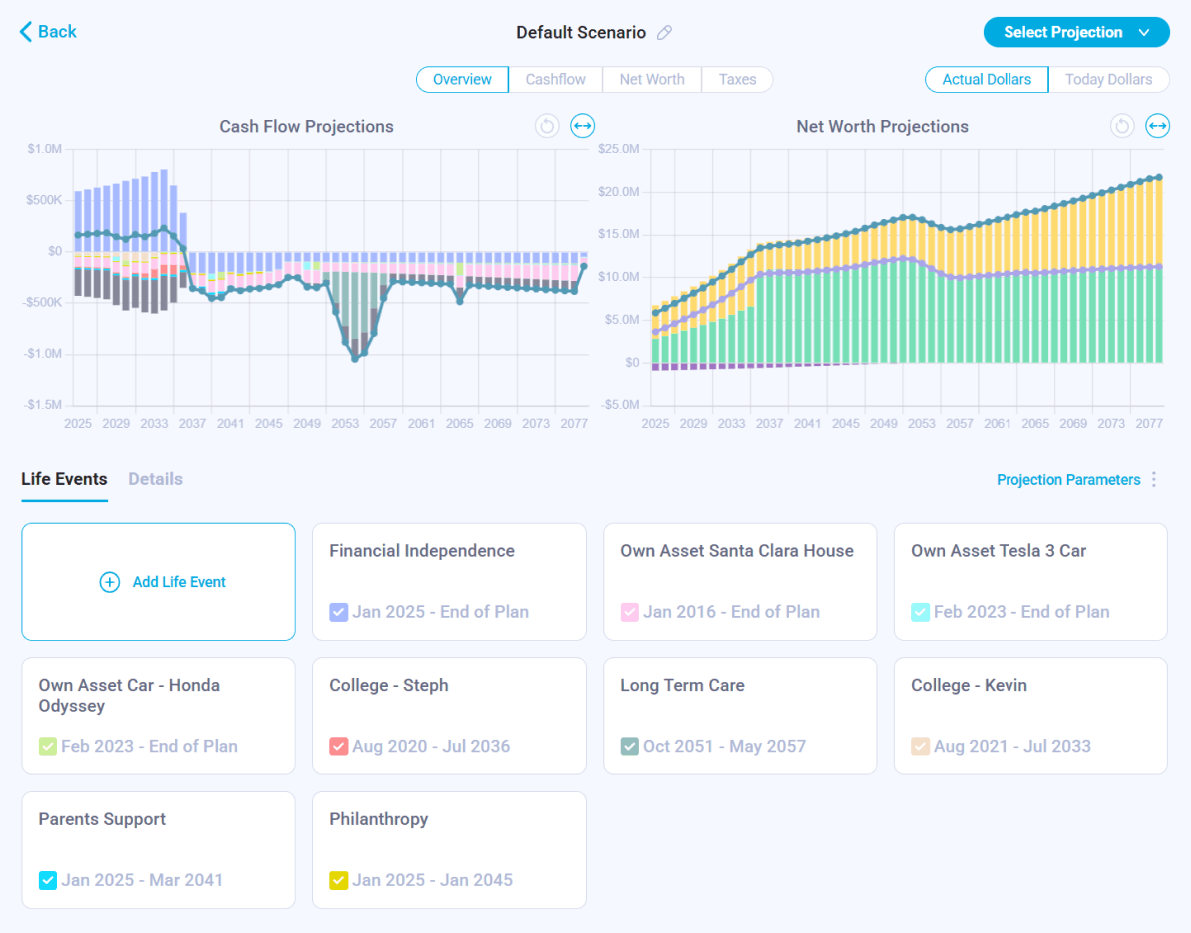
The foundation of retirement goal-setting is a life events inventory — a complete list of the significant financial events you expect or want to experience over the rest of your life. This is different from a budget. A budget tracks recurring monthly expenses. A life events inventory captures the non-recurring, large-scale events that define the shape of your financial life.
Start by mapping events across four time horizons:
Pre-retirement (next 1–10 years): Career transitions, sabbaticals, parental leave, home purchase or renovation, children's education, equity liquidity events (RSU vests, option exercises, ESPP purchases), relocation, startup equity or business involvement.
Early retirement (first 10–15 years after leaving work): Travel-intensive years, supporting aging parents, second home or international property, children's weddings, Roth conversion window, healthcare before Medicare.
Mid retirement (years 15–25): Housing downshift, reduced travel, increased healthcare spending, possible long-term care needs beginning.
Late retirement (years 25+): Long-term care, estate transfers, charitable giving, legacy goals.
For each event, assign three parameters: a rough dollar amount, a likely timing, and a confidence level (planned, likely, possible). You do not need precision at this stage — a $200,000 estimate for college costs that later turns out to be $180,000 or $220,000 does not break the plan. What breaks plans is leaving a $200,000 event off the map entirely.
The life events inventory is the raw material that drives every downstream calculation. Without it, a retirement projection is modeling someone's life — just not necessarily yours.
Step 2: Translate Life Events Into Five Goal Categories
Once you have a life events inventory, the next step is organizing those events into goal categories. Each category has different financial characteristics — different time horizons, different inflation profiles, different probability distributions, and different trade-off dynamics when the goals compete.
Spending goals define your ongoing lifestyle in retirement: housing costs, food, travel, healthcare, hobbies, subscriptions, transportation. These are the most important goals because they determine the baseline withdrawal rate that drives everything else. Be specific: "travel" is not a spending goal. "Two international trips per year averaging $12,000 each, from age 48 to 68" is a spending goal. The specificity matters because spending goals need to survive a sequence of return risk analysis — your Monte Carlo simulation needs to know whether you can cut the travel budget in a bad market year or whether the spending is fixed. See Sequence of Return Risk for why this distinction significantly affects your retirement probability.
One-time purchase goals are discrete, bounded expenditures: a vacation home, a boat, a major renovation, an international property. These differ from spending goals in that they happen once (or a small number of times) and can often be timed flexibly. A $300,000 vacation home purchase can be moved from year 3 to year 5 of retirement without changing the overall plan dramatically. This flexibility is valuable when running scenario analysis — deferred one-time purchases are often the first lever to pull when a base scenario shows insufficient probability of success.
Support goals cover financial obligations to others: funding a child's college education, supporting a parent, helping an adult child with a down payment, covering a sibling's medical bills. Support goals are often emotionally charged and frequently underestimated. FAANG retirees in particular often have parents who are themselves reaching peak care needs at the same time their children are hitting college age — the "sandwich generation" financial pressure is real and needs to be in the plan. A parent requiring $5,000–$8,000 per month in assisted living for 3–5 years is a $180,000–$480,000 goal that appears nowhere in a standard retirement calculator.
Legacy goals define what you want to leave behind: an inheritance for children, a charitable endowment, a family foundation, gifts to grandchildren. Legacy goals interact with the rest of the plan in a specific way: they compete directly with spending goals for the same pool of assets. A retiree who wants to leave $1,000,000 to their children cannot spend that $1,000,000 on themselves. Making this trade-off explicit — rather than hoping the money "works out" — is one of the highest-value activities in retirement goal-setting. It is also the category most often left vague: "we'd like to leave something for the kids" is not a goal. "$500,000 to each of two children, in 2026 dollars" is a goal.
Protection goals cover downside scenarios: long-term care costs, healthcare cost inflation, longevity risk (outliving your assets). These are not spending goals — they are insurance against outcomes you hope to avoid. But they need to be sized and funded deliberately. Long-term care in 2026 averages $8,000–$12,000 per month in a skilled nursing facility, and the duration of need averages 2–3 years with significant variance. A couple that does not plan for this possibility is implicitly planning to self-insure against a $500,000–$800,000 tail risk. Whether that is the right decision depends on their total assets, their family situation, and their values — but it should be a deliberate choice, not an oversight.
Step 3: Assign Numbers, Timelines, and Confidence Levels
A goal without a number is a wish. The translation from intention to goal requires three specific parameters for each item on your list.
Dollar amount in today's dollars. Start with current costs and adjust for inflation in the projection, rather than trying to estimate future inflated costs directly. If your target retirement lifestyle costs $120,000 per year today, enter $120,000 and let the projection engine apply your assumed inflation rate over time. If you want to buy a vacation home that would cost $500,000 today, enter $500,000. Inflation adjustments are a function of the modeling tool, not something you need to calculate manually.
Timeline: start date and duration. A spending goal that begins at age 50 and runs until 90 has very different capital requirements than one that begins at 65 and runs until 85. A support goal that funds college for three children from 2028–2036 has a specific cash flow shape. The timeline determines when money needs to be available, which in turn determines how it should be invested and whether sequence of return risk is relevant. Goals with near-term timelines need more conservative positioning than goals 20 years out.
Confidence level: planned, likely, or possible. Not all goals are equally certain. The trip to Japan you want to take in year two of retirement is planned — you will be disappointed if it does not happen. The beach house you might buy if the market cooperates is possible — it is a goal, but one you could defer or forgo without serious regret. Running projections at different confidence thresholds tells you something important: if your plan only works when every possible goal is deferred, the base plan is underfunded. If it works even with all goals included, you may be oversaving.
Step 4: Check for Goal Conflicts
With a full goal list in hand, the next step is examining where goals compete. In an unlimited capital world, every goal is achievable. In the real world, goals conflict — and the conflicts are where the most important planning decisions happen.
The most common goal conflicts for tech workers approaching retirement:
Retire early vs. retire securely. Retiring at 47 instead of 55 adds 8 years of spending before Social Security and RMDs, reduces the investment compounding window, and lengthens the retirement horizon from perhaps 35 years to 45+ years. A 45-year retirement requires a meaningfully larger portfolio than a 30-year retirement — the 4% rule, derived from 30-year historical data, understates the required capital for a 45-year retirement. The goal conflict is real: early retirement and financial security are not incompatible, but the capital requirements for both simultaneously are higher than many people assume.
High spending in early retirement vs. long-term security. Many retirees want to travel extensively and spend generously in their 50s and 60s when they are healthy and energetic — "go-go years" — and plan to spend less in their 70s and 80s. This spending pattern is reasonable and well-documented. But it creates a specific sequence of return risk problem: the years of highest spending overlap with the years of highest sequence risk. A major market decline in year 3 of retirement, coinciding with a $40,000 international trip, permanently depletes the portfolio more than the same trip in year 15. The goal conflict is between spending desires and timing risk — and resolving it requires modeling both together rather than separately.
Legacy goals vs. spending goals. Every dollar set aside for a legacy goal is a dollar unavailable for spending. For tech workers with concentrated equity wealth, legacy intentions and spending ambitions often both expand as net worth grows — without the explicit trade-off being confronted. A couple who wants to leave $2 million to their children while also spending $180,000 per year for 40 years needs significantly more capital than one who either wants to leave $2 million or spend $180,000 per year, but not both. Making the trade-off explicit is uncomfortable but essential.
Support obligations vs. personal goals. Funding a parent's care and funding a child's college simultaneously while maintaining retirement savings is a genuine financial constraint that many tech workers encounter in their 40s and 50s. The plan needs to model all three simultaneously to determine whether they are feasible together, or whether one needs to be reduced or restructured.
These conflicts do not have universal right answers. They have personal answers that depend on your values, your circumstances, and what you learn when you run the numbers. The goal of the analysis is not to tell you what to want — it is to make the trade-offs visible so you can choose deliberately.
Step 5: Validate Goals Against a Projection
Individual goals are inputs. A financial projection converts them into outputs: whether the plan works, by how much, and under what conditions it fails.
A projection-based validation has three components:
Base case probability. Running a Monte Carlo simulation across your full goal set — with realistic assumptions about investment returns, inflation, taxes, and Social Security — produces a probability of success. A result of 85–90% is generally considered robust for a long retirement. A result below 70% suggests the goals collectively exceed the capital available, and something needs to change. A result above 95% may indicate either excessive conservatism in the plan or unused capacity to pursue additional goals. See Monte Carlo Simulation for why the tax treatment of different account types significantly affects what a "success rate" actually means — a simulation that ignores taxes will produce an overstated probability.
Scenario testing. Beyond the base case, the most informative analysis tests specific scenarios: what happens if you retire two years earlier? What if healthcare costs inflate at 7% instead of 4%? What if the market delivers a decade of flat returns starting in year one of retirement — the worst-case sequence of return scenario? What if your parent needs 5 years of care instead of 2? Scenario testing does not predict which future will arrive. It tells you which of your goals survive under adverse conditions and which ones require the base case to hold. Goals that fail under modest stress deserve different treatment than goals that fail only under extreme scenarios.
Sensitivity analysis. Some goals are more sensitive to changes in assumptions than others. A spending goal that requires 40 years of withdrawals is extremely sensitive to the assumed return rate — a 1% reduction in expected returns can change the required portfolio size by 15–20%. A one-time purchase goal 3 years from now is nearly insensitive to long-run return assumptions. Understanding which goals drive the most uncertainty in the plan tells you where to focus — and where precision in the modeling actually matters versus where rough estimates are fine.
The validation step is where goals transform from a wish list into a plan. It is also where most people discover that their intuitive "retirement number" was either too high or too low — because it was not derived from their actual goals in the first place.
Step 6: Build In Flexibility Mechanisms
A retirement plan is not a contract. The future will differ from your projections — markets will be better or worse, health will improve or decline, children will need more or less support, opportunities will emerge that were not in the original plan. A well-structured goal framework builds in flexibility mechanisms that allow the plan to adapt without requiring a complete rebuild every time something changes.
Tiered spending. Separate your spending goals into fixed commitments (housing, healthcare, food) and discretionary items (travel, dining, hobbies). The fixed floor is what the plan must support in all scenarios. The discretionary layer is what you fund with the upside. In a poor sequence year, discretionary spending can be reduced without affecting the fixed commitments. This spending tiering, combined with a Monte Carlo analysis of the base-case floor, gives you a realistic picture of the true downside: not "what happens if everything goes wrong" but "what does my life look like in the worst 10% of scenarios."
Flexible retirement date. For tech workers still in the accumulation phase, the retirement date is the most powerful lever in the plan. Working two additional years adds two years of contributions, eliminates two years of withdrawals, and adds two years of portfolio compounding — the combined effect typically improves retirement probability by 10–15 percentage points. Building the retirement date into scenario analysis — with explicit modeled alternatives at ages 48, 50, 52, and 55 — converts an abstract decision into a concrete comparison.
Staged goal commitment. Not all goals need to be fully funded on day one. A vacation property purchase planned for year 5 of retirement does not need to be fully reserved today — it needs to be in the model so that the overall trajectory accounts for it. As you approach the purchase date, the goal moves from "projected" to "committed" and the reserves become more concrete. This staged approach prevents the paralysis that comes from trying to simultaneously solve for every possible goal before taking any action.
What a Good Retirement Goal Framework Looks Like
After working through the six steps, a complete retirement goal framework has a specific structure:
It has a spending floor — the minimum annual spending that must be sustained regardless of market conditions, covering housing, healthcare, food, and essential living costs. For most tech workers targeting Fat FIRE or Regular FIRE lifestyles, this floor is $60,000–$100,000 per year.
It has a target spending level — the full lifestyle including discretionary spending, travel, hobbies, and personal spending — that the plan aims to support in the base case. This is the $120,000–$180,000 per year that drives the FIRE number.
It has identified one-time events with dollar amounts, timelines, and confidence levels: property purchases, support obligations, children's milestones, planned gifts.
It has an explicit legacy intention — even if that intention is zero ("we plan to spend it all") — so the capital allocation between spending and legacy is deliberate.
It has protection sizing — an acknowledgment of long-term care risk and a decision about how to address it: self-insure, purchase insurance, or plan to rely on family support.
And it has flexibility mechanisms — specifically, which goals can be deferred or reduced if the market cooperates poorly, and which are fixed commitments that must be funded in all scenarios.
A plan with this structure can be modeled, stress-tested, and updated annually. It connects to a financial projection that shows the trajectory year by year and to a Monte Carlo simulation that estimates the probability of success across thousands of possible futures.
Frequently Asked Questions
Turn Your Goals Into a Living Financial Plan
Nauma builds year-by-year projections from your actual goals — spending, one-time events, support obligations, legacy intentions — and runs Monte Carlo simulations that account for taxes, RMDs, and Social Security to show you the real probability that your plan works.
Get Started for Free