'%3e%3cpath%20d='M136%2043.0521C135.893%2043.4991%20131.298%2041.3697%20123.51%2041.5186C120.787%2041.5712%20109.626%2040.8001%20104.06%2049.4228C101.316%2053.664%20102.266%2056.2491%20100.601%2061.5769C95.2065%2078.8661%2087.7394%2075.1856%2062.5302%2088.5228C54.5058%2092.764%2045.1595%20101.562%2043.5589%20103.087C31.9403%20114.163%2025.1664%20123.189%2025.1521%20123.171C25.1378%20123.162%2034.1912%20104.357%2047.7676%2082.7655C60.6795%2062.2429%2063.8235%2070.0769%2079.7722%2049.1336C81.7015%2046.6011%2084.8526%2037.6805%2089.683%2036.1032C93.6345%2034.815%2098.6148%2036.6114%20100.065%2038.5568C101.044%2039.8712%20101.459%2040.765%20103.831%2040.4408C110.048%2039.5996%20113.613%2039.8625%20115.492%2039.7748C116.95%2039.7047%20119.751%2039.915%20120.509%2039.9939C130.419%2040.9753%20136.15%2042.4563%20136.007%2043.0434L136%2043.0521Z'%20fill='%23127398'/%3e%3cpath%20d='M22.1867%2043.6392C30.3968%2055.0923%2031.5544%2062.348%2040.6506%2068.6923C45.9954%2072.4253%2053.4839%2075.4134%2058.2928%2075.5361C61.9084%2075.6325%2063.7305%2075.2557%2064.6023%2074.949C64.8524%2074.8614%2065.1025%2074.8351%2065.3597%2074.8263L76.0636%2070.6727C76.8068%2066.8871%2076.1637%2063.4784%2076.1065%2063.1892C75.0561%2058.0103%2072.3337%2053.3835%2070.5402%2051.2542C55.4561%2033.3428%2055.8062%2034.298%2046.5814%2028.0237C26.7884%2014.5902%20-1.22192%2021.3464%200.0428309%2022.0562C0.55016%2022.3454%2010.2394%2026.9634%2022.1867%2043.6392Z'%20fill='%23127398'/%3e%3cpath%20d='M79.8366%2044.0161C81.33%2046.4784%2083.4093%2051.5784%2083.7666%2056.8975C83.7952%2057.3094%2084.1667%2064.0393%2080.4654%2068.4733C78.5004%2070.8217%2076.2281%2071.5403%2075.585%2071.7506C61.487%2076.5264%2028.4319%20116.196%2023.3515%20133.494C23.2229%20133.941%2022.6227%20136.026%2022.5655%20136C22.3797%20135.921%2023.5373%20120.753%2028.925%20106.303C28.925%20106.303%2033.7196%2090.5295%2046.7387%2073.9326C49.1896%2070.8042%2052.8052%2067.0362%2052.8052%2067.0362C54.2414%2065.1434%2059.8006%2068.3068%2066.1887%2068.482C69.9401%2068.5872%2073.2198%2067.6846%2073.2055%2067.3604C73.2055%2067.2377%2073.0698%2067.0712%2072.8911%2066.9047C72.3195%2066.3702%2071.5907%2066.1423%2070.8761%2066.2475C69.9758%2066.379%2068.1323%2066.3877%2064.5738%2065.5903C59.8435%2064.5212%2052.8481%2060.096%2048.0534%2055.364C39.9076%2047.3109%2039.7147%2039.9238%2033.1051%2026.9985C23.4944%208.17586%2014.0767%201.32328%2014.0767%201.32328C17.285%20-1.64734%2041.451%20-0.788575%2059.229%2016.3692C67.5177%2024.3697%2067.2962%2023.3619%2079.8366%2044.0073V44.0161Z'%20fill='%23EF9920'/%3e%3c/g%3e%3cdefs%3e%3cclipPath%20id='clip0_882_3310'%3e%3crect%20width='136'%20height='136'%20fill='white'/%3e%3c/clipPath%3e%3c/defs%3e%3c/svg%3e)
How RMDs Affect Your Retirement Tax Rate
Why the Mandatory Withdrawals You Can't Avoid Often Cost More Than You Expect
Most tech workers spend their careers optimizing contributions into traditional 401(k)s and IRAs — maximizing pre-tax deferrals, capturing employer matches, and watching balances compound tax-free for decades. Then RMDs arrive. And what felt like disciplined saving suddenly looks different: the IRS now requires mandatory withdrawals each year, whether you need the money or not, and those withdrawals cascade through the tax code in ways that affect far more than just the income tax rate on the withdrawal itself.
For a senior FAANG engineer who has contributed $20,000–$23,000 annually into a 401(k) for 25 years, the traditional account balance at retirement can easily reach $1,500,000–$2,000,000 or more. The RMD on a $1,500,000 balance at age 73 is approximately $56,600. That single withdrawal — mandatory, unavoidable, added on top of Social Security and any other income — can push a retiree into a higher federal bracket, trigger IRMAA Medicare surcharges, cause Social Security benefits to become taxable, and activate the 3.8% Net Investment Income Tax. The effective tax cost of that RMD is often 40–50% higher than the nominal bracket rate suggests.
This guide explains each mechanism, how they stack, and what can be done before RMDs begin to reduce their impact.
What RMDs Are and How They're Calculated
A Required Minimum Distribution is the minimum amount the IRS requires you to withdraw each year from traditional (pre-tax) retirement accounts — traditional IRAs, rollover IRAs, SEP IRAs, SIMPLE IRAs, 401(k)s, 403(b)s, and 457(b)s. Roth IRAs are exempt from RMDs during the original owner's lifetime.
RMDs begin at age 73 for individuals born between 1951 and 1959, and at age 75 for those born in 1960 or later (under SECURE 2.0). Your first RMD can be deferred until April 1 of the following year — but doing so means two RMDs in one calendar year, which often produces a worse tax outcome than taking the first RMD on schedule.
The calculation is straightforward: divide your account balance as of December 31 of the prior year by an IRS life expectancy factor from the Uniform Lifetime Table. Key factors for 2026:
- Age 73: factor 26.5 → RMD ≈ 3.77% of balance
- Age 75: factor 24.6 → RMD ≈ 4.07% of balance
- Age 80: factor 20.2 → RMD ≈ 4.95% of balance
- Age 85: factor 16.0 → RMD ≈ 6.25% of balance
The factor shrinks every year while the balance may continue to grow — meaning RMDs typically increase in dollar terms each year, even in a flat market. On a $2,000,000 balance, the RMD at age 73 is approximately $75,500. At age 80, assuming the balance held at $2,000,000, the RMD would be approximately $99,000.
RMDs are taxed as ordinary income in the year withdrawn, added to all other income sources — Social Security, pension, dividends, interest, capital gains — and taxed at the applicable marginal federal and state rates.
For a full explanation of RMD mechanics, tables, and account aggregation rules, see Required Minimum Distributions (RMDs).
Effect 1: Pushing Income Into Higher Federal Brackets
The most direct tax effect of an RMD is the simplest: it adds taxable income, which can push total income into a higher federal bracket.
The 2026 federal ordinary income tax brackets for married filing jointly are approximately:
- 10%: up to $23,850
- 12%: $23,851–$96,950
- 22%: $96,951–$206,700
- 24%: $206,701–$394,600
- 32%: $394,601–$501,050
- 35%: $501,051–$751,600
- 37%: above $751,600
A retired couple with $60,000 in Social Security benefits (of which $51,000 is taxable at 85%), a $30,000 pension, and no other income has taxable income of approximately $81,000 — comfortably in the 12% bracket after the standard deduction. Adding a $56,600 RMD pushes taxable income to approximately $137,600 — squarely in the 22% bracket for a meaningful portion of the withdrawal. That 10-percentage-point jump on tens of thousands of dollars compounds substantially over a retirement that may span 25 years.
The bracket effect is amplified by a structural feature of the tax code: RMDs add to the income base on which all other stacked effects are calculated. They don't just move themselves into a higher bracket — they can move Social Security benefits, capital gains, and other income into higher brackets simultaneously.
Effect 2: Triggering or Increasing Social Security Taxation
Social Security benefits are taxed based on "combined income" — AGI plus tax-exempt interest plus half of Social Security benefits. The thresholds have not changed since 1984:
- Below $32,000 (MFJ): 0% of benefits taxable
- $32,000–$44,000 (MFJ): up to 50% of benefits taxable
- Above $44,000 (MFJ): up to 85% of benefits taxable
An RMD that pushes combined income above $44,000 causes up to 85% of Social Security benefits to become taxable. This creates the effective rate multiplication known as the Tax Torpedo: in the income band where Social Security transitions from untaxed to taxed, each additional $1 of RMD income adds $1.85 to taxable income — $1.00 of RMD plus $0.85 of newly taxable Social Security. At a 22% marginal rate, the effective rate on that dollar of RMD is 22% × 1.85 = 40.7%.
For tech workers with large pre-tax balances, this interaction is not a corner case — it is virtually guaranteed. A couple receiving $36,000 in Social Security and taking a $56,600 RMD will almost certainly have combined income well above $44,000, meaning the full 85% inclusion applies and the torpedo is firing across the entire RMD amount.
The Social Security taxation thresholds are not indexed for inflation — the same $44,000 MFJ threshold that applied in 1984 applies today. As incomes and Social Security benefits have grown with inflation, the proportion of retirees paying tax on their benefits has increased steadily. For FAANG retirees with substantial pre-tax balances and full Social Security benefits, near-complete Social Security taxation is the baseline expectation, not an edge case.
Effect 3: Triggering IRMAA Medicare Surcharges
IRMAA (Income-Related Monthly Adjustment Amount) is a surcharge on Medicare Part B and Part D premiums for beneficiaries whose MAGI exceeds certain thresholds. The surcharge is calculated based on MAGI from two years prior — meaning a large RMD or Roth conversion in 2024 determines IRMAA premiums in 2026.
The 2026 IRMAA thresholds and total monthly Part B premiums (MFJ):
| MAGI (MFJ, based on 2024 income) | Monthly Part B premium | Annual cost per person |
|---|---|---|
| ≤ $218,000 | $202.90 | $2,435 |
| $218,001–$274,000 | $284.10 | $3,409 |
| $274,001–$328,000 | $405.30 | $4,864 |
| $328,001–$382,000 | $526.50 | $6,318 |
| $382,001–$748,000 | $647.70 | $7,772 |
| Above $748,000 | $689.90 | $8,279 |
Part D surcharges add $14.50–$91.00 per month on top of plan premiums.
IRMAA operates as a cliff — crossing a threshold by $1 triggers the full surcharge for the entire tier. For a married couple both on Medicare, jumping from no IRMAA to Tier 1 costs approximately $2,297 per year combined. Jumping from Tier 1 to Tier 2 adds another $3,475 per year combined. A single large RMD or Roth conversion that pushes MAGI $1 above a tier boundary costs thousands of dollars in additional Medicare premiums — and because IRMAA is based on income two years prior, the damage is done before the retiree even knows it happened.
For FAANG retirees with large traditional account balances, IRMAA is not a risk to avoid — it is likely a permanent feature of retirement. The planning question becomes which tier to occupy, not whether to pay IRMAA at all. A $1,500,000 IRA generating $56,600 in RMDs, combined with Social Security and other income, typically puts a couple solidly in Tier 1 or Tier 2. Managing below those tier boundaries requires deliberately reducing the pre-tax balance before RMDs begin — which brings us to Roth conversion strategy.
See Medicare for a complete treatment of IRMAA tiers, the two-year lookback, and the SSA-44 appeal process for life-changing events.
Effect 4: Activating the Net Investment Income Tax
The 3.8% Net Investment Income Tax (NIIT) applies to net investment income for individuals with MAGI above $200,000 (single) or $250,000 (MFJ). Traditional IRA and 401(k) distributions are not themselves investment income — but they increase MAGI, which can push other investment income (dividends, interest, capital gains in taxable accounts) above the NIIT threshold.
For a retired couple with $180,000 in MAGI before an RMD, adding a $56,600 RMD pushes MAGI to $236,600 — above the $250,000 threshold? No, not in this example. But for couples with larger balances or higher Social Security benefits, RMDs frequently push MAGI above $250,000, subjecting all net investment income in their taxable brokerage account to an additional 3.8% surtax.
The practical impact: a couple with $500,000 in a taxable brokerage account generating $20,000 in annual dividends and interest pays $760 in NIIT on that investment income if their MAGI exceeds $250,000. That $760 is a recurring annual cost triggered not by their investment decisions but by mandatory RMDs. As RMDs grow over time and the NIIT threshold remains fixed (it has never been inflation-adjusted since 2013), the NIIT interaction becomes increasingly likely for large-balance retirees.
See Net Investment Income Tax (NIIT) for a full treatment of the "lesser of" rule and how MAGI management affects NIIT exposure.
How the Effects Stack: A Complete Example
Consider a married couple filing jointly, both age 75 in 2026:
- Combined Social Security: $48,000/year
- Traditional IRA balance: $1,800,000 (December 31, 2025)
- Taxable brokerage: $600,000 generating $24,000/year in dividends and interest
- No pension, no part-time income
Without RMD (hypothetical baseline):
Combined income for SS taxation: $24,000 (other) + $24,000 (½ SS) = $48,000 → 85% of SS taxable = $40,800 taxable SS
AGI: $24,000 dividends + $40,800 SS = $64,800
Standard deduction for MFJ both age 75: $32,200 (base) + $1,650 × 2 (age 65+ add-on per spouse) = $35,500
Taxable income: approximately $29,300 → mostly 12% bracket
No NIIT (MAGI $64,800 well below $250,000)
No IRMAA (below $218,000)
With RMD at age 75 (factor 24.6):
RMD: $1,800,000 ÷ 24.6 = $73,171
Combined income for SS: $24,000 + $73,171 + $24,000 (½ SS) = $121,171 → 85% of SS taxable = $40,800
AGI: $24,000 + $73,171 + $40,800 = $137,971
Taxable income after $35,500 standard deduction: approximately $102,471 → 22% bracket
NIIT: MAGI $137,971 still below $250,000 — no NIIT triggered in this example
IRMAA: Based on 2024 income — if similar, MAGI $137,971 is below $218,000 — no IRMAA
But add a second IRA of $800,000 (common for FAANG couples with two earners):
Combined RMD: $73,171 + $32,520 = $105,691
AGI: $24,000 + $105,691 + $40,800 = $170,491
Still in 22% bracket but higher within it
IRMAA: Still below $218,000 threshold — but growing
By age 80 (factor 20.2), same balances if grown to $2,000,000 total:
RMD: $2,000,000 ÷ 20.2 = $99,010
AGI rises to approximately $164,000 — approaching IRMAA Tier 1 threshold of $218,000
If portfolio grew more: IRMAA surcharges become a certainty
This stacking is why the effective tax rate on an RMD is often 35–45% for FAANG retirees, even though the nominal federal bracket is 22% or 24%. The bracket effect, Social Security torpedo, and future IRMAA exposure all compound the visible rate.
The Two-Year IRMAA Trap
One of the most important and least understood aspects of RMD planning is the two-year lookback for IRMAA. Your 2026 Medicare premiums are determined by your 2024 income. This creates a temporal disconnect that catches many retirees off guard.
A tech worker who retires in 2024 with a final working year of high income — salary, bonus, large RSU vest — will pay elevated IRMAA surcharges in 2026 even if their 2025 and 2026 income is much lower. Conversely, a large Roth conversion executed in 2024 to reduce future RMDs will increase 2026 IRMAA, even though the long-term benefit may be substantial.
The practical implication: IRMAA tier management requires planning two years in advance. Decisions made in 2024 affect 2026 premiums. Decisions made in 2026 affect 2028 premiums. The years between retirement (often 60–65) and Medicare eligibility (65) and RMD start (73 or 75) are the highest-value planning window — because income is typically lower than peak working years, but it is also shaping the IRMAA tiers that will apply throughout the RMD years.
A qualified life-changing event — retirement, death of spouse, loss of income-producing property — can be appealed to the SSA using Form SSA-44 to use more recent income rather than the two-year lookback. This is one of the most underutilized tools in Medicare planning.
Strategies for Reducing RMD Tax Impact
The most effective strategies address the problem before RMDs begin — reducing the pre-tax balance during the lower-income years between retirement and age 73 or 75.
Roth conversions in early retirement. Converting traditional IRA or 401(k) balances to Roth during the years between retirement and RMD start is the single most powerful tool for reducing RMD tax burden. Each dollar converted reduces the future RMD base. Conversions are taxable income in the year executed — but in early retirement years when salary income has ended, a couple can often convert $50,000–$100,000 per year while remaining in the 22% or 24% bracket, below IRMAA Tier 1, and with manageable Social Security taxation. The long-term benefit: smaller future RMDs, lower future IRMAA exposure, and Roth balances that grow tax-free and pass to heirs tax-free. See Roth Conversions for the bracket-filling strategy and the ACA interaction during pre-Medicare years.
Qualified Charitable Distributions. For retirees age 70½ or older with charitable intent, a QCD transfers up to $111,000 directly from a traditional IRA to a qualifying charity. The QCD satisfies the RMD obligation for that amount but is excluded from AGI entirely — it does not appear as income, does not count toward combined income for Social Security taxation, and does not count toward MAGI for IRMAA. For a retiree whose RMD is $60,000, donating $30,000 via QCD reduces AGI by $30,000 compared to taking the full RMD as income and then donating from after-tax funds. At a 22% rate plus Social Security torpedo effect, that $30,000 reduction can save $8,000–$12,000 in combined taxes annually. See What Is the Tax Torpedo? for the combined income interaction.
Delaying Social Security. Every year Social Security is delayed past age 62 increases the benefit by approximately 6–8% per year (more precisely, 8% per year between full retirement age and age 70). Delaying to 70 maximizes lifetime benefits. But there is a tax planning dimension: in the years between retirement and claiming Social Security, income is lower — making those years ideal for Roth conversions at lower brackets and lower IRMAA tiers. Once Social Security begins, combined income rises permanently, making every subsequent dollar of RMD more expensive. Coordinating the timing of Social Security claiming with the Roth conversion window is a central element of retirement tax strategy. See Social Security for the breakeven analysis and taxation mechanics.
Spending down traditional accounts before RMDs. Taking voluntary withdrawals from traditional IRAs and 401(k)s in early retirement — even if you don't need the income — reduces the balance subject to future mandatory RMDs. Combined with Roth conversions, this is the most direct approach to reducing future RMD size. The goal is to arrive at RMD age with a smaller pre-tax balance, not because the money was wasted, but because it was repositioned into Roth accounts or spent on living expenses rather than left to compound in a tax-deferred account that will generate larger future mandatory withdrawals.
Asset location optimization. Holding the highest-growth assets in Roth accounts — where growth is permanently tax-free — and lower-growth assets (bonds, stable value) in traditional accounts reduces the rate at which traditional balances compound, limiting future RMD growth. This is particularly relevant for FAANG retirees with both large traditional balances and meaningful Roth balances.
Frequently Asked Questions
Model Your RMDs and Their Full Tax Impact
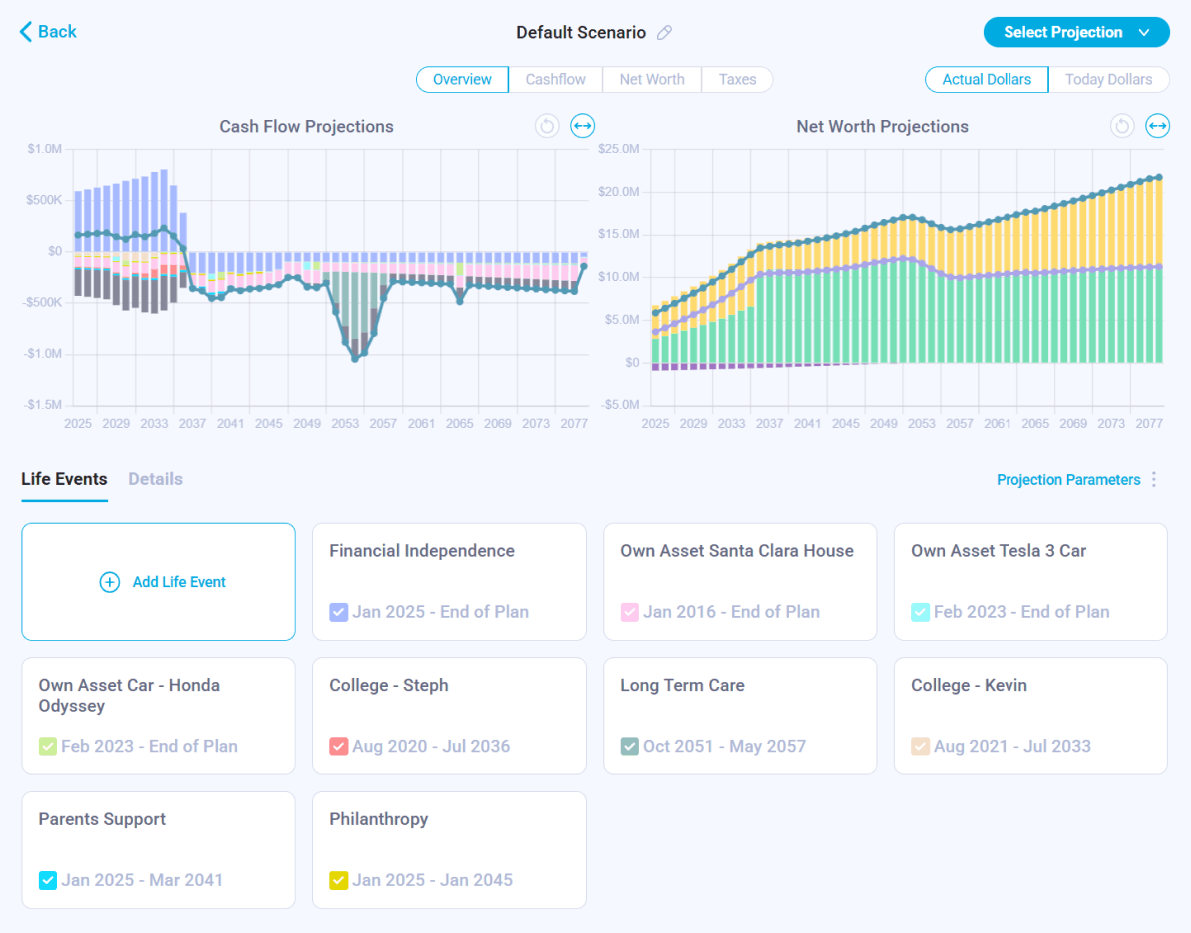
See how Required Minimum Distributions interact with Social Security, IRMAA, and your complete retirement income picture — year by year — in Nauma's financial planning projections.
Get Started for Free