'%3e%3cpath%20d='M136%2043.0521C135.893%2043.4991%20131.298%2041.3697%20123.51%2041.5186C120.787%2041.5712%20109.626%2040.8001%20104.06%2049.4228C101.316%2053.664%20102.266%2056.2491%20100.601%2061.5769C95.2065%2078.8661%2087.7394%2075.1856%2062.5302%2088.5228C54.5058%2092.764%2045.1595%20101.562%2043.5589%20103.087C31.9403%20114.163%2025.1664%20123.189%2025.1521%20123.171C25.1378%20123.162%2034.1912%20104.357%2047.7676%2082.7655C60.6795%2062.2429%2063.8235%2070.0769%2079.7722%2049.1336C81.7015%2046.6011%2084.8526%2037.6805%2089.683%2036.1032C93.6345%2034.815%2098.6148%2036.6114%20100.065%2038.5568C101.044%2039.8712%20101.459%2040.765%20103.831%2040.4408C110.048%2039.5996%20113.613%2039.8625%20115.492%2039.7748C116.95%2039.7047%20119.751%2039.915%20120.509%2039.9939C130.419%2040.9753%20136.15%2042.4563%20136.007%2043.0434L136%2043.0521Z'%20fill='%23127398'/%3e%3cpath%20d='M22.1867%2043.6392C30.3968%2055.0923%2031.5544%2062.348%2040.6506%2068.6923C45.9954%2072.4253%2053.4839%2075.4134%2058.2928%2075.5361C61.9084%2075.6325%2063.7305%2075.2557%2064.6023%2074.949C64.8524%2074.8614%2065.1025%2074.8351%2065.3597%2074.8263L76.0636%2070.6727C76.8068%2066.8871%2076.1637%2063.4784%2076.1065%2063.1892C75.0561%2058.0103%2072.3337%2053.3835%2070.5402%2051.2542C55.4561%2033.3428%2055.8062%2034.298%2046.5814%2028.0237C26.7884%2014.5902%20-1.22192%2021.3464%200.0428309%2022.0562C0.55016%2022.3454%2010.2394%2026.9634%2022.1867%2043.6392Z'%20fill='%23127398'/%3e%3cpath%20d='M79.8366%2044.0161C81.33%2046.4784%2083.4093%2051.5784%2083.7666%2056.8975C83.7952%2057.3094%2084.1667%2064.0393%2080.4654%2068.4733C78.5004%2070.8217%2076.2281%2071.5403%2075.585%2071.7506C61.487%2076.5264%2028.4319%20116.196%2023.3515%20133.494C23.2229%20133.941%2022.6227%20136.026%2022.5655%20136C22.3797%20135.921%2023.5373%20120.753%2028.925%20106.303C28.925%20106.303%2033.7196%2090.5295%2046.7387%2073.9326C49.1896%2070.8042%2052.8052%2067.0362%2052.8052%2067.0362C54.2414%2065.1434%2059.8006%2068.3068%2066.1887%2068.482C69.9401%2068.5872%2073.2198%2067.6846%2073.2055%2067.3604C73.2055%2067.2377%2073.0698%2067.0712%2072.8911%2066.9047C72.3195%2066.3702%2071.5907%2066.1423%2070.8761%2066.2475C69.9758%2066.379%2068.1323%2066.3877%2064.5738%2065.5903C59.8435%2064.5212%2052.8481%2060.096%2048.0534%2055.364C39.9076%2047.3109%2039.7147%2039.9238%2033.1051%2026.9985C23.4944%208.17586%2014.0767%201.32328%2014.0767%201.32328C17.285%20-1.64734%2041.451%20-0.788575%2059.229%2016.3692C67.5177%2024.3697%2067.2962%2023.3619%2079.8366%2044.0073V44.0161Z'%20fill='%23EF9920'/%3e%3c/g%3e%3cdefs%3e%3cclipPath%20id='clip0_882_3310'%3e%3crect%20width='136'%20height='136'%20fill='white'/%3e%3c/clipPath%3e%3c/defs%3e%3c/svg%3e)
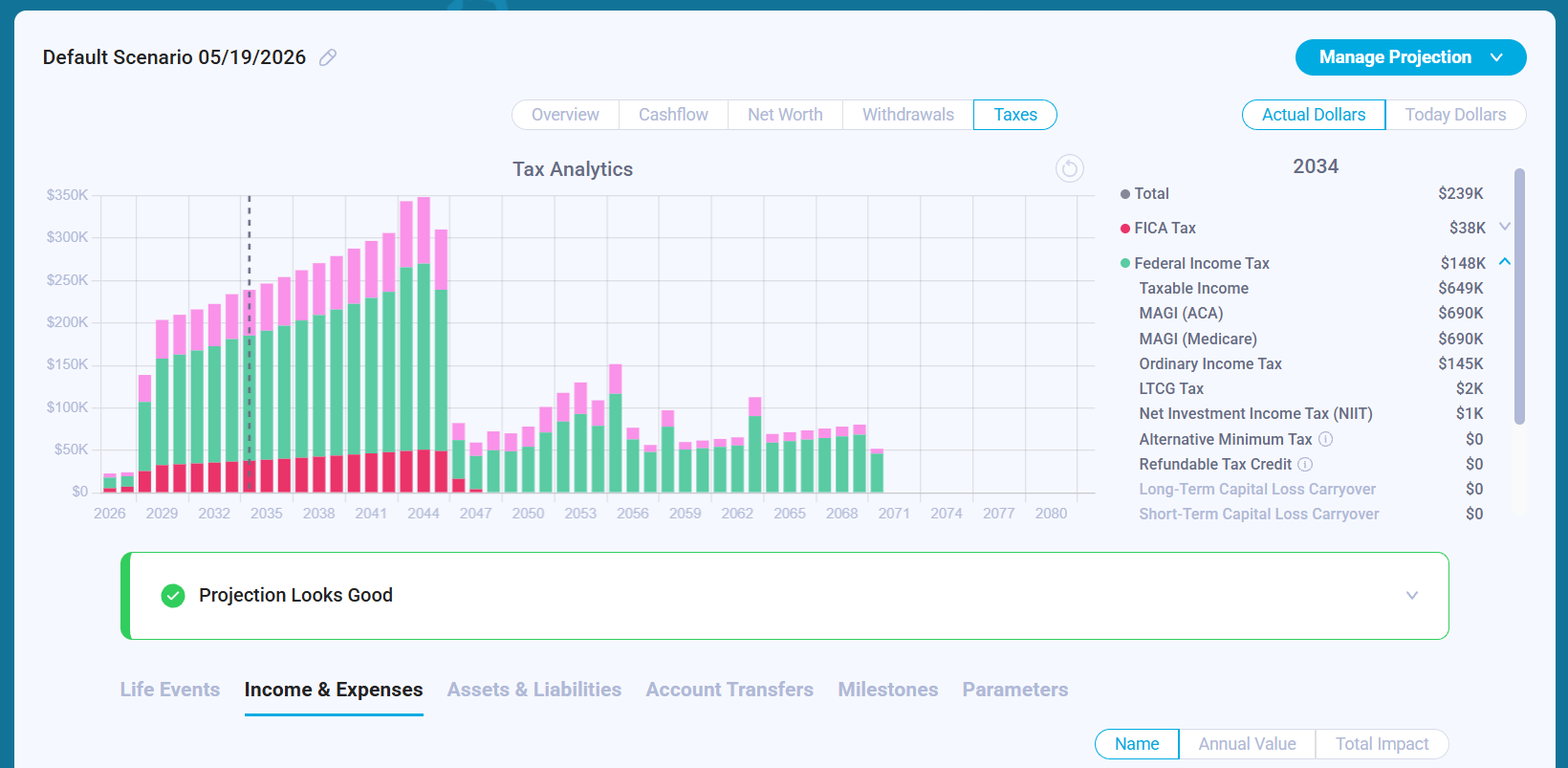
I was working on adding Washington State’s new 9.9% tax on income over $1 million, starting in 2028, to Nauma’s tax engine. While testing the changes, I found a cliff built into the tax law that could cause some taxpayers to overpay their state taxes by about $27K if they’re not careful.
That discovery led me to take a closer look at the bill, which takes effect on January 1, 2028, its mechanics, and its implications for tax planning for high earners living in Washington State. This post explains my findings and their impact.
The Families Behind the $1M Income Number
While $1M may sound like an extremely high income, and the new bill is intended to target wealthy people, the way it is structured means it can also affect some otherwise ordinary high-earning families. A few examples:
A married couple where both spouses work as senior or staff engineers and each earns $500K–$600K a year.
A tech startup employee who worked at a company for 5-7years, received relatively modest cash compensation, took significant risks, and was fortunate to see their equity appreciate and become liquid.
These are not necessarily the super-rich, but hardworking professionals who invested years in their education, became experts in their fields, and took meaningful career risks to achieve this income.
Problem #1: Capital Gains Cliff
Who is affected: High earners making $1M+ and realizing capital gains the same year.
Potential impact: Overpaying ~$30K in taxes if realizing capital gains without tax planning.
Washington already has a 7% capital gains tax on gains over $278K and a 9.9% tax on gains over $1M. The new income tax is 9.9% on income over $1M, based on federal AGI with adjustments. To avoid double-taxing capital gains, the 2028 bill first removes all long-term capital gains from income, then adds back the WA-taxed gain plus the $278K deduction. This is described in Section 302.
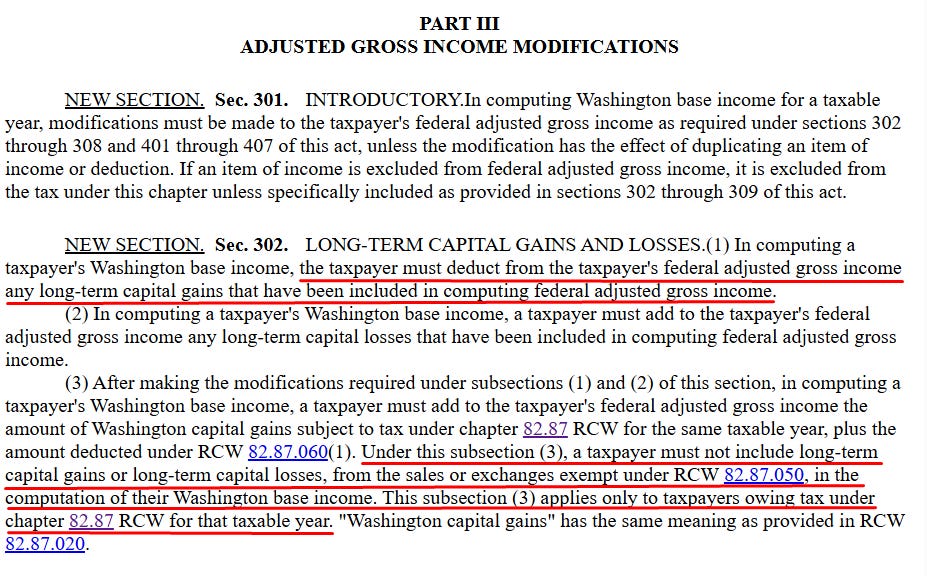
Here is the problem I see. The bill says the add-back “applies only to taxpayers owing tax under chapter 82.87 RCW” — the capital gains tax. That gives us two scenarios:
Capital gain is under ~$278K. You owe no capital gains tax, so nothing gets added back and the gain never enters the income-tax base.
Capital gain is even $1 over $278K. You owe capital gains tax, so the *entire* gain gets added back, including the first $278K that was previously excluded.
Example: single filer, $1.2M in wages, using the 2025 deduction amount.
Scenario-1:
Long-term gain: $277,000
Capital gains tax: $0
Income-tax base: $1,200,000
Total WA tax: $19,800
Scenario-2
Long-term gain: $279,000
Capital gains tax: $70
Income-tax base: $1,479,000
Total WA tax: $47,421
A $2,000 larger gain in Scenario-2 therefore costs about $27,600 more in tax because 9.9% × $279,000 of additional income suddenly becomes taxable. This only affects taxpayers whose other income is already above $1M.
Problem #2: Threshold indexing for inflation
Who is affected: Financial Advisors and Tax Planners
Potential impact: Miscalculating thresholds and making clients overpay ~$30K in taxes
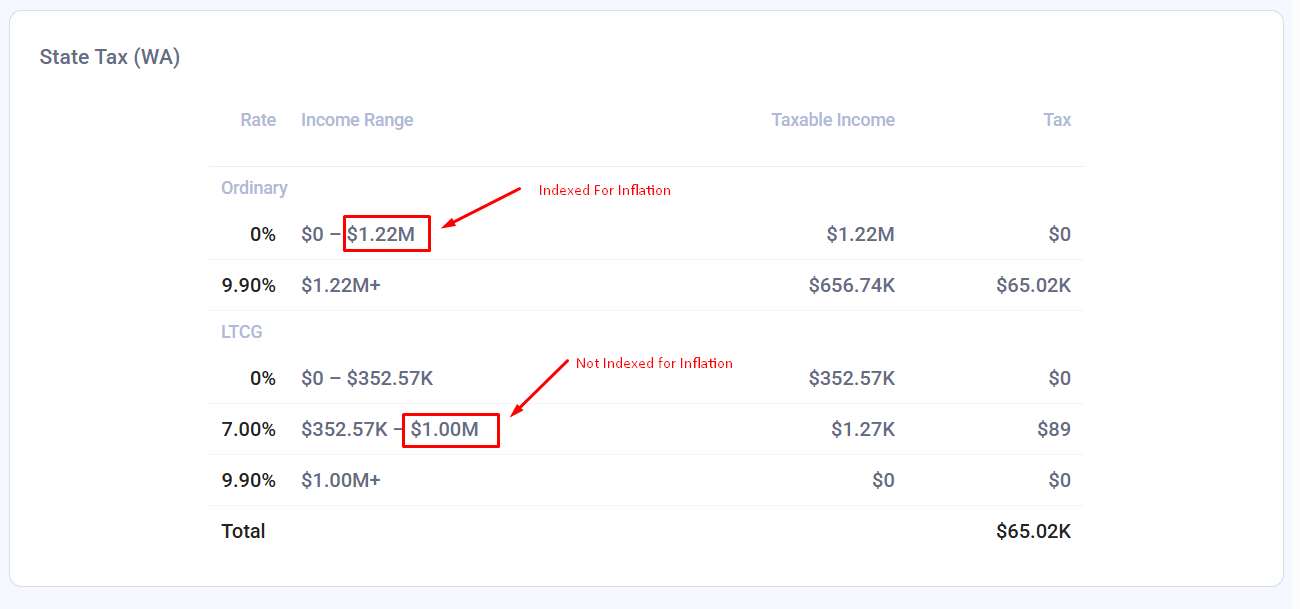
Starting in 2028, the Washington tax code has two thresholds that currently have the same value of $1M, but have different rules for inflation indexing:
The $1M capital-gains threshold is not indexed for inflation. RCW 82.87.040 says “the portion of an individual’s Washington capital gains exceeding $1,000,000” and never mentions indexing. RCW 82.87.150 lists only four indexed items: the education trust distribution, the standard deduction, the family business revenue amount, and the charitable donation limits.
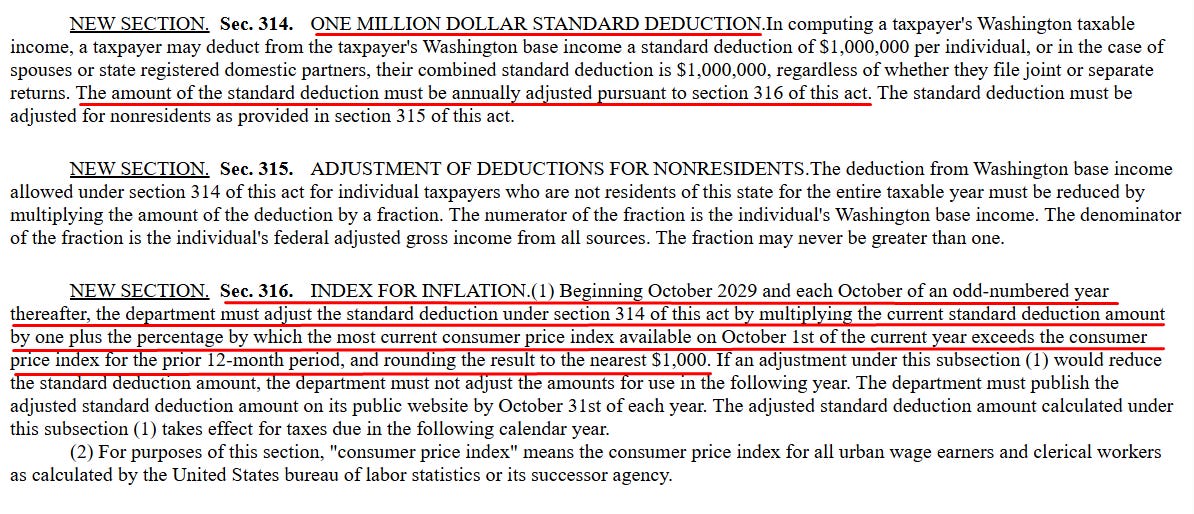
The $1M income-tax threshold is indexed for inflation. It’s a standard deduction defined in Section 314. Section 316 describes how it adjusts standard deduction every odd October from 2029 by CPI-W, rounded to the nearest $1,000.
This difference shows up in financial projections and makes tax planning more complicated for families living in Washington State. Tax professionals need to account for it when developing financial plans, while tax-planning software developers need to spend additional time implementing and maintaining this nuance in their software. This added complexity ultimately translates into additional costs in both time and capital.
Here is how these two thresholds diverge over time. Calculation for 2038:
Problem #3: The Marriage Penalty
Who is affected: Married couples with income over $1M.
Potential impact: Overpaying up to $99K in taxes for ordinary income and $19.5K for capital gains
The $1M deduction is per person, but for spouses it’s shared. The federal system roughly doubles the standard deduction and the lower brackets for joint filers, so the marriage penalty is relatively limited. WA does not. Section 314 says: “in the case of spouses or state registered domestic partners, their combined standard deduction is $1,000,000, regardless of whether they file joint or separate returns.”

How large it can get:
The most a couple can lose is 9.9% x $1M = $99K a year, in 2028 dollars. That happens when both partners individually have over $1M.
For capital gains, the equivalent is 7% x $278K, about $19,500, when both partners have gains above the deduction.

How the Bill Can Be Improved
The issues above do not necessarily require redesigning the entire tax. They could be addressed with relatively small changes. If these changes affect state revenue, the thresholds or tax rates could be adjusted to maintain the same overall revenue level for Washington state.
Eliminate the capital-gains cliff. This could be accomplished either by adding back only the portion of the gain above the $278K deduction or by always adding back the full gain, even when it is below the deduction.
Consider progressive brackets. Multiple and separate tax brackets for ordinary and capital gain income could create a smoother transition than moving directly from no tax to a 9.9% marginal rate above the threshold.
Reduce the marriage penalty. Married couples should receive a higher threshold than single taxpayers, potentially twice the individual amount.
Use consistent inflation indexing. The $1M income-tax threshold and the $1M capital-gains threshold should follow the same indexing rules so they do not gradually diverge over time.
These changes would make the tax more predictable and easier for taxpayers, advisors, and software developers to understand and model.
About The Author
Alex Sukhanov, founder of Nauma, a financial planning platform built for people in tech and high-net-worth families. Alex previously worked at Google and started Nauma to help more people in tech make better financial decisions and achieve more in their lives. You can reach out to Alex on linkedin.
Nauma is supported entirely by its users: no commissions, no affiliate incentives, and no financial products to sell. Built as an independent software platform rather than a traditional advisory firm, Nauma is designed to give tech professionals the tools and modeling clarity to evaluate their own equity, tax, and retirement scenarios.