'%3e%3cpath%20d='M136%2043.0521C135.893%2043.4991%20131.298%2041.3697%20123.51%2041.5186C120.787%2041.5712%20109.626%2040.8001%20104.06%2049.4228C101.316%2053.664%20102.266%2056.2491%20100.601%2061.5769C95.2065%2078.8661%2087.7394%2075.1856%2062.5302%2088.5228C54.5058%2092.764%2045.1595%20101.562%2043.5589%20103.087C31.9403%20114.163%2025.1664%20123.189%2025.1521%20123.171C25.1378%20123.162%2034.1912%20104.357%2047.7676%2082.7655C60.6795%2062.2429%2063.8235%2070.0769%2079.7722%2049.1336C81.7015%2046.6011%2084.8526%2037.6805%2089.683%2036.1032C93.6345%2034.815%2098.6148%2036.6114%20100.065%2038.5568C101.044%2039.8712%20101.459%2040.765%20103.831%2040.4408C110.048%2039.5996%20113.613%2039.8625%20115.492%2039.7748C116.95%2039.7047%20119.751%2039.915%20120.509%2039.9939C130.419%2040.9753%20136.15%2042.4563%20136.007%2043.0434L136%2043.0521Z'%20fill='%23127398'/%3e%3cpath%20d='M22.1867%2043.6392C30.3968%2055.0923%2031.5544%2062.348%2040.6506%2068.6923C45.9954%2072.4253%2053.4839%2075.4134%2058.2928%2075.5361C61.9084%2075.6325%2063.7305%2075.2557%2064.6023%2074.949C64.8524%2074.8614%2065.1025%2074.8351%2065.3597%2074.8263L76.0636%2070.6727C76.8068%2066.8871%2076.1637%2063.4784%2076.1065%2063.1892C75.0561%2058.0103%2072.3337%2053.3835%2070.5402%2051.2542C55.4561%2033.3428%2055.8062%2034.298%2046.5814%2028.0237C26.7884%2014.5902%20-1.22192%2021.3464%200.0428309%2022.0562C0.55016%2022.3454%2010.2394%2026.9634%2022.1867%2043.6392Z'%20fill='%23127398'/%3e%3cpath%20d='M79.8366%2044.0161C81.33%2046.4784%2083.4093%2051.5784%2083.7666%2056.8975C83.7952%2057.3094%2084.1667%2064.0393%2080.4654%2068.4733C78.5004%2070.8217%2076.2281%2071.5403%2075.585%2071.7506C61.487%2076.5264%2028.4319%20116.196%2023.3515%20133.494C23.2229%20133.941%2022.6227%20136.026%2022.5655%20136C22.3797%20135.921%2023.5373%20120.753%2028.925%20106.303C28.925%20106.303%2033.7196%2090.5295%2046.7387%2073.9326C49.1896%2070.8042%2052.8052%2067.0362%2052.8052%2067.0362C54.2414%2065.1434%2059.8006%2068.3068%2066.1887%2068.482C69.9401%2068.5872%2073.2198%2067.6846%2073.2055%2067.3604C73.2055%2067.2377%2073.0698%2067.0712%2072.8911%2066.9047C72.3195%2066.3702%2071.5907%2066.1423%2070.8761%2066.2475C69.9758%2066.379%2068.1323%2066.3877%2064.5738%2065.5903C59.8435%2064.5212%2052.8481%2060.096%2048.0534%2055.364C39.9076%2047.3109%2039.7147%2039.9238%2033.1051%2026.9985C23.4944%208.17586%2014.0767%201.32328%2014.0767%201.32328C17.285%20-1.64734%2041.451%20-0.788575%2059.229%2016.3692C67.5177%2024.3697%2067.2962%2023.3619%2079.8366%2044.0073V44.0161Z'%20fill='%23EF9920'/%3e%3c/g%3e%3cdefs%3e%3cclipPath%20id='clip0_882_3310'%3e%3crect%20width='136'%20height='136'%20fill='white'/%3e%3c/clipPath%3e%3c/defs%3e%3c/svg%3e)
Early Retirement for Tech Workers
Non-Linear Careers, RSU Vesting Decisions, and the Cost of Living Outside California
Early retirement for tech workers is not a fantasy — it is an arithmetic problem. The average FAANG software engineer earns more in a single year than many professionals earn in three. When you combine that income with deliberate savings, equity compensation, and tax strategy, the math compresses a 40-year career into 10 to 15 years. The harder questions are not about saving enough. They are about knowing when you actually have enough, where you plan to live, what happens to your career optionality, and how to structure decades of withdrawals from accounts designed for people who retire at 65.
This guide focuses specifically on the early retirement path for people who have built wealth inside tech — not just through high salaries, but through stock vesting cycles, non-linear career trajectories, and the financial complexity that comes with them.
What Makes Tech Careers Uniquely Well-Suited for Early Retirement
Most early retirement content is written for people earning $80,000–$120,000 who achieve financial independence through extreme frugality over 15–20 years. That path is real and valid. But it is not the path available to a senior software engineer at Google or a staff engineer at Meta who earns $350,000–$600,000 in total compensation with a meaningful portion arriving in RSU vests.
Tech careers have several structural features that accelerate the early retirement timeline:
- Compensation is front-weighted toward high earners. A software engineer who reaches senior or staff level in 6–10 years can earn more than 90% of American households combined. The income gap between a new grad and a principal engineer at a top company is enormous — but it can be closed in under a decade of strong performance.
- Equity vesting creates windfall events. RSUs at a company with appreciating stock can produce single-year income events worth $200,000–$1,000,000+. These windfalls, invested rather than spent, compress the savings timeline dramatically. A single RSU vest at a company whose stock tripled since the grant date can equal five years of conventional savings.
- Careers are non-linear. Tech workers frequently change employers, take sabbaticals, move between roles (engineering, product, management, consulting), or launch startups. This non-linearity is not an obstacle to early retirement — it is often an accelerant. A two-year stint at a pre-IPO company that goes public, a well-timed move to a higher-compensation role, or a consulting period between full-time jobs can all generate income asymmetric to hours worked.
- Remote work has decoupled income from geography. A senior engineer at a San Francisco company can now earn Bay Area compensation while living in Austin, Raleigh, or abroad. This geographic arbitrage — earning at California rates while spending at Texas rates — is one of the most powerful early retirement accelerators available to tech workers today.
The Non-Linear Career and Its Retirement Implications
The traditional retirement planning framework assumes a 40-year uninterrupted career followed by a fixed retirement date. Tech careers rarely look like this. A realistic career arc might include:
- 3 years at a startup that was acquired, generating a liquidity event and a refreshed RSU grant at the acquirer
- 2 years at a large company, followed by a sabbatical or an extended personal project
- Return to a staff-level role at a FAANG company with a large equity grant
- Consulting or advisory work in parallel with or after full-time employment
- A period of part-time work — what the FIRE community calls Barista FIRE or Coast FIRE — before full retirement
This non-linearity has important implications for retirement planning. First, your income will not be smooth — it will spike during vesting cycles and drop during gaps. Financial planning needs to accommodate variable income, not assume a linear salary trajectory. Second, each job change restarts your vesting clock, which affects the opportunity cost of leaving. Third, career gaps can create Roth conversion opportunities — periods of lower income when it makes sense to convert traditional IRA or 401(k) funds to Roth at a lower marginal rate.
The other implication is that early retirement for a tech worker often does not mean stopping work entirely. It means reaching a financial position where work becomes optional — where you can take a gap year, decline a bad manager, switch to an interesting but lower-paying role, or launch something without needing it to succeed financially. This optionality, not the cessation of all work, is what most tech workers are actually optimizing for.
Your Early Retirement Number: The Bay Area Math vs. Everywhere Else
The most important variable in your early retirement calculation is not your portfolio size — it is your annual spending in retirement. And in California, that number is exceptional.
A couple living in San Francisco or the Bay Area with no mortgage might spend $180,000–$240,000 per year once healthcare, property taxes, dining, travel, and childcare (if relevant) are included. At a 3.5% withdrawal rate — appropriate for a 40+ year retirement horizon — that implies a required portfolio of $5.1M–$6.9M. Achievable for a high-earning couple who vested well, but a high bar that will take most people 12–18 years to reach.
The same couple, relocated to a lower cost-of-living city, faces a fundamentally different math:
- Austin, TX: No state income tax, median home prices well below Bay Area, total annual spend for a couple might be $90,000–$130,000. FIRE number: $2.6M–$3.7M at 3.5%.
- Denver, CO: Flat 4.4% state income tax, outdoor lifestyle, tech-friendly city. Annual spend: $100,000–$140,000. FIRE number: $2.9M–$4.0M.
- Raleigh, NC: Growing tech hub, significantly lower cost of living than coastal cities, 4.5% flat state income tax. Annual spend: $85,000–$120,000. FIRE number: $2.4M–$3.4M.
- Nashville, TN: No state income tax on wages, strong job market, lower housing costs. Annual spend: $85,000–$115,000. FIRE number: $2.4M–$3.3M.
- Lisbon, Portugal / Medellín, Colombia / Chiang Mai, Thailand: International geo-arbitrage options for tech workers without dependent parents or strong geographic ties. Annual spend can fall to $40,000–$70,000 for a couple at a high quality of life. FIRE number: $1.1M–$2.0M.
The difference between staying in San Francisco and relocating to Austin is not a marginal adjustment to your FIRE date — it can be 5 to 8 additional years of required work. The relocation decision is often the single largest lever available to a tech worker planning early retirement.
California Cost of Living: The True Price of Staying
California's cost of living premium extends well beyond housing. For a tech worker planning early retirement in California, the full expense picture includes:
- State income tax. California's top marginal rate is 13.3%, applied starting at $1,000,000 for single filers and $1,340,000 for married filing jointly. But even at $200,000 of income, the effective California rate is 8–9%. In retirement, ordinary income from traditional IRA and 401(k) withdrawals is taxed at these rates. Roth withdrawals are California tax-free, which is one reason Roth conversion strategy matters so much for California-resident retirees.
- Property taxes and housing costs. California's Proposition 13 limits annual property tax increases for existing homeowners, but purchase-price basis for new buyers is high. A $2M home in the Bay Area carries approximately $22,000–$25,000 in annual property tax. Renting is not reliably cheaper — a 3-bedroom apartment in a desirable Bay Area suburb can exceed $5,000/month.
- HSA non-conformity. California is the only state that taxes HSA contributions and investment growth at the state level. For a retiree drawing from an accumulated HSA, this reduces the triple-tax advantage to a double-tax advantage — meaningful but worth knowing.
- Healthcare costs in retirement. Without employer-sponsored insurance, healthcare is priced on the ACA marketplace. California's Covered California exchange offers subsidies, but premium costs are generally higher than national averages. A couple in their early 50s in the Bay Area can pay $1,500–$2,500/month in ACA premiums at full price before subsidies.
None of this means California is a bad place to retire — its climate, infrastructure, cultural amenities, and proximity to major airports are genuine lifestyle advantages. But the cost must be planned for explicitly. A retirement budget that looks comfortable at $150,000/year in Colorado may require $200,000+ in California to maintain the same standard of living, purely due to taxes and baseline costs.
States With No Income Tax: Where Tech Workers Are Relocating
Nine U.S. states have no state income tax on wages and retirement income: Alaska, Florida, Nevada, New Hampshire (wages only — investment income taxed until 2025), South Dakota, Tennessee, Texas, Washington, and Wyoming. For tech workers retiring in their 40s or 50s with large traditional IRA or 401(k) balances, choosing to retire in a no-income-tax state can save tens of thousands of dollars annually in withdrawal taxes.
Among these, the most popular destinations for tech workers leaving California are:
- Texas (Austin, Dallas): Largest inbound migration from California, strong tech ecosystem, no state income tax. Property taxes are higher than California's (effective rate of 1.5–2.2% of appraised value), but even accounting for property tax, total annual costs are typically 25–40% lower than the Bay Area. Austin in particular has developed a substantial tech community and maintains many of the cultural characteristics that appeal to tech workers.
- Washington (Seattle area): No state income tax, existing large tech community (Amazon, Microsoft, and thousands of tech companies), similar climate to San Francisco — gray and mild rather than sunny and dry. Seattle housing costs are lower than Bay Area, though not dramatically so. Washington has a 7% capital gains tax on gains above $270,000 (2026), which affects tech workers selling concentrated stock positions.
- Nevada (Las Vegas, Henderson): No state income tax, close to California (drive-commutable to Southern California), lower housing costs, and a growing remote-work population. Less common among tech workers than Austin or Seattle but increasingly popular for early retirees from Southern California.
- Florida (Miami, Tampa, Orlando): No state income tax, year-round warmth, lower costs than California. Florida's growing tech scene and the Miami tech community have accelerated in-migration from California. Property insurance costs have risen significantly in recent years due to hurricane risk — a meaningful budget item for Florida retirees.
The RSU Vesting Decision: When to Leave, When to Stay
For most tech workers, the decision of when to retire is inseparable from the RSU vesting schedule. Unvested RSUs are forfeited when you leave your employer. A single unvested tranche can represent $200,000–$500,000+ — real money that changes the calculus of whether to leave now or stay for one more vest.
The correct framework for evaluating this decision:
- Calculate the after-tax value of remaining unvested grants. RSUs vest as ordinary income. If you are in the 37% federal bracket and a 9% California bracket, every $100,000 of unvested RSUs yields approximately $54,000 after tax. Model the actual post-tax value, not the gross grant amount.
- Assess the vest schedule. A 4-year grant with monthly vesting has very different economics than one with annual cliff vesting. If you are 30 months into a 4-year monthly grant and the next 18 months will vest $400,000 gross ($216,000 after tax at the rates above), you are trading 18 months of your working life for $216,000 in investable capital. Is that trade worth it to you?
- Account for opportunity cost. Staying for 18 more months also means 18 months of continuing to contribute to your 401(k), HSA, and taxable accounts. The total financial benefit of the extended stay is greater than just the unvested RSU value.
- Consider the stock concentration risk. If a significant portion of your net worth is in unvested RSUs and company stock, you are heavily concentrated in a single asset. Diversifying that risk is a valid financial goal — and leaving before full vest can accelerate diversification, not delay it.
Many tech workers find themselves in a recurring "one more vest" cycle — always 12–18 months from a meaningful vest that justifies staying. This is a real phenomenon and should be named explicitly in your planning. Set a concrete financial target and a date: "When my liquid investable assets reach $X, I will be free to leave regardless of where I am in the vesting cycle."
Tax Strategy for Early Retirement from a High-Income Career
The years immediately after leaving a high-income tech job are a unique tax opportunity. Your income drops dramatically — no salary, no RSU vests — while your portfolio has not yet started generating significant distributions. This creates a window for aggressive Roth conversion at low marginal rates.
The core early retirement tax playbook for tech workers:
- Roth conversion ladder in early retirement. If most of your wealth is in traditional 401(k) and IRA accounts (common for people who maxed pre-tax contributions for years), convert to Roth in the low-income years immediately after leaving work. At $0–$94,050 of taxable income for married filing jointly in 2026, the federal capital gains rate is 0% and you are likely in the 22–24% federal income tax bracket — significantly lower than your 32–37% bracket during peak earning years. Converting $100,000–$200,000 per year from traditional to Roth during early retirement years reduces future required minimum distributions and locks in decades of tax-free growth.
- ACA subsidy optimization. In 2026, ACA premium tax credits phase out above 400% of the Federal Poverty Level (approximately $83,000 for a married couple with no dependents). Many early retirees structure their first retirement years to keep Modified Adjusted Gross Income below this threshold — drawing from Roth accounts and long-term capital gains (taxed at 0% below the $94,050 threshold) rather than traditional IRA distributions. This can save $10,000–$20,000 annually in healthcare premiums.
- State income tax considerations in the relocation year. If you are relocating from California to a no-income-tax state in the same year you retire, your income in that year may still be partially California-sourced. California taxes all income earned while you are a California resident, and it aggressively pursues former residents who claim to have moved. Document the move with physical evidence — a new lease or home purchase, California driver's license surrender, voter registration change, and changed primary residence — before the end of the tax year.
- Capital gains harvesting. In early retirement years with low ordinary income, you may be in the 0% long-term capital gains bracket. Selling appreciated assets and immediately repurchasing them resets the cost basis with no tax owed — a technique called tax gain harvesting. This is the opposite of tax-loss harvesting but equally powerful in low-income years.
Healthcare Before 65: Closing the Gap
Retiring before Medicare eligibility at 65 means covering healthcare entirely through ACA marketplace plans, employer COBRA (limited to 18 months), a spouse's plan, or private coverage. For a couple retiring at 45, this means 20 years of self-funded healthcare — often the largest fixed expense in an early retirement budget.
The planning variables:
- ACA marketplace plans. Coverage through Healthcare.gov or your state's marketplace. Premiums vary by age, location, and income (through the ACA subsidy). A 50-year-old couple in Texas on a Silver plan might pay $1,200–$1,800/month at full price, or substantially less with subsidies. Shop every year — the best value plan changes annually.
- HSA as a bridge. If you accumulated a significant HSA balance during your working years, it can cover out-of-pocket medical costs tax-free in early retirement. A $200,000 HSA balance, invested and growing, provides meaningful healthcare runway for a couple with reasonable medical utilization.
- Health-sharing ministries. Non-insurance organizations where members share healthcare costs. Lower monthly contributions than ACA plans but significant coverage limitations. Not appropriate for anyone with pre-existing conditions or high-cost medical needs, but used by some early retirees as a lower-cost alternative to ACA coverage in years where ACA premiums are prohibitive.
- Relocating to a lower-cost healthcare state. ACA premiums vary significantly by state and even by county. Relocating to a lower-premium state (Texas, Indiana, Georgia) vs. a higher-premium state (Vermont, West Virginia, Wyoming) can reduce premiums by 30–50% for identical coverage levels.
Social Security and Early Retirement: How Gaps Affect Your Benefit
Social Security benefits are calculated based on your 35 highest-earning years, indexed for inflation. A tech worker who retires at 45 with 20 years of high earnings will have 15 zero-income years factored into their benefit calculation — dragging down the average and reducing the monthly benefit at 62 or 67.
The practical implication: early retirees should not count on Social Security as a significant portion of their retirement income. It will be there — probably — but at a meaningfully lower level than someone who worked until 65. A person who earns $250,000/year for 20 years and then retires might receive $2,000–$2,500/month at full retirement age, compared to $4,000–$5,000 for someone with the same earnings who worked 35 years. Plan your portfolio withdrawals as the primary income source, with Social Security as a supplemental benefit that arrives at 62 or 67.
Also worth knowing: if you plan to do any paid work after "retiring" — consulting, part-time employment, advisory roles — those earnings continue to count toward your Social Security record and can increase your eventual benefit. Even modest earned income in the early retirement years can fill some of those zero-year gaps in your calculation.
The Early Retirement Dry Run: Testing Your Plan Before You Quit
One of the most common early retirement mistakes is optimizing the financial plan without testing the life plan. Before giving notice, consider a structured trial period:
- Take a sabbatical if your company offers one. Some large tech companies (Google, Salesforce, LinkedIn) offer paid or unpaid sabbaticals. Use one to experience extended non-working time before committing to full retirement. Many people discover within months that the structure of work was more valuable than they realized.
- Negotiate a part-time or consulting arrangement. Rather than a hard stop, negotiate a reduced-hours arrangement or a consulting contract with your current employer. This generates income while you test your retirement lifestyle, reduces the sequence-of-returns risk of retiring into a market downturn, and preserves professional relationships that are hard to rebuild later.
- Live on your projected retirement budget for 12 months before you leave. If your retirement plan assumes $120,000/year in spending and you currently spend $200,000, practice the $120,000 budget while still employed. This reveals whether your projected number is realistic and creates an accelerated savings period as a bonus.
- Identify your replacement for work-provided structure and identity. Many tech workers derive significant identity, intellectual stimulation, and social connection from their jobs. These are not replaced automatically by free time. Think concretely about what replaces them before retirement, not after.
Frequently Asked Questions
Model Your Early Retirement Timeline
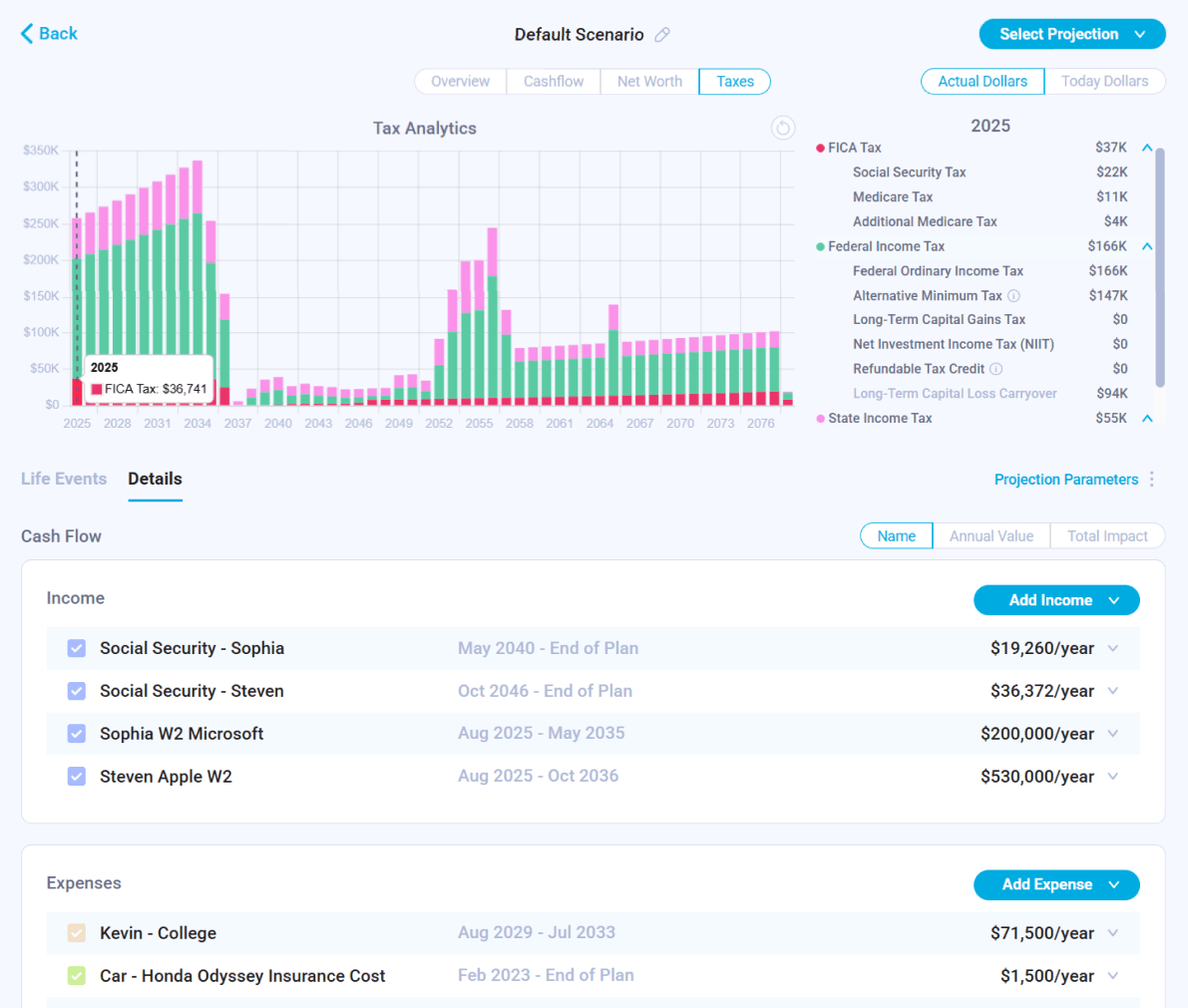
Nauma projects your exact retirement date based on your RSU vests, tax strategy, relocation scenarios, and withdrawal plan — so you know the number and the date, not just the concept.
Get Started for Free