'%3e%3cpath%20d='M136%2043.0521C135.893%2043.4991%20131.298%2041.3697%20123.51%2041.5186C120.787%2041.5712%20109.626%2040.8001%20104.06%2049.4228C101.316%2053.664%20102.266%2056.2491%20100.601%2061.5769C95.2065%2078.8661%2087.7394%2075.1856%2062.5302%2088.5228C54.5058%2092.764%2045.1595%20101.562%2043.5589%20103.087C31.9403%20114.163%2025.1664%20123.189%2025.1521%20123.171C25.1378%20123.162%2034.1912%20104.357%2047.7676%2082.7655C60.6795%2062.2429%2063.8235%2070.0769%2079.7722%2049.1336C81.7015%2046.6011%2084.8526%2037.6805%2089.683%2036.1032C93.6345%2034.815%2098.6148%2036.6114%20100.065%2038.5568C101.044%2039.8712%20101.459%2040.765%20103.831%2040.4408C110.048%2039.5996%20113.613%2039.8625%20115.492%2039.7748C116.95%2039.7047%20119.751%2039.915%20120.509%2039.9939C130.419%2040.9753%20136.15%2042.4563%20136.007%2043.0434L136%2043.0521Z'%20fill='%23127398'/%3e%3cpath%20d='M22.1867%2043.6392C30.3968%2055.0923%2031.5544%2062.348%2040.6506%2068.6923C45.9954%2072.4253%2053.4839%2075.4134%2058.2928%2075.5361C61.9084%2075.6325%2063.7305%2075.2557%2064.6023%2074.949C64.8524%2074.8614%2065.1025%2074.8351%2065.3597%2074.8263L76.0636%2070.6727C76.8068%2066.8871%2076.1637%2063.4784%2076.1065%2063.1892C75.0561%2058.0103%2072.3337%2053.3835%2070.5402%2051.2542C55.4561%2033.3428%2055.8062%2034.298%2046.5814%2028.0237C26.7884%2014.5902%20-1.22192%2021.3464%200.0428309%2022.0562C0.55016%2022.3454%2010.2394%2026.9634%2022.1867%2043.6392Z'%20fill='%23127398'/%3e%3cpath%20d='M79.8366%2044.0161C81.33%2046.4784%2083.4093%2051.5784%2083.7666%2056.8975C83.7952%2057.3094%2084.1667%2064.0393%2080.4654%2068.4733C78.5004%2070.8217%2076.2281%2071.5403%2075.585%2071.7506C61.487%2076.5264%2028.4319%20116.196%2023.3515%20133.494C23.2229%20133.941%2022.6227%20136.026%2022.5655%20136C22.3797%20135.921%2023.5373%20120.753%2028.925%20106.303C28.925%20106.303%2033.7196%2090.5295%2046.7387%2073.9326C49.1896%2070.8042%2052.8052%2067.0362%2052.8052%2067.0362C54.2414%2065.1434%2059.8006%2068.3068%2066.1887%2068.482C69.9401%2068.5872%2073.2198%2067.6846%2073.2055%2067.3604C73.2055%2067.2377%2073.0698%2067.0712%2072.8911%2066.9047C72.3195%2066.3702%2071.5907%2066.1423%2070.8761%2066.2475C69.9758%2066.379%2068.1323%2066.3877%2064.5738%2065.5903C59.8435%2064.5212%2052.8481%2060.096%2048.0534%2055.364C39.9076%2047.3109%2039.7147%2039.9238%2033.1051%2026.9985C23.4944%208.17586%2014.0767%201.32328%2014.0767%201.32328C17.285%20-1.64734%2041.451%20-0.788575%2059.229%2016.3692C67.5177%2024.3697%2067.2962%2023.3619%2079.8366%2044.0073V44.0161Z'%20fill='%23EF9920'/%3e%3c/g%3e%3cdefs%3e%3cclipPath%20id='clip0_882_3310'%3e%3crect%20width='136'%20height='136'%20fill='white'/%3e%3c/clipPath%3e%3c/defs%3e%3c/svg%3e)
Fat FIRE for Tech Workers
Early Retirement on a Generous Budget — The Complete Guide for Senior Engineers and Tech Professionals
Fat FIRE is financial independence on a generous budget — typically $150,000 or more per year — that allows you to retire without meaningfully changing your lifestyle. It is the dominant retirement target for senior tech workers, engineering managers, and tech executives in high-cost metro areas. Where Lean FIRE requires radical frugality and lifestyle compression, Fat FIRE requires simply accumulating enough wealth that your current spending is sustainable indefinitely. For FAANG engineers and tech professionals earning $300,000–$700,000+ in total compensation, Fat FIRE is the realistic goal — and with the right tax strategy and equity planning, it is achievable in 10–20 years.
What Fat FIRE Actually Means
There is no single agreed definition, but Fat FIRE is generally understood as retiring with $150,000–$300,000+ of annual spending capacity. Applying the 4% rule:
- $150,000/year spend: $3,750,000 portfolio required
- $200,000/year spend: $5,000,000 portfolio required
- $250,000/year spend: $6,250,000 portfolio required
- $300,000/year spend: $7,500,000 portfolio required
For early retirees with 40- or 50-year horizons, many planners use 3–3.5% instead of 4%, which pushes these targets 15–33% higher. A $200,000/year spend at 3.5% requires $5,714,000; at 3%, it requires $6,667,000.
The higher target is not an obstacle — it is a calibration. A tech worker saving $200,000–$400,000 per year in a high-income stretch compounds toward these numbers faster than most people realize, especially when RSU windfalls are directed efficiently into a diversified portfolio.
The Fat FIRE Number for Bay Area and Seattle Tech Workers
Geography shapes the Fat FIRE number more than any other single variable. A couple planning to remain in San Francisco post-retirement — after paying off or selling a home — might spend $200,000–$280,000 per year: housing costs or rent, property taxes, private health insurance before Medicare, generous travel, dining, and discretionary spending. That implies a portfolio of $5,000,000–$9,333,000 depending on withdrawal rate and spending level.
A couple in Seattle faces a similar baseline before Washington's capital gains tax on investment income, which begins at 7% on gains over $270,000 from 2024. This tax applies to long-term capital gains and some dividends — directly relevant to Fat FIRE retirees drawing from large taxable brokerage accounts built from RSU proceeds. Washington's tax-friendly reputation on ordinary income (no state income tax) does not extend to large capital gains realizations in retirement.
The most common Fat FIRE relocation playbook for Bay Area and Seattle tech workers: retire, sell or rent the high-cost home, and relocate to a lower-cost U.S. city (Austin, Nashville, Denver, Phoenix) or internationally (Lisbon, Barcelona, Medellín). The relocation reduces annual spending by $50,000–$100,000, which reduces the required portfolio by $1,250,000–$3,333,000 at 4%. Many tech workers who cannot quite hit their Bay Area Fat FIRE number can easily hit a Fat FIRE number for a lower-cost destination.
Tax Strategy at Fat FIRE Scale
At Fat FIRE income and portfolio levels, tax strategy is not optional — it is the primary determinant of how many years sooner or later you reach the number. A senior tech worker in California earning $450,000 faces combined federal and state marginal rates of 50%+ on the top dollar. The Fat FIRE tax toolkit:
- Max every tax-advantaged account, always. The 401(k) ($24,500 employee limit in 2026), backdoor Roth IRA ($7,500), and HSA ($8,750 family) are non-negotiable first steps. Together they shelter over $40,000 from current taxation. The mega backdoor Roth — if your plan allows after-tax contributions and in-plan Roth conversions — can shelter an additional $40,000+ per year in tax-free growth, critical for building the Roth balance you will need for tax-free withdrawals in retirement.
- RSU strategy: sell and diversify immediately. RSUs vest as ordinary income — you cannot avoid that tax. But you can avoid concentration risk by selling immediately and diversifying into a broad index fund portfolio. Fat FIRE retirees with concentrated tech stock positions are exposed to a specific risk: if your former employer's stock declines 50% (common in tech bear markets), your portfolio may fall far below the number you needed. The 2022 market showed this clearly.
- Tax-loss harvesting in taxable accounts. Large taxable brokerage accounts built from RSU proceeds contain embedded gains that generate capital gains on sale. In down years, systematically harvesting losses against those gains — selling a position, immediately buying a similar-but-not-identical fund — creates tax losses that offset current gains or carry forward. For Fat FIRE savers with $2M–$5M in taxable accounts, this practice can save $10,000–$50,000 in taxes per year.
- Qualified Opportunity Zone or charitable strategies for large gains. For tech workers who have large concentrated gains — from a pre-IPO company, a long-held position, or an acquisition — QOZ investments defer and partially exclude capital gains. Donor-Advised Funds allow contributions of appreciated stock at fair market value with an immediate deduction, eliminating the embedded gain. For Fat FIRE savers with charitable intentions, a DAF can accelerate the timeline by reducing a large one-time tax bill.
- Roth conversions in the pre-Medicare retirement gap. The period between leaving work and age 65 (Medicare) is often the best window for Roth conversions. With no earned income and before Social Security, a Fat FIRE retiree may have unusually low MAGI — allowing large traditional IRA conversions at 22% or 24% federal rates rather than the 37% rate they faced while working. This front-loading of Roth assets reduces future RMDs and creates a tax-free pool for later-life spending.
Building the Fat FIRE Portfolio: Account Sequencing
Fat FIRE requires a multi-account strategy because no single account type is sufficient. The typical Fat FIRE portfolio at retirement contains:
- Taxable brokerage account: Often the largest component for tech workers — built from RSU proceeds, bonuses, and savings beyond tax-advantaged limits. Accessible at any age. Long-term gains taxed at 0%, 15%, or 20% (plus NIIT at higher incomes). The primary early retirement spending account.
- Traditional 401(k) / IRA: Tax-deferred. Optimal to delay withdrawals until needed, but RMDs begin at 73. Roth conversions during early retirement can reduce the RMD burden.
- Roth IRA / Roth 401(k): Tax-free growth and withdrawals. Contributions accessible immediately; conversions accessible after 5 years. The most flexible account in retirement — used for large discretionary spending, healthcare spikes, or years when other income is already high.
- HSA: Triple tax-advantaged. After 65, can be used for any expense (taxed as ordinary income, like a traditional IRA). Before 65, tax-free for qualified medical expenses. Useful for covering Fat FIRE's largest uncontrolled expense: healthcare before Medicare.
The optimal Fat FIRE withdrawal sequence is not simply "taxable first, then traditional, then Roth." It is a dynamic strategy that considers your marginal rate each year, Roth conversion opportunities, IRMAA thresholds (which affect Medicare Part B and D premiums two years in advance), ACA subsidy cliffs, and capital gains tax brackets. This sequencing is worth professional modeling — the tax savings over a 30-year retirement easily justify the cost.
Equity and Vesting: The Fat FIRE Decision Point
The most consequential Fat FIRE decision for most senior tech workers is not how to invest — it is when to leave. The calculation involves unvested RSUs, unvested options, and the opportunity cost of staying versus leaving. If you are 70% of the way to your Fat FIRE number with 18 months of unvested RSUs worth $400,000 remaining, those shares are equivalent to $16,000/year of sustainable portfolio income at 4%. Waiting 18 months to collect them — and reach the target cleanly — may be the highest-return use of your time.
The reverse calculation matters equally: if you are sitting on a Fat FIRE number already but a new grant is keeping you anchored to a job you dislike, the NPV of staying for incremental vesting needs to be weighed against the value of the years you are spending. Many tech workers at Fat FIRE reach the realization that they are no longer working for financial security — they are working for additional wealth they do not need. Recognizing that moment and acting on it is the final step.
Healthcare Before Medicare: The Fat FIRE Budget Wildcard
Fat FIRE retirees face a healthcare planning problem that Lean FIRE retirees do not: they earn too much to qualify for meaningful ACA subsidies. A couple with $200,000/year in portfolio withdrawals almost certainly has MAGI above the subsidy threshold, meaning full-price marketplace coverage. In 2026, a comprehensive family plan for a couple in their 40s can run $2,500–$4,000 per month — $30,000–$48,000 per year. This is not a minor line item; it is a major budget component that must be planned explicitly.
The most practical approaches for Fat FIRE healthcare before 65: budget for full ACA marketplace coverage as a fixed cost, investigate whether your employer offers COBRA continuation for a year or two, and consider health-sharing organizations as a lower-cost alternative with significant coverage limitations. The 20-year period from early retirement to Medicare at 65 — particularly the later years when health costs typically rise — is the highest-cost healthcare window.
Frequently Asked Questions
Model Your Fat FIRE Number
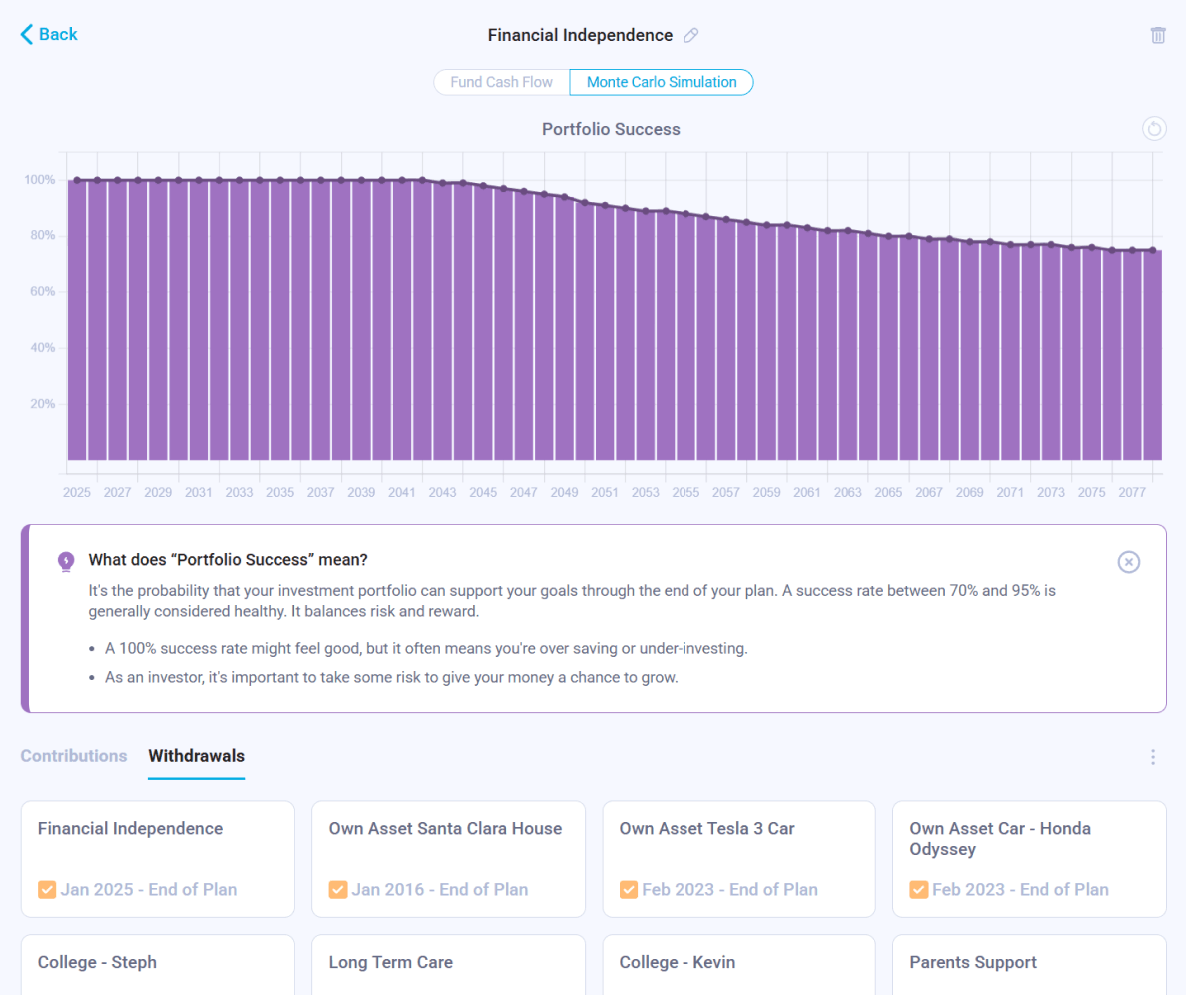
Nauma builds your personalized Fat FIRE projection — RSU vesting schedule, account sequencing, Roth conversion strategy, and tax-optimized withdrawal plan — so you can see exactly when financial independence is within reach.
Get Started for Free