'%3e%3cpath%20d='M136%2043.0521C135.893%2043.4991%20131.298%2041.3697%20123.51%2041.5186C120.787%2041.5712%20109.626%2040.8001%20104.06%2049.4228C101.316%2053.664%20102.266%2056.2491%20100.601%2061.5769C95.2065%2078.8661%2087.7394%2075.1856%2062.5302%2088.5228C54.5058%2092.764%2045.1595%20101.562%2043.5589%20103.087C31.9403%20114.163%2025.1664%20123.189%2025.1521%20123.171C25.1378%20123.162%2034.1912%20104.357%2047.7676%2082.7655C60.6795%2062.2429%2063.8235%2070.0769%2079.7722%2049.1336C81.7015%2046.6011%2084.8526%2037.6805%2089.683%2036.1032C93.6345%2034.815%2098.6148%2036.6114%20100.065%2038.5568C101.044%2039.8712%20101.459%2040.765%20103.831%2040.4408C110.048%2039.5996%20113.613%2039.8625%20115.492%2039.7748C116.95%2039.7047%20119.751%2039.915%20120.509%2039.9939C130.419%2040.9753%20136.15%2042.4563%20136.007%2043.0434L136%2043.0521Z'%20fill='%23127398'/%3e%3cpath%20d='M22.1867%2043.6392C30.3968%2055.0923%2031.5544%2062.348%2040.6506%2068.6923C45.9954%2072.4253%2053.4839%2075.4134%2058.2928%2075.5361C61.9084%2075.6325%2063.7305%2075.2557%2064.6023%2074.949C64.8524%2074.8614%2065.1025%2074.8351%2065.3597%2074.8263L76.0636%2070.6727C76.8068%2066.8871%2076.1637%2063.4784%2076.1065%2063.1892C75.0561%2058.0103%2072.3337%2053.3835%2070.5402%2051.2542C55.4561%2033.3428%2055.8062%2034.298%2046.5814%2028.0237C26.7884%2014.5902%20-1.22192%2021.3464%200.0428309%2022.0562C0.55016%2022.3454%2010.2394%2026.9634%2022.1867%2043.6392Z'%20fill='%23127398'/%3e%3cpath%20d='M79.8366%2044.0161C81.33%2046.4784%2083.4093%2051.5784%2083.7666%2056.8975C83.7952%2057.3094%2084.1667%2064.0393%2080.4654%2068.4733C78.5004%2070.8217%2076.2281%2071.5403%2075.585%2071.7506C61.487%2076.5264%2028.4319%20116.196%2023.3515%20133.494C23.2229%20133.941%2022.6227%20136.026%2022.5655%20136C22.3797%20135.921%2023.5373%20120.753%2028.925%20106.303C28.925%20106.303%2033.7196%2090.5295%2046.7387%2073.9326C49.1896%2070.8042%2052.8052%2067.0362%2052.8052%2067.0362C54.2414%2065.1434%2059.8006%2068.3068%2066.1887%2068.482C69.9401%2068.5872%2073.2198%2067.6846%2073.2055%2067.3604C73.2055%2067.2377%2073.0698%2067.0712%2072.8911%2066.9047C72.3195%2066.3702%2071.5907%2066.1423%2070.8761%2066.2475C69.9758%2066.379%2068.1323%2066.3877%2064.5738%2065.5903C59.8435%2064.5212%2052.8481%2060.096%2048.0534%2055.364C39.9076%2047.3109%2039.7147%2039.9238%2033.1051%2026.9985C23.4944%208.17586%2014.0767%201.32328%2014.0767%201.32328C17.285%20-1.64734%2041.451%20-0.788575%2059.229%2016.3692C67.5177%2024.3697%2067.2962%2023.3619%2079.8366%2044.0073V44.0161Z'%20fill='%23EF9920'/%3e%3c/g%3e%3cdefs%3e%3cclipPath%20id='clip0_882_3310'%3e%3crect%20width='136'%20height='136'%20fill='white'/%3e%3c/clipPath%3e%3c/defs%3e%3c/svg%3e)
FICA Taxes
Social Security, Medicare, Self-Employment Tax, and What Happens to FICA When You Retire Early
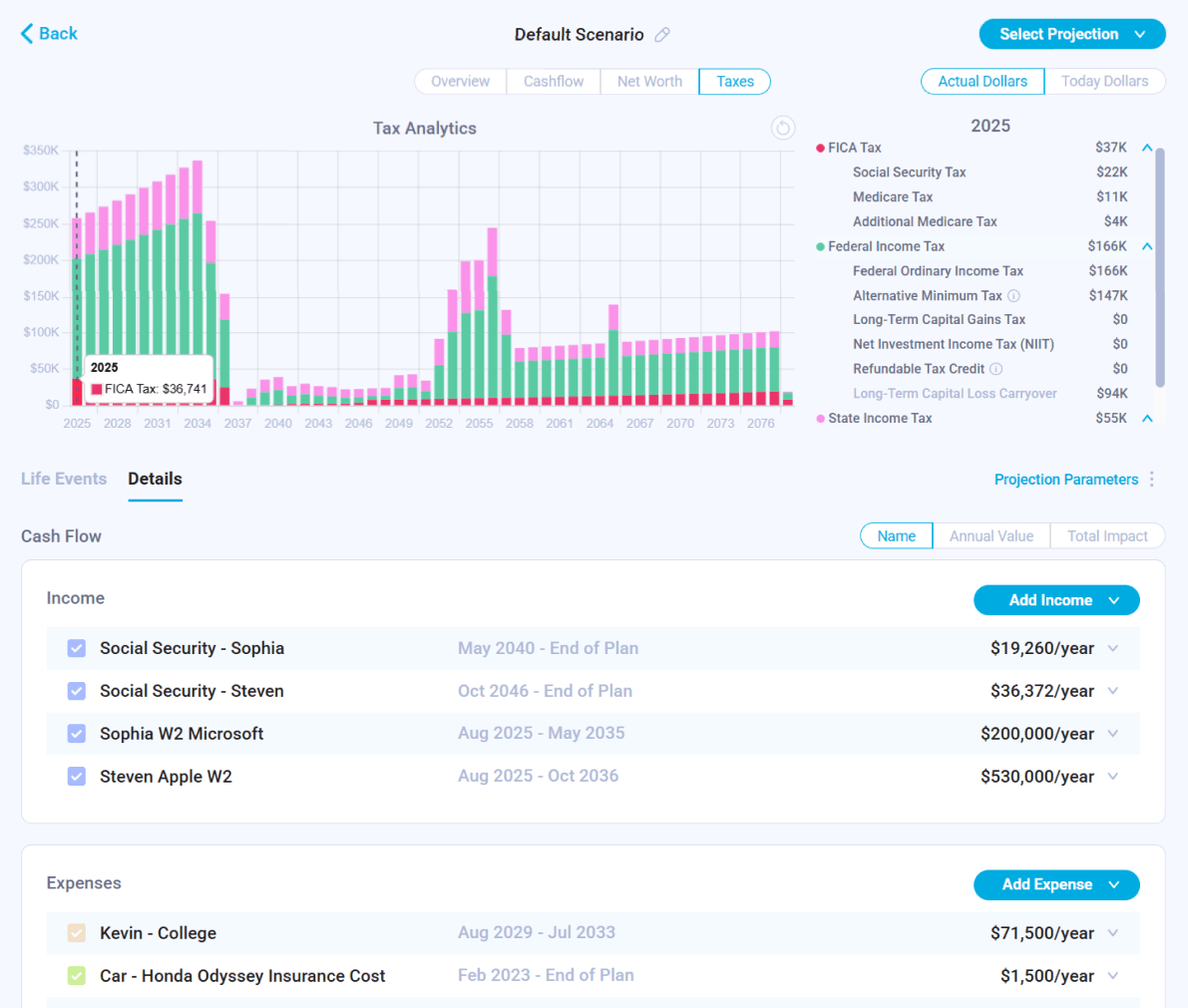
FICA — the Federal Insurance Contributions Act — is the payroll tax that funds Social Security and Medicare. For W-2 employees, it is deducted automatically from every paycheck before you see a dollar. For self-employed workers and consultants, it is collected as the self-employment tax on Schedule SE. FICA is one of the largest tax obligations for working tech employees: a senior engineer earning $400,000 pays over $12,000 in employee-side FICA per year, with another $12,000+ paid invisibly by the employer on their behalf. Understanding how it works, when it stops, and how it interacts with early retirement is essential for accurate financial planning.
The Two Components of FICA
Social Security Tax (OASDI)
The Social Security portion of FICA is 12.4% of wages — split equally between employee (6.2%) and employer (6.2%). However, it only applies up to the Social Security wage base, which adjusts for inflation each year. For 2025, the wage base is $176,100. Every dollar of wages above that threshold is exempt from Social Security tax for the remainder of the calendar year.
For a tech worker earning $300,000, Social Security tax stops being withheld partway through the year once cumulative wages pass $176,100. At that point, take-home pay effectively increases by 6.2% of each additional dollar of wages — a jump that can be noticeable on mid-year paychecks for high earners. RSU vesting events and bonuses that push you past the wage base in a single paycheck produce no Social Security withholding on the amount above the cap.
Medicare Tax (HI)
The Medicare portion of FICA is 2.9% of all wages — again split evenly at 1.45% employee and 1.45% employer. Unlike Social Security, Medicare has no wage base cap. Every dollar of wages, regardless of amount, is subject to Medicare tax. A tech executive earning $2,000,000 in W-2 wages pays 1.45% Medicare tax on all of it.
The Additional Medicare Tax: 0.9% on High Earners
The Affordable Care Act added a 0.9% Additional Medicare Tax on wages above $200,000 (single filers) or $250,000 (married filing jointly). This tax is employee-only — the employer does not match it. It applies to the same wage types as regular Medicare tax: W-2 wages, self-employment income, and Railroad Retirement Board compensation.
The threshold is applied at the individual level by employers — employers must withhold the additional 0.9% on all wages paid to an individual above $200,000 in the calendar year, regardless of the employee's filing status. For a married couple where each spouse earns $180,000, neither employer withholds the Additional Medicare Tax — but the couple's combined wages of $360,000 exceed the $250,000 MFJ threshold by $110,000. The $990 shortfall is reconciled on Form 8959 at tax time. This is a common source of an unexpected balance due for dual-income tech couples.
The full FICA rate summary for 2025:
- Social Security: 6.2% employee + 6.2% employer on wages up to $176,100
- Medicare: 1.45% employee + 1.45% employer on all wages
- Additional Medicare Tax: 0.9% employee-only on wages above $200,000 (single) / $250,000 (MFJ)
- Combined employee-side FICA at the wage base: 7.65% up to the Social Security cap (6.2% + 1.45%), then 1.45%–2.35% above it
Self-Employment Tax: FICA for Consultants and Freelancers
W-2 employees only see the employee half of FICA on their pay stub — the employer quietly pays the matching half as an additional cost of employment. Self-employed individuals, independent contractors, and freelancers pay both halves themselves as the self-employment (SE) tax, reported on Schedule SE.
The SE tax rates mirror FICA:
- Social Security: 12.4% on net self-employment income up to the annual wage base
- Medicare: 2.9% on all net self-employment income
- Additional Medicare Tax: 0.9% on self-employment income above $200,000 (single) / $250,000 (MFJ), combined with any W-2 wages for the threshold calculation
Two partial offsets exist for the self-employed. First, you can deduct half of the SE tax paid from gross income (reducing AGI) — this is the equivalent of the employer's matching contribution being a business expense. Second, self-employed individuals who set up a qualified retirement plan (SEP-IRA, Solo 401k) can deduct retirement contributions from self-employment income, reducing the net earnings subject to SE tax.
The S-Corp Strategy
Because SE tax applies to all net self-employment income, a freelance engineer earning $300,000 from consulting pays SE tax on the full amount — approximately $27,000 in Social Security and Medicare taxes before the deductible half offset. By instead operating through an S-corporation, paying themselves a "reasonable salary" (say $150,000), and taking the remaining $150,000 as an S-corp distribution, FICA applies only to the $150,000 salary. The distribution is not subject to FICA. At meaningful consulting income levels, the SE tax savings can exceed $10,000–$20,000 per year — often worth the administrative cost of maintaining an S-corp. The IRS requires the salary to be "reasonable" for the work performed, and audits S-corps with suspiciously low salaries relative to distributions.
FICA and Early Retirement: When It Stops
One of the underappreciated financial benefits of early retirement is that FICA stops the day you stop receiving W-2 wages or self-employment income. Investment income — dividends, interest, capital gains, rental income — is completely exempt from FICA. A retired engineer living on $200,000 per year from their brokerage account and Roth conversions pays zero FICA. The same person working as an employee would pay $12,000+ in employee-side FICA on that same income if it were wages.
This is a meaningful but often overlooked component of the total tax reduction that comes with early retirement. The marginal effective tax rate comparison between working and retiring includes not just federal and state income taxes but also the 7.65% employee FICA rate (or 15.3% self-employment rate) that disappears entirely in retirement. For a dual-income household where both spouses are below the Social Security wage base, eliminating FICA can reduce total taxes by $25,000–$35,000 per year.
FICA and Social Security Benefit Credits
Every year you pay Social Security tax, you earn up to four Social Security work credits based on your earnings. You need 40 credits (10 years of work) to be eligible for retirement benefits at all. Early retirees who leave the workforce in their 30s or 40s typically have well over 40 credits, so eligibility is not the concern.
The concern for early retirees is benefit amount. Social Security calculates your benefit using the 35 highest-earning years of your career. Every year below 35 years of substantial earnings is filled in with a zero. A tech worker who retires at 40 after 15 working years will have 20 zeros in their benefit calculation, significantly reducing their eventual Social Security benefit compared to someone who works 35 years.
Additionally, the Social Security benefit formula is progressive — it replaces a higher percentage of lower earnings than higher earnings (the "bend points"). Early retirees who had high-income working years but few of them often find their expected Social Security benefit is lower than intuition suggests, because the high earnings only partially offset the zeros from non-working years.
FICA on RSUs, Bonuses, and Supplemental Wages
RSU vesting income and cash bonuses are W-2 wages and fully subject to FICA. The timing of RSU vests relative to the Social Security wage base matters:
- If a large RSU tranche vests early in the calendar year before the wage base is reached, the entire bargain element is subject to 6.2% Social Security tax in addition to Medicare tax and income tax withholding
- If the same tranche vests later in the year after the wage base is already exceeded by salary alone, no Social Security tax applies to the RSU income — only the 1.45% (or 2.35%) Medicare rate
- This is one reason why the timing of large RSU grants relative to salary can meaningfully affect total annual FICA exposure — though for most senior engineers, the wage base is crossed relatively early in the year from salary alone
Common Mistakes With FICA
1. Thinking Investment Income in Retirement Is Subject to FICA
It is not. Dividends, interest, capital gains, rental income, and Roth distributions are all completely exempt from FICA. This is a meaningful feature of retirement income — not just a technical detail. Early retirees sometimes incorrectly model their tax burden in retirement by applying FICA rates to portfolio income. The correct answer is zero FICA on investment income, regardless of amount.
2. Forgetting SE Tax When Modeling Consulting Income in Semi-Retirement
Barista FIRE and semi-retirement strategies often involve ongoing consulting or freelance work. Every dollar of net self-employment income is subject to 15.3% SE tax (up to the wage base) on top of regular income tax. A consultant earning $80,000 in net self-employment income pays approximately $11,300 in SE tax ($80,000 × 14.1% after the deductible-half calculation) before income tax. Not modeling SE tax makes part-time consulting income look much more profitable than it is.
3. Not Accounting for the Dual-Income Additional Medicare Tax Gap
Employers withhold the 0.9% Additional Medicare Tax only after an individual's wages with that employer exceed $200,000. For dual-income couples where each earns below $200,000 but together exceed $250,000, neither employer withholds anything — but the couple owes the tax on the combined amount above $250,000. The shortfall is due at tax time and can generate an unexpected balance due and potential underpayment penalty if quarterly estimates are not adjusted.
4. Treating the Employer's Share as "Free" Money
The employer's matching 7.65% FICA contribution is part of your total compensation cost — employers factor it into the total cost of hiring you. It does not go into your paycheck or your retirement account; it funds the Social Security and Medicare systems on your behalf. Understanding this matters when comparing a W-2 job to a consulting arrangement: a $300,000 W-2 salary costs the employer approximately $322,000 in total compensation cost including the employer FICA match, while a $300,000 consulting contract has no employer match (but the consultant pays both sides as SE tax). The economics are different and worth modeling correctly.
5. Not Understanding the Annual Reset
FICA withholding resets on January 1 every year. Even if you exceeded the Social Security wage base in December and paid no Social Security tax on your final paychecks of the year, the clock restarts in January and Social Security withholding resumes from dollar one of new wages. New year RSU vests, bonuses paid in January, and regular salary all restart the FICA cycle. This is why some employees notice a seemingly lower paycheck in January after a higher December — the Social Security withholding that had stopped mid-year resumes at the beginning of the new year.
Frequently Asked Questions
Model Your Total Tax Burden — Including FICA
Nauma projects your full tax picture across working years and into retirement — showing exactly when FICA drops off, how consulting income triggers self-employment tax, and what your effective rate looks like living off a portfolio.
Get Started for Free