'%3e%3cpath%20d='M136%2043.0521C135.893%2043.4991%20131.298%2041.3697%20123.51%2041.5186C120.787%2041.5712%20109.626%2040.8001%20104.06%2049.4228C101.316%2053.664%20102.266%2056.2491%20100.601%2061.5769C95.2065%2078.8661%2087.7394%2075.1856%2062.5302%2088.5228C54.5058%2092.764%2045.1595%20101.562%2043.5589%20103.087C31.9403%20114.163%2025.1664%20123.189%2025.1521%20123.171C25.1378%20123.162%2034.1912%20104.357%2047.7676%2082.7655C60.6795%2062.2429%2063.8235%2070.0769%2079.7722%2049.1336C81.7015%2046.6011%2084.8526%2037.6805%2089.683%2036.1032C93.6345%2034.815%2098.6148%2036.6114%20100.065%2038.5568C101.044%2039.8712%20101.459%2040.765%20103.831%2040.4408C110.048%2039.5996%20113.613%2039.8625%20115.492%2039.7748C116.95%2039.7047%20119.751%2039.915%20120.509%2039.9939C130.419%2040.9753%20136.15%2042.4563%20136.007%2043.0434L136%2043.0521Z'%20fill='%23127398'/%3e%3cpath%20d='M22.1867%2043.6392C30.3968%2055.0923%2031.5544%2062.348%2040.6506%2068.6923C45.9954%2072.4253%2053.4839%2075.4134%2058.2928%2075.5361C61.9084%2075.6325%2063.7305%2075.2557%2064.6023%2074.949C64.8524%2074.8614%2065.1025%2074.8351%2065.3597%2074.8263L76.0636%2070.6727C76.8068%2066.8871%2076.1637%2063.4784%2076.1065%2063.1892C75.0561%2058.0103%2072.3337%2053.3835%2070.5402%2051.2542C55.4561%2033.3428%2055.8062%2034.298%2046.5814%2028.0237C26.7884%2014.5902%20-1.22192%2021.3464%200.0428309%2022.0562C0.55016%2022.3454%2010.2394%2026.9634%2022.1867%2043.6392Z'%20fill='%23127398'/%3e%3cpath%20d='M79.8366%2044.0161C81.33%2046.4784%2083.4093%2051.5784%2083.7666%2056.8975C83.7952%2057.3094%2084.1667%2064.0393%2080.4654%2068.4733C78.5004%2070.8217%2076.2281%2071.5403%2075.585%2071.7506C61.487%2076.5264%2028.4319%20116.196%2023.3515%20133.494C23.2229%20133.941%2022.6227%20136.026%2022.5655%20136C22.3797%20135.921%2023.5373%20120.753%2028.925%20106.303C28.925%20106.303%2033.7196%2090.5295%2046.7387%2073.9326C49.1896%2070.8042%2052.8052%2067.0362%2052.8052%2067.0362C54.2414%2065.1434%2059.8006%2068.3068%2066.1887%2068.482C69.9401%2068.5872%2073.2198%2067.6846%2073.2055%2067.3604C73.2055%2067.2377%2073.0698%2067.0712%2072.8911%2066.9047C72.3195%2066.3702%2071.5907%2066.1423%2070.8761%2066.2475C69.9758%2066.379%2068.1323%2066.3877%2064.5738%2065.5903C59.8435%2064.5212%2052.8481%2060.096%2048.0534%2055.364C39.9076%2047.3109%2039.7147%2039.9238%2033.1051%2026.9985C23.4944%208.17586%2014.0767%201.32328%2014.0767%201.32328C17.285%20-1.64734%2041.451%20-0.788575%2059.229%2016.3692C67.5177%2024.3697%2067.2962%2023.3619%2079.8366%2044.0073V44.0161Z'%20fill='%23EF9920'/%3e%3c/g%3e%3cdefs%3e%3cclipPath%20id='clip0_882_3310'%3e%3crect%20width='136'%20height='136'%20fill='white'/%3e%3c/clipPath%3e%3c/defs%3e%3c/svg%3e)
Financial Projections
Why Knowing Where You Stand Today Is Not Enough — and How a Projection Helps Families Set Direction
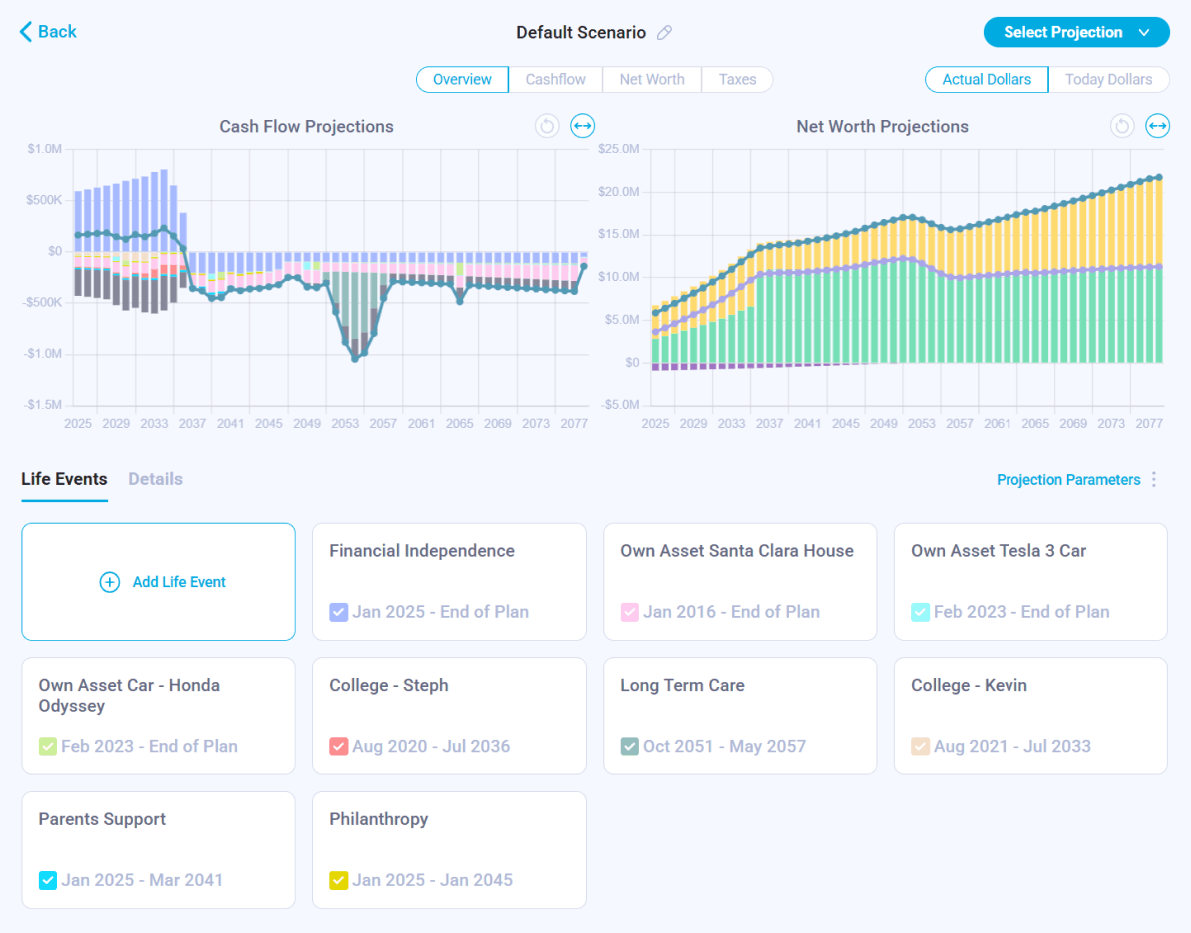
Most people have a reasonable sense of where they stand today — their paycheck, their account balances, what they owe. Far fewer have any idea where they are headed. A current net worth snapshot and a monthly budget are necessary but not sufficient for making the financial decisions that actually matter: when you can afford to retire, whether you can afford to send two children to private college without derailing your retirement, how much risk your portfolio can absorb, or whether you should take equity in a startup instead of a higher base salary.
These decisions cannot be made from a snapshot. They require a projection — a model of how your financial position will evolve over time given your current trajectory, your planned decisions, and reasonable assumptions about the future. Not a prediction. A projection is not a forecast of what will happen; it is a structured way of understanding where your current path leads and what levers you can pull to change it.
The Gap Between a Snapshot and a Decision
A balance sheet tells you what you own and what you owe today. A cash flow statement tells you how much you earn and spend each month. Both are essential foundations. Neither tells you what you actually need to know to make a major financial decision.
Consider a 42-year-old software engineer with $1,800,000 in total net worth — $900,000 in a traditional 401(k), $300,000 in a Roth IRA, $400,000 in a taxable brokerage account, and $200,000 in home equity. She earns $320,000 per year and saves $80,000 annually. Is she on track to retire at 55? Can she afford to take two years off to care for an aging parent? Should she take the job offer with a $50,000 lower base salary but a 0.2% equity stake at a Series B startup?
None of these questions can be answered by looking at today's numbers alone. Each one requires projecting the trajectory — modeling how assets grow, how tax obligations evolve, when income stops and withdrawals begin, and what happens to the overall financial picture under different choices. The snapshot is the starting point. The projection is the map.
What a Financial Projection Actually Models
A meaningful financial projection is not a single-line chart showing account balances growing to a large number. It is a multi-dimensional model that tracks, simultaneously, how different components of a financial plan interact and evolve. The key inputs and outputs:
Income trajectory: Current earned income, expected raises or promotions, RSU vesting schedules, bonus patterns, and the eventual transition from earned income to retirement withdrawals. For someone mid-career with active equity vesting, the income picture over the next five years looks very different from year-to-year salary alone.
Savings and contributions: Annual contributions to each account type — 401(k) pre-tax, Roth IRA, HSA, taxable brokerage — and how they change as income changes. A projection that assumes flat contributions misses the compounding effect of increasing contributions during peak earning years.
Spending in accumulation and retirement: Current household spending, how it changes over time (children's costs, mortgage payoff, healthcare costs rising after 65), and the retirement spending level the household is actually targeting. Most projections use a single retirement spending number; better projections model spending as a curve — higher in early active retirement, potentially lower in mid-retirement, rising again in late life for healthcare.
Portfolio growth: Investment returns applied to each account, net of fees, using assumptions calibrated to the actual asset allocation. A 100% equity portfolio has a different expected return and variance than a 60/40 portfolio. Returns should be modeled in real (inflation-adjusted) terms or with explicit inflation assumptions, not nominal terms that flatter the numbers.
Tax obligations at every stage: Federal and state income taxes during accumulation; taxes on capital gains realizations; taxes on retirement withdrawals from traditional accounts; Medicare IRMAA surcharges triggered by high retirement income; taxes on Social Security benefits when combined income exceeds thresholds. Tax is often the largest single line item in a retirement budget and the one most commonly omitted from projections.
Major life events: Planned purchases, college funding, mortgage payoff, business sale, inheritance, or other lump-sum events that materially change the trajectory. A projection that ignores a planned $200,000 college expense in year seven is not modeling the household's actual financial life.
Projections Set Direction and Articulate Preferences
The most valuable thing a financial projection does is not produce a number — it is force explicit choices. A projection without decisions baked in is just extrapolation. A projection with specific decisions modeled reveals the cost and consequence of each one, which is where real financial planning begins.
When a family sits down with a projection that extends 30 years into the future, they are not trying to predict the future. They are answering questions like:
- What do we actually want retirement to look like? Retiring at 58 versus 62 looks like four years on a calendar, but in a projection it often represents $600,000–$1,000,000 in additional required portfolio size — or a significantly lower sustainable spending level. Seeing that tradeoff quantified changes the conversation from abstract preference to concrete prioritization.
- How much risk can we actually afford to take? A projection that stress-tests the plan against a 30% market decline in year two of retirement reveals whether the household has true margin or is running close to the edge. Risk tolerance is not just a questionnaire — it is a function of how much buffer the projection shows.
- Which financial decisions are actually consequential? Families often worry about the wrong things — optimizing a 0.05% expense ratio difference while ignoring a $200,000 Roth conversion opportunity. A projection quantifies the impact of different decisions and makes the hierarchy of priorities visible.
- What would we give up, and what would we protect? When a projection shows a tight retirement path, the question becomes which spending categories are non-negotiable and which are flexible. This is not a financial question — it is a values question, and the projection gives it concrete stakes.
A projection is a shared language for financial decision-making within a household. It makes implicit assumptions explicit and gives both partners a common reference point for discussing tradeoffs that might otherwise feel abstract or contentious.
Tax Analytics: The Component Most Projections Get Wrong
The most common failure in financial projections — including those produced by many financial planning software tools — is inadequate tax modeling. A projection that shows pre-tax account balances growing to $4,000,000 without modeling the tax obligation embedded in those balances is not showing you your retirement wealth. It is showing you a number that overstates your actual spending power by 25–40%.
A projection with meaningful tax analytics models taxes at every stage:
During accumulation: The tax savings from pre-tax 401(k) contributions reduce current-year tax liability. The tax cost of Roth contributions is paid upfront. Both affect annual cash flow and therefore actual savings capacity. A projection that ignores these effects mismodels how much is actually available to save each year.
During Roth conversion windows: The years between retirement and age 73 — when Required Minimum Distributions begin — are often the lowest-income years of a high earner's life, creating an opportunity to convert traditional IRA funds to Roth at a lower marginal rate than was paid during accumulation. A good projection identifies the size of this window, quantifies the tax cost of conversion in each year, and shows the long-term benefit in reduced RMDs and lower lifetime tax paid.
On capital gains realizations: Each sale of appreciated securities in a taxable account triggers a capital gains tax event. A projection that models planned liquidations — to fund college, a home purchase, or early retirement spending — shows the tax cost of those liquidations and identifies whether timing adjustments (harvesting in a low-income year, donating appreciated shares to a DAF instead) would reduce the bill.
On retirement withdrawals: Distributions from traditional 401(k) and IRA accounts are ordinary income. In retirement, this income stacks on top of Social Security, capital gains distributions, and any other income — potentially pushing the household into a higher bracket than expected, triggering Medicare IRMAA surcharges, or causing up to 85% of Social Security benefits to become taxable. A projection that shows these interactions catches planning problems before they become expensive surprises.
On Required Minimum Distributions: A large traditional IRA or 401(k) balance generates mandatory distributions starting at age 73, whether or not the money is needed for living expenses. For high savers who accumulated $2,000,000–$4,000,000 in pre-tax accounts, RMDs can force six-figure ordinary income in their 70s — pushing them into high tax brackets, triggering IRMAA, and making Social Security mostly taxable. A projection shows the RMD trajectory years in advance, when Roth conversion and other mitigation strategies are still available.
Account Balance Mix: How the Taxable / Tax-Deferred / Tax-Free Ratio Changes Over Time
One of the most illuminating outputs of a long-term financial projection is the evolution of the account balance mix across the three tax buckets. This ratio — how much of your wealth sits in taxable, tax-deferred (traditional), and tax-free (Roth/HSA) accounts — has enormous implications for retirement tax planning, withdrawal flexibility, and estate value.
For most high-income earners who have prioritized pre-tax 401(k) contributions throughout their career, the mix at retirement is heavily skewed toward tax-deferred: perhaps 60–75% in traditional accounts, 15–25% in taxable, and 10–20% in Roth. This is the mix that generates large RMDs, high effective tax rates in retirement, and IRMAA surcharges — even for households with modest lifestyle spending.
A projection that tracks the account mix over time makes this problem visible before retirement. It shows:
- How the mix evolves under the current strategy. If contributions continue going primarily to pre-tax accounts and no Roth conversions are planned, the traditional account share will likely grow as a percentage of total wealth — worsening the RMD problem over time.
- What happens under a Roth conversion strategy. Converting $100,000–$200,000 per year from traditional to Roth in a low-income window after retirement but before RMDs begin shifts the mix meaningfully. The projection shows how many years of conversion are needed to reach a target Roth/traditional ratio, and what the tax cost is each year.
- How withdrawals should be sequenced. In early retirement, drawing from taxable accounts (spending down low-basis positions while managing capital gains) while traditional accounts continue to grow tax-deferred may be optimal — until the Roth conversion window opens. Later, coordinating between Roth and traditional withdrawals to stay in a target tax bracket requires knowing the balance in each bucket at each point in time.
- The estate value implications of each mix. Roth IRA assets inherited by non-spouse beneficiaries must be distributed within 10 years but are tax-free. Traditional IRA assets must also be distributed within 10 years but generate ordinary income tax on every dollar. A large traditional IRA left to children in high income years is materially less valuable than the same balance in a Roth account. A projection that extends through the estate shows this difference in dollar terms.
The account mix is not a set-it-and-forget-it allocation — it is something to actively manage over decades, and a long-term projection is the tool that makes that management possible.
The Case for Conservative Assumptions
Financial projections are only as reliable as their assumptions. Optimistic assumptions feel good and are easy to present, but they produce plans that fail in conditions that are entirely plausible. Conservative assumptions produce plans with margin — and margin is what financial resilience actually looks like.
The assumptions that matter most:
Investment returns: The long-run real return on a diversified equity portfolio has historically been approximately 6–7% per year. Many projections use 7–8% nominal — which sounds similar but embeds an assumption that inflation will average only 1–2%. A conservative projection uses 5–6% real returns (approximately 7–8% nominal at 2–3% inflation) for an equity-heavy portfolio, and lower for a balanced or conservative allocation. Using 10% nominal returns — which some projections do — is an assumption that has been true in specific historical periods but is widely considered optimistic as a planning baseline.
Inflation: Healthcare costs for retirees inflate at 5–6% annually — significantly faster than general consumer inflation. A projection that applies a flat 2–3% inflation assumption to all spending understates the real cost of healthcare in late retirement. Better projections apply separate inflation rates to different spending categories.
Retirement duration: Planning to age 90 feels conservative; planning to age 95 or 100 is more conservative still. Life expectancy tables are averages — by definition, half of people live longer. For a couple, the probability that at least one person lives to 90 is over 50%. Building a plan around a 30-year retirement horizon rather than 25 is a meaningful margin of safety, not overcaution.
Social Security: Current Social Security projections assume no change in benefits. The program faces a projected funding shortfall that, if unaddressed, would require a roughly 20–25% benefit cut around 2035. Conservative projections apply a haircut — modeling 75–80% of the projected Social Security benefit — to avoid a plan that fails if Congress makes benefit adjustments.
Tax rates: Current federal income tax rates are scheduled to revert in 2026 to pre-TCJA levels for most brackets. Projecting current rates forward indefinitely assumes no legislative change over a 30-year period — an assumption with essentially no historical support. Conservative projections plan for tax rates that are at least as high as, and potentially higher than, today's.
The purpose of conservative assumptions is not pessimism — it is to identify a plan that works even when things do not go perfectly. If the plan works under conservative assumptions, good outcomes (higher returns, lower inflation, better-than-expected Social Security) create upside. If the plan only works under optimistic assumptions, the first deviation from expectations creates a problem.
What a Projection Cannot Do
A financial projection is a powerful planning tool, but it has real limits that matter.
A projection cannot predict the future. It cannot know what markets will return next year, what inflation will average over the next decade, or what tax legislation will look like in 2040. Anyone who presents a projection as a reliable forecast of a specific outcome is misrepresenting what projections do. The output of a projection is a range of plausible outcomes under stated assumptions — not a predicted account balance on a specific date.
A projection cannot substitute for judgment. The assumptions embedded in a projection encode implicit views about the future. The choice of return assumptions, inflation rates, spending levels, and life expectancy all reflect judgments that can be reasonable or unreasonable, disclosed or hidden. A projection produced by software that uses default assumptions you have never reviewed may not reflect your actual situation or preferences at all.
A projection also cannot account for the decisions you have not yet made. A 30-year projection assumes some version of a stable future path. In reality, careers change, relationships change, health changes, values change. A projection should be revisited and updated regularly — annually at minimum, and whenever a significant life event changes the inputs. It is a living document, not a one-time calculation.
What a projection can do — and does uniquely well — is make the consequences of your current trajectory visible before you arrive at them, and quantify the impact of decisions before you make them. That combination of foresight and specificity is what distinguishes financial planning from financial hope.
Frequently Asked Questions
See Where Your Financial Path Actually Leads
Nauma builds a personalized 30-year projection — tax analytics, account mix evolution, Roth conversion windows, and retirement income modeling — so you can make major decisions with a complete picture, not just today's numbers.
Get Started for Free