'%3e%3cpath%20d='M136%2043.0521C135.893%2043.4991%20131.298%2041.3697%20123.51%2041.5186C120.787%2041.5712%20109.626%2040.8001%20104.06%2049.4228C101.316%2053.664%20102.266%2056.2491%20100.601%2061.5769C95.2065%2078.8661%2087.7394%2075.1856%2062.5302%2088.5228C54.5058%2092.764%2045.1595%20101.562%2043.5589%20103.087C31.9403%20114.163%2025.1664%20123.189%2025.1521%20123.171C25.1378%20123.162%2034.1912%20104.357%2047.7676%2082.7655C60.6795%2062.2429%2063.8235%2070.0769%2079.7722%2049.1336C81.7015%2046.6011%2084.8526%2037.6805%2089.683%2036.1032C93.6345%2034.815%2098.6148%2036.6114%20100.065%2038.5568C101.044%2039.8712%20101.459%2040.765%20103.831%2040.4408C110.048%2039.5996%20113.613%2039.8625%20115.492%2039.7748C116.95%2039.7047%20119.751%2039.915%20120.509%2039.9939C130.419%2040.9753%20136.15%2042.4563%20136.007%2043.0434L136%2043.0521Z'%20fill='%23127398'/%3e%3cpath%20d='M22.1867%2043.6392C30.3968%2055.0923%2031.5544%2062.348%2040.6506%2068.6923C45.9954%2072.4253%2053.4839%2075.4134%2058.2928%2075.5361C61.9084%2075.6325%2063.7305%2075.2557%2064.6023%2074.949C64.8524%2074.8614%2065.1025%2074.8351%2065.3597%2074.8263L76.0636%2070.6727C76.8068%2066.8871%2076.1637%2063.4784%2076.1065%2063.1892C75.0561%2058.0103%2072.3337%2053.3835%2070.5402%2051.2542C55.4561%2033.3428%2055.8062%2034.298%2046.5814%2028.0237C26.7884%2014.5902%20-1.22192%2021.3464%200.0428309%2022.0562C0.55016%2022.3454%2010.2394%2026.9634%2022.1867%2043.6392Z'%20fill='%23127398'/%3e%3cpath%20d='M79.8366%2044.0161C81.33%2046.4784%2083.4093%2051.5784%2083.7666%2056.8975C83.7952%2057.3094%2084.1667%2064.0393%2080.4654%2068.4733C78.5004%2070.8217%2076.2281%2071.5403%2075.585%2071.7506C61.487%2076.5264%2028.4319%20116.196%2023.3515%20133.494C23.2229%20133.941%2022.6227%20136.026%2022.5655%20136C22.3797%20135.921%2023.5373%20120.753%2028.925%20106.303C28.925%20106.303%2033.7196%2090.5295%2046.7387%2073.9326C49.1896%2070.8042%2052.8052%2067.0362%2052.8052%2067.0362C54.2414%2065.1434%2059.8006%2068.3068%2066.1887%2068.482C69.9401%2068.5872%2073.2198%2067.6846%2073.2055%2067.3604C73.2055%2067.2377%2073.0698%2067.0712%2072.8911%2066.9047C72.3195%2066.3702%2071.5907%2066.1423%2070.8761%2066.2475C69.9758%2066.379%2068.1323%2066.3877%2064.5738%2065.5903C59.8435%2064.5212%2052.8481%2060.096%2048.0534%2055.364C39.9076%2047.3109%2039.7147%2039.9238%2033.1051%2026.9985C23.4944%208.17586%2014.0767%201.32328%2014.0767%201.32328C17.285%20-1.64734%2041.451%20-0.788575%2059.229%2016.3692C67.5177%2024.3697%2067.2962%2023.3619%2079.8366%2044.0073V44.0161Z'%20fill='%23EF9920'/%3e%3c/g%3e%3cdefs%3e%3cclipPath%20id='clip0_882_3310'%3e%3crect%20width='136'%20height='136'%20fill='white'/%3e%3c/clipPath%3e%3c/defs%3e%3c/svg%3e)
What Is HEMS?
Health, Education, Maintenance, and Support — How the HEMS Standard Defines Trustee Discretion and Protects Estates from Tax
HEMS stands for Health, Education, Maintenance, and Support — a four-part legal standard that defines the boundaries within which a trustee may make discretionary distributions to a beneficiary. When a trust document gives the trustee authority to distribute funds "for the health, education, maintenance, and support" of a beneficiary, that phrase is not casual language. It is a term of art drawn directly from the Internal Revenue Code, with specific legal and tax consequences that flow from its use. Understanding HEMS matters for any tech worker who is a beneficiary of a trust, who has named a trustee to manage assets for a family member, or who is creating an estate plan that will hold substantial IRA, brokerage, or real estate assets for the next generation.
The HEMS standard sits at the intersection of trust law and federal tax law. Used correctly, it gives trustees meaningful flexibility to provide for beneficiaries while simultaneously shielding trust assets from estate taxation. Used incorrectly — or misunderstood by the trustee — it can expose those same assets to estate tax or generate distributions that defeat the purpose of the trust structure entirely.
The Four Categories: What Each One Covers
Health includes medical and dental expenses not covered by insurance, health insurance premiums, long-term care costs, prescription drugs, mental health treatment, and physical therapy. It does not require that expenses be medically necessary in a clinical sense — reasonable health-related costs within the beneficiary's accustomed standard of living generally qualify. For a beneficiary managing a serious illness or disability, health distributions are often the largest and most frequent category.
Education covers tuition at any level — K–12, undergraduate, graduate, and professional education — as well as related expenses such as room and board, books, and reasonable living expenses during enrollment. It also extends to vocational training, tutoring, and in some trust instruments, to education-related technology and travel. A trustee distributing funds for a beneficiary's MBA program, for example, is comfortably within the education prong of HEMS.
Maintenance is the broadest and most frequently litigated of the four categories. It refers to the beneficiary's ongoing cost of living — housing, utilities, food, clothing, transportation, and the general expenses of maintaining a reasonable standard of living. The critical qualifier is that "maintenance" is measured against the beneficiary's accustomed standard of living at the time the trust was created, not an absolute floor. A beneficiary who lived in a $4,000/month apartment before becoming the trust beneficiary has a different HEMS baseline than one who lived in a $1,200/month apartment. This context-sensitivity is both the flexibility and the complexity of the standard.
Support overlaps significantly with maintenance but tends to cover ongoing financial obligations — support payments, dependent care, and costs associated with supporting people who depend on the beneficiary. In practice, many trust instruments use "maintenance and support" as a paired phrase, treating the two as functionally interchangeable for most distributions.
Why HEMS Is an IRS Ascertainable Standard — and Why That Matters
The reason HEMS has become the dominant distribution standard in estate planning is not primarily about what it allows trustees to pay — it is about what it prevents for estate tax purposes.
Under IRC Section 2041, a person who holds a general power of appointment over trust assets — the unrestricted ability to demand that the trust pay them any amount for any reason — is treated as owning those assets for federal estate tax purposes. This means the trust assets would be included in their taxable estate at death, potentially triggering estate tax at the top 40% federal rate. A poorly drafted trust that gives a beneficiary unlimited withdrawal rights can inadvertently include millions of dollars of trust assets in the beneficiary's estate.
HEMS solves this problem because it qualifies as an ascertainable standard under the IRC. A power to demand distributions only for health, education, maintenance, and support is limited enough — the standard is defined by reference to an objective external measure — that it does not constitute a general power of appointment. Assets subject to a HEMS-limited power are not included in the beneficiary's taxable estate, even if the beneficiary is also serving as their own trustee. This is the core estate planning function of HEMS: it allows a beneficiary to have meaningful access to trust funds without triggering estate inclusion.
For a tech worker with a $15 million estate (the 2026 federal exemption is $15 million per person, indexed for inflation going forward under the One Big Beautiful Bill Act — see Estate Tax Exemption for the full mechanics, including portability and why this figure is now permanent), this distinction may not yet be relevant at the federal level. But for estates approaching or exceeding that threshold — or for families in states with lower estate tax exemptions, such as Oregon ($1 million) or Massachusetts ($2 million) — the difference between a HEMS-limited and an unlimited distribution standard can be worth millions of dollars.
HEMS in the Context of a Special Needs Trust
HEMS plays a specific and important role in special needs trusts (SNTs). A third-party SNT is typically drafted to give the trustee discretionary authority over distributions — meaning the trustee decides whether and how much to distribute, guided by the trust's stated purpose. The trust language deliberately restricts distributions to supplemental needs rather than basic support, to preserve the beneficiary's eligibility for SSI and Medicaid.
However, the HEMS standard is generally not used as the distribution standard in a special needs trust, precisely because it is too broad. A trustee authorized to distribute for "maintenance and support" could — and technically should — pay for housing, food, and basic living expenses. Those payments would reduce or eliminate SSI benefits under the in-kind support and maintenance rules. A well-drafted SNT uses more restrictive language than HEMS, limiting the trustee to supplemental and discretionary distributions that do not duplicate government benefits.
The HEMS standard is most commonly found in trusts created for beneficiaries who are not receiving means-tested government benefits — children who will eventually inherit assets outright, surviving spouses, or other family members for whom the goal is flexible access combined with estate tax protection.
See What Is a Special Needs Trust (SNT)? for a full discussion of SNT distribution standards and how they differ from HEMS.
Practical Examples of HEMS Distributions
What does a trustee actually approve under HEMS? The standard is deliberately flexible — it is calibrated to the beneficiary's circumstances, not a fixed dollar list. Some examples that typically fall within HEMS:
Clearly within HEMS: Monthly rent or mortgage payments on the beneficiary's primary residence. Health insurance premiums and out-of-pocket medical costs. Tuition and living expenses for a child in college. Grocery and utility bills. Routine vehicle costs for a car the beneficiary drives daily. Mental health therapy. Long-term care facility costs for an aging beneficiary.
In the gray zone: A vacation home maintained for the beneficiary's use. Private school tuition for the beneficiary's children (some trustees approve this under "education" or "support," others do not). Travel expenses beyond ordinary commuting. Home renovations that exceed basic maintenance.
Generally outside HEMS: Gifts to third parties. Business investments on behalf of the beneficiary. Payments to satisfy debts not related to the beneficiary's living expenses. Luxury purchases that exceed the beneficiary's historical standard of living by a wide margin.
The gray zone is where trustee judgment — and potential disputes — arise. A trustee who consistently approves distributions well outside the standard creates legal exposure. A trustee who applies the standard too narrowly may fail to adequately provide for the beneficiary and face a different kind of liability. Many trust instruments include additional guidance, a statement of intent from the grantor, or provisions for a trust protector who can clarify the standard when disputes arise.
The Trustee's Fiduciary Duty Under HEMS
A trustee administering a HEMS-standard trust is not a passive check-writer. The trustee has a fiduciary duty to apply the standard in good faith, treating all current and remainder beneficiaries equitably. This creates an inherent tension: distributions to the current beneficiary reduce what passes to the remainder beneficiaries (typically the beneficiary's children or other heirs). A trustee who distributes too generously may benefit the current beneficiary at the expense of future ones. A trustee who distributes too conservatively may fail to meet the standard.
When a family member serves as trustee — which is common in smaller or mid-sized trusts — this tension can become personal. A parent serving as trustee for their own trust, or a sibling serving as trustee for another sibling, faces the HEMS standard with family relationships layered on top of legal obligations. This is one of the reasons professional trustees and private fiduciaries are often recommended for trusts where distributions are expected to be substantial or contentious.
HEMS and the Surviving Spouse: Marital Trusts and the Estate Tax
One of the most common applications of the HEMS standard is in marital trusts — trusts created for a surviving spouse after the first spouse's death. In a typical bypass trust or credit shelter trust structure, the surviving spouse is the primary beneficiary and may also serve as trustee. The trust holds assets up to the estate tax exemption amount, and distributions are limited to HEMS.
The HEMS limitation on the surviving spouse's access is what keeps the trust assets outside the surviving spouse's taxable estate. If the surviving spouse had an unlimited right to withdraw the trust assets, those assets would be included in their estate at death. By limiting access to HEMS, the trust preserves the estate tax benefit of the bypass structure — the assets pass to children or other remainder beneficiaries without being taxed again in the surviving spouse's estate.
For a tech couple with combined assets of $20–30 million, this trust structure — and the HEMS standard that makes it work — can protect several million dollars of assets from the 40% federal estate tax. The math is straightforward: a $5 million bypass trust that avoids estate taxation saves $2 million in federal estate tax at the top rate. The HEMS standard is the legal mechanism that makes the bypass trust work.
Frequently Asked Questions
Model Your Estate Plan
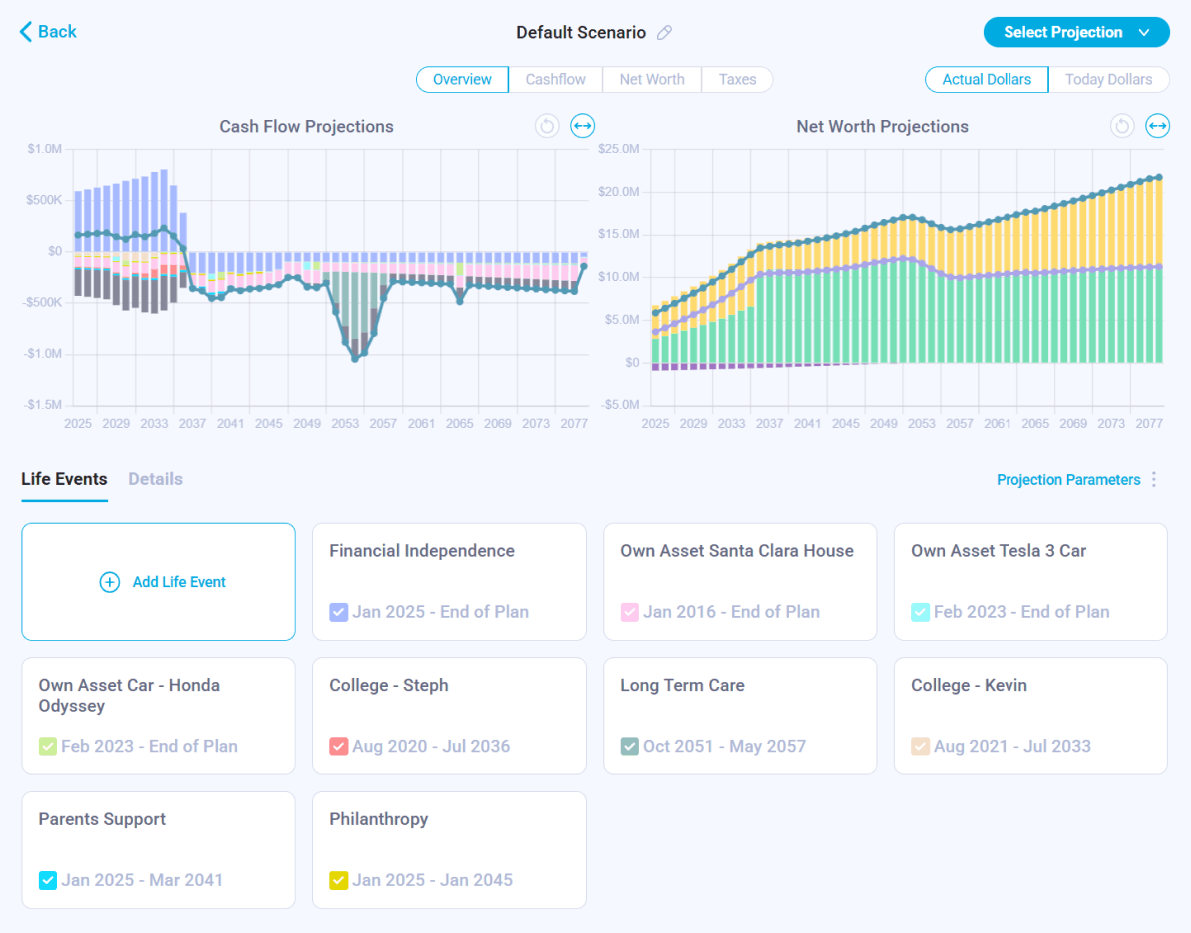
Nauma's financial projections model trust structures, estate tax exposure, and long-term wealth transfer — including how bypass trusts and HEMS distributions interact with your overall retirement picture.
Get Started for Free