'%3e%3cpath%20d='M136%2043.0521C135.893%2043.4991%20131.298%2041.3697%20123.51%2041.5186C120.787%2041.5712%20109.626%2040.8001%20104.06%2049.4228C101.316%2053.664%20102.266%2056.2491%20100.601%2061.5769C95.2065%2078.8661%2087.7394%2075.1856%2062.5302%2088.5228C54.5058%2092.764%2045.1595%20101.562%2043.5589%20103.087C31.9403%20114.163%2025.1664%20123.189%2025.1521%20123.171C25.1378%20123.162%2034.1912%20104.357%2047.7676%2082.7655C60.6795%2062.2429%2063.8235%2070.0769%2079.7722%2049.1336C81.7015%2046.6011%2084.8526%2037.6805%2089.683%2036.1032C93.6345%2034.815%2098.6148%2036.6114%20100.065%2038.5568C101.044%2039.8712%20101.459%2040.765%20103.831%2040.4408C110.048%2039.5996%20113.613%2039.8625%20115.492%2039.7748C116.95%2039.7047%20119.751%2039.915%20120.509%2039.9939C130.419%2040.9753%20136.15%2042.4563%20136.007%2043.0434L136%2043.0521Z'%20fill='%23127398'/%3e%3cpath%20d='M22.1867%2043.6392C30.3968%2055.0923%2031.5544%2062.348%2040.6506%2068.6923C45.9954%2072.4253%2053.4839%2075.4134%2058.2928%2075.5361C61.9084%2075.6325%2063.7305%2075.2557%2064.6023%2074.949C64.8524%2074.8614%2065.1025%2074.8351%2065.3597%2074.8263L76.0636%2070.6727C76.8068%2066.8871%2076.1637%2063.4784%2076.1065%2063.1892C75.0561%2058.0103%2072.3337%2053.3835%2070.5402%2051.2542C55.4561%2033.3428%2055.8062%2034.298%2046.5814%2028.0237C26.7884%2014.5902%20-1.22192%2021.3464%200.0428309%2022.0562C0.55016%2022.3454%2010.2394%2026.9634%2022.1867%2043.6392Z'%20fill='%23127398'/%3e%3cpath%20d='M79.8366%2044.0161C81.33%2046.4784%2083.4093%2051.5784%2083.7666%2056.8975C83.7952%2057.3094%2084.1667%2064.0393%2080.4654%2068.4733C78.5004%2070.8217%2076.2281%2071.5403%2075.585%2071.7506C61.487%2076.5264%2028.4319%20116.196%2023.3515%20133.494C23.2229%20133.941%2022.6227%20136.026%2022.5655%20136C22.3797%20135.921%2023.5373%20120.753%2028.925%20106.303C28.925%20106.303%2033.7196%2090.5295%2046.7387%2073.9326C49.1896%2070.8042%2052.8052%2067.0362%2052.8052%2067.0362C54.2414%2065.1434%2059.8006%2068.3068%2066.1887%2068.482C69.9401%2068.5872%2073.2198%2067.6846%2073.2055%2067.3604C73.2055%2067.2377%2073.0698%2067.0712%2072.8911%2066.9047C72.3195%2066.3702%2071.5907%2066.1423%2070.8761%2066.2475C69.9758%2066.379%2068.1323%2066.3877%2064.5738%2065.5903C59.8435%2064.5212%2052.8481%2060.096%2048.0534%2055.364C39.9076%2047.3109%2039.7147%2039.9238%2033.1051%2026.9985C23.4944%208.17586%2014.0767%201.32328%2014.0767%201.32328C17.285%20-1.64734%2041.451%20-0.788575%2059.229%2016.3692C67.5177%2024.3697%2067.2962%2023.3619%2079.8366%2044.0073V44.0161Z'%20fill='%23EF9920'/%3e%3c/g%3e%3cdefs%3e%3cclipPath%20id='clip0_882_3310'%3e%3crect%20width='136'%20height='136'%20fill='white'/%3e%3c/clipPath%3e%3c/defs%3e%3c/svg%3e)
What Is a Mega Backdoor Roth?
How to move up to $47,500 per year — before employer match — into tax-free growth through your 401(k)
The standard backdoor Roth IRA moves $7,500 per year into tax-free growth — a meaningful amount, but modest relative to the balances tech workers accumulate over a career. The mega backdoor Roth operates on a different scale entirely: using a feature inside your 401(k) plan, it can move up to $47,500 per year into a Roth account, more than six times the standard backdoor limit.
For senior tech workers trying to accelerate toward financial independence, the mega backdoor Roth is one of the most powerful tools available — when your plan supports it.
Why the Mega Backdoor Roth Exists
The IRS sets two separate 401(k) limits each year:
- Employee elective deferral limit: $24,500 in 2026 — this is the amount you can contribute as pre-tax or Roth contributions through payroll
- Total plan limit (Section 415): $72,000 in 2026 — this is the ceiling for all contributions combined: employee deferrals, employer match, and after-tax contributions
The gap between these two numbers is the opportunity. If your employer contributes $8,000 in matching, your total so far is $32,500 ($24,500 + $8,000) — leaving $39,500 of unused space under the $72,000 ceiling. Some 401(k) plans allow employees to fill that gap with after-tax contributions — money you have already paid income tax on, similar to a non-deductible IRA contribution.
By itself, after-tax contributions inside a 401(k) are not particularly useful — the growth is taxable when withdrawn. But when your plan also allows those after-tax contributions to be converted to Roth — either through an in-plan Roth conversion or an in-service withdrawal to a Roth IRA — the result is that after-tax money becomes permanently tax-free. That is the mega backdoor Roth.
The 2026 Numbers
| Contribution type | 2026 limit |
|---|---|
| Employee elective deferrals (pre-tax + Roth) | $24,500 |
| Catch-up (age 50+) | $8,000 |
| Catch-up (ages 60–63, SECURE 2.0) | $11,250 |
| Total plan limit (Section 415) | $72,000 |
| Maximum after-tax contribution (assuming $8,000 employer match)* | $39,500 |
| Maximum after-tax contribution (assuming $0 employer match)* | $47,500 |
* Maximum available space before employer match is applied. Your actual limit = $72,000 − $24,500 − employer match.
A 2026 Rule Change That Affects High Earners: Mandatory Roth Catch-Up
Starting in 2026, SECURE 2.0 introduces a significant change for higher-earning employees. If your prior-year W-2 compensation from the same employer exceeded $150,000, your catch-up contributions — the $8,000 (or $11,250 for ages 60–63) above the standard $24,500 limit — must be made as Roth contributions. You can no longer make catch-up contributions on a pre-tax basis.
This rule applies per employer, based on your W-2 wages from the previous year. It does not affect your regular $24,500 elective deferral — only the catch-up portion.
What this means in practice: For most senior tech workers earning well above $150,000, catch-up contributions in 2026 automatically go into the Roth bucket. This is actually favorable from a long-term tax perspective — you pay tax now on the catch-up amount, and that money grows and withdraws tax-free. But it does mean less flexibility to reduce current-year taxable income through pre-tax deferrals.
If your plan was not updated to support this requirement, the IRS provided transition relief — but by 2026 most major plan administrators have implemented the change.
The actual amount available for after-tax contributions depends on your employer match. The more your employer contributes, the less room remains under the $72,000 ceiling. A company with a generous 6% match on a $300,000 salary adds $18,000 — leaving $29,500 for after-tax contributions.
How It Works: Step by Step
Step 1: Confirm your plan allows after-tax contributions
Not all 401(k) plans support this. The plan document — specifically the Summary Plan Description (SPD) — will state whether after-tax contributions beyond the standard deferral limit are permitted. If you cannot find it, ask your HR or benefits team directly: "Does our 401(k) plan allow after-tax contributions beyond the $24,500 elective deferral limit?"
Step 2: Confirm your plan allows in-plan Roth conversions or in-service withdrawals
After-tax contributions alone are not enough — you also need a way to move them into Roth. There are two mechanisms:
- In-plan Roth conversion: Your plan allows you to convert after-tax 401(k) balances to a Roth 401(k) within the same plan. Most modern plans that support the mega backdoor Roth use this method.
- In-service withdrawal: Your plan allows you to roll after-tax balances out to a Roth IRA while still employed. Less common, but available at some employers.
If your plan only allows after-tax contributions but not conversion or withdrawal, you are stuck with taxable growth — the mega backdoor does not work.
Step 3: Set your after-tax contribution amount
In your 401(k) portal, set your after-tax contribution rate separately from your pre-tax or Roth deferral. This is usually a separate election, not the same field as your standard contribution percentage.
Step 4: Convert immediately
After-tax contributions that sit in the plan accumulate earnings — and those earnings are pre-tax and taxable at conversion. To keep things clean, convert to Roth as soon as possible after each contribution. Many plans allow automatic in-plan Roth conversions; if yours does, enable it. If not, convert manually on a regular cadence — monthly or with each paycheck.
Step 5: Report correctly at tax time
Your plan will issue a Form 1099-R showing the conversion. Because the after-tax contributions have no additional tax owed at conversion (you already paid income tax on that money), the taxable amount should be close to zero — only the small amount of earnings accumulated before conversion is taxable. Keep records of your after-tax contribution basis in case you need to reconcile at tax time.
Which Plans Support It
The mega backdoor Roth is available at many large tech companies, but not universally. Support depends on the plan document, not the company size or prestige.
Generally supported at many large tech employers including Google, Meta, Microsoft, and Amazon — but plan details change and you should always verify with your current plan documents rather than relying on general reputation.
How to check your own plan:
- Log into your 401(k) portal and look for a contribution election page — if you see an "after-tax" option separate from pre-tax and Roth, the plan likely supports it
- Download your Summary Plan Description from the portal or HR portal and search for "after-tax contributions" and "in-plan Roth conversion"
- Call your plan administrator — Fidelity, Vanguard, Schwab, or whoever administers your plan — and ask directly
Mega Backdoor Roth vs. Standard Backdoor Roth
| Standard Backdoor Roth | Mega Backdoor Roth | |
|---|---|---|
| Account used | Traditional IRA → Roth IRA | 401(k) after-tax → Roth |
| 2026 annual limit | $7,500 ($8,600 if 50+) | Up to $47,500 (varies by employer match) |
| Income limit | None | None |
| Plan requirement | No employer plan needed | Requires employer plan support |
| Pro-rata rule | Applies if you hold pre-tax IRA balances | Does not apply |
| Who benefits most | Any high earner above Roth IRA income limit | High earners with a supportive 401(k) plan |
These two strategies are not mutually exclusive — many tech workers use both simultaneously, maximizing the standard backdoor Roth IRA ($7,500) and the mega backdoor Roth ($39,500+) in the same year for a combined $47,000+ into tax-free accounts annually.
→ For the standard backdoor Roth mechanics, see Backdoor Roth IRA.
The Long-Term Value
The compounding math on the mega backdoor Roth is significant. A tech worker who contributes $40,000 per year in after-tax contributions and converts immediately to Roth, every year for 10 years, puts $400,000 of after-tax principal into a tax-free account. At a 7% real return over 20 years, that $400,000 grows to approximately $1,550,000 — entirely tax-free in retirement, with no required minimum distributions.
The same $400,000 in a pre-tax 401(k) would face ordinary income tax at withdrawal — potentially 22%–32% federal plus state tax, depending on total retirement income. The difference in after-tax value between the two scenarios can exceed $300,000–$400,000 over a full retirement.
For someone targeting FIRE in their mid-40s with a substantial pre-tax retirement balance, the mega backdoor Roth also provides a tax-diversified foundation — a Roth pool that does not generate RMDs, does not increase Social Security taxation, and does not trigger IRMAA Medicare surcharges.
Frequently Asked Questions
See How the Mega Backdoor Roth Fits Into Your Full Plan
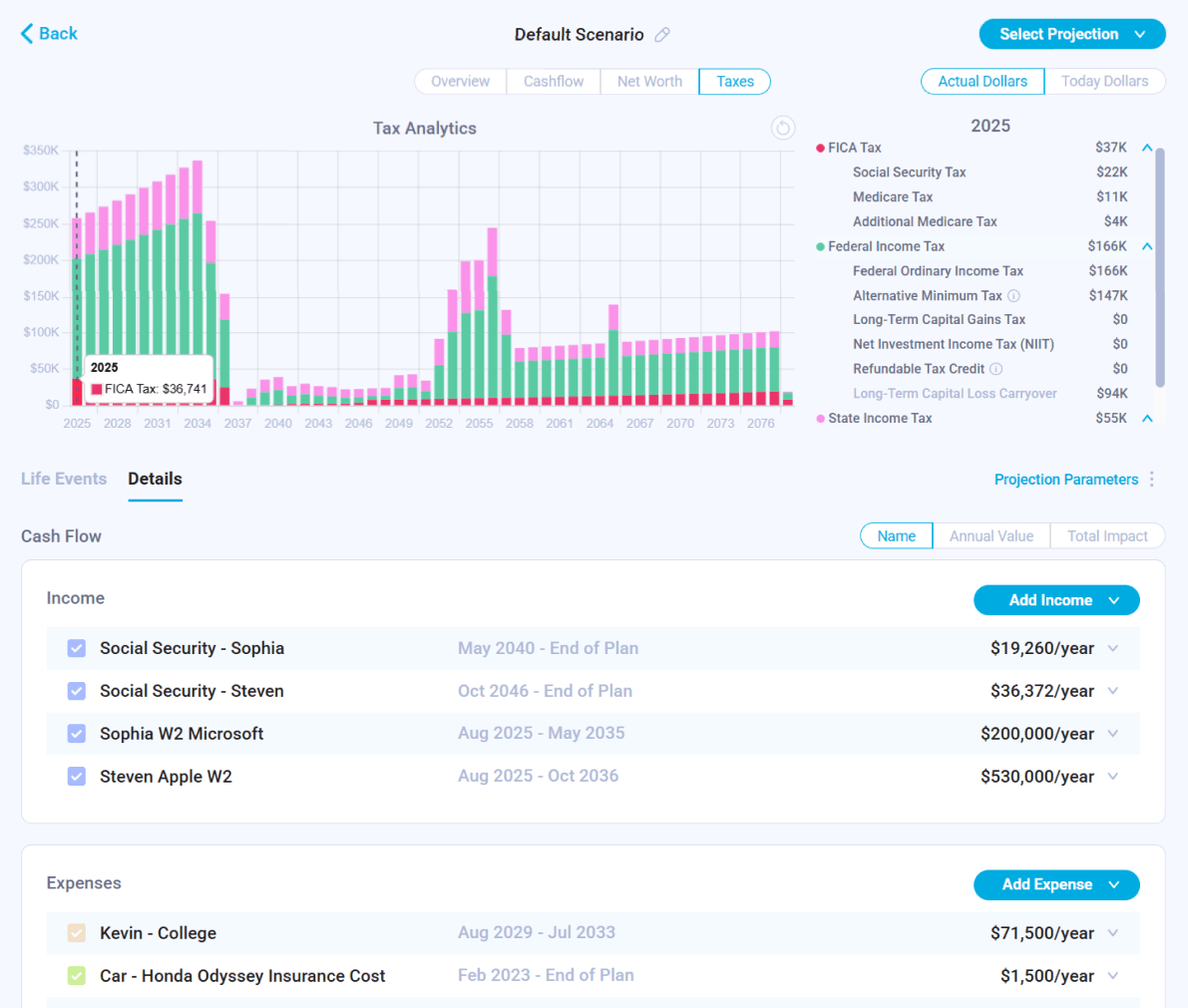
The optimal after-tax contribution amount each year depends on your tax situation, employer match, income level, and retirement timeline. Nauma models your complete 401(k) strategy — showing how after-tax contributions, Roth conversions, and your overall account mix interact across your full financial picture.
Get Started for Free