'%3e%3cpath%20d='M136%2043.0521C135.893%2043.4991%20131.298%2041.3697%20123.51%2041.5186C120.787%2041.5712%20109.626%2040.8001%20104.06%2049.4228C101.316%2053.664%20102.266%2056.2491%20100.601%2061.5769C95.2065%2078.8661%2087.7394%2075.1856%2062.5302%2088.5228C54.5058%2092.764%2045.1595%20101.562%2043.5589%20103.087C31.9403%20114.163%2025.1664%20123.189%2025.1521%20123.171C25.1378%20123.162%2034.1912%20104.357%2047.7676%2082.7655C60.6795%2062.2429%2063.8235%2070.0769%2079.7722%2049.1336C81.7015%2046.6011%2084.8526%2037.6805%2089.683%2036.1032C93.6345%2034.815%2098.6148%2036.6114%20100.065%2038.5568C101.044%2039.8712%20101.459%2040.765%20103.831%2040.4408C110.048%2039.5996%20113.613%2039.8625%20115.492%2039.7748C116.95%2039.7047%20119.751%2039.915%20120.509%2039.9939C130.419%2040.9753%20136.15%2042.4563%20136.007%2043.0434L136%2043.0521Z'%20fill='%23127398'/%3e%3cpath%20d='M22.1867%2043.6392C30.3968%2055.0923%2031.5544%2062.348%2040.6506%2068.6923C45.9954%2072.4253%2053.4839%2075.4134%2058.2928%2075.5361C61.9084%2075.6325%2063.7305%2075.2557%2064.6023%2074.949C64.8524%2074.8614%2065.1025%2074.8351%2065.3597%2074.8263L76.0636%2070.6727C76.8068%2066.8871%2076.1637%2063.4784%2076.1065%2063.1892C75.0561%2058.0103%2072.3337%2053.3835%2070.5402%2051.2542C55.4561%2033.3428%2055.8062%2034.298%2046.5814%2028.0237C26.7884%2014.5902%20-1.22192%2021.3464%200.0428309%2022.0562C0.55016%2022.3454%2010.2394%2026.9634%2022.1867%2043.6392Z'%20fill='%23127398'/%3e%3cpath%20d='M79.8366%2044.0161C81.33%2046.4784%2083.4093%2051.5784%2083.7666%2056.8975C83.7952%2057.3094%2084.1667%2064.0393%2080.4654%2068.4733C78.5004%2070.8217%2076.2281%2071.5403%2075.585%2071.7506C61.487%2076.5264%2028.4319%20116.196%2023.3515%20133.494C23.2229%20133.941%2022.6227%20136.026%2022.5655%20136C22.3797%20135.921%2023.5373%20120.753%2028.925%20106.303C28.925%20106.303%2033.7196%2090.5295%2046.7387%2073.9326C49.1896%2070.8042%2052.8052%2067.0362%2052.8052%2067.0362C54.2414%2065.1434%2059.8006%2068.3068%2066.1887%2068.482C69.9401%2068.5872%2073.2198%2067.6846%2073.2055%2067.3604C73.2055%2067.2377%2073.0698%2067.0712%2072.8911%2066.9047C72.3195%2066.3702%2071.5907%2066.1423%2070.8761%2066.2475C69.9758%2066.379%2068.1323%2066.3877%2064.5738%2065.5903C59.8435%2064.5212%2052.8481%2060.096%2048.0534%2055.364C39.9076%2047.3109%2039.7147%2039.9238%2033.1051%2026.9985C23.4944%208.17586%2014.0767%201.32328%2014.0767%201.32328C17.285%20-1.64734%2041.451%20-0.788575%2059.229%2016.3692C67.5177%2024.3697%2067.2962%2023.3619%2079.8366%2044.0073V44.0161Z'%20fill='%23EF9920'/%3e%3c/g%3e%3cdefs%3e%3cclipPath%20id='clip0_882_3310'%3e%3crect%20width='136'%20height='136'%20fill='white'/%3e%3c/clipPath%3e%3c/defs%3e%3c/svg%3e)
What Is Portfolio Rebalancing?
Why Portfolios Drift From Their Target Allocation Over Time — and the Three Approaches Used to Bring Them Back
Portfolio rebalancing is the process of restoring a portfolio's allocation to its target weights after market movements have caused the actual weights to drift. Because different asset classes produce different returns over time, a portfolio that begins at a specific allocation — say, 70% equities and 30% bonds — will drift away from that target as equities outperform or underperform bonds. Rebalancing corrects this drift by selling assets that have grown beyond their target weight and buying assets that have fallen below it.
Rebalancing is not about chasing better returns. It is about maintaining the risk and return characteristics the portfolio was designed to have — and ensuring that the portfolio continues to match the requirements of the specific financial goal it is funding.
Why Portfolios Drift and Why That Matters
A portfolio's target allocation is set deliberately to match a goal's time horizon, required return, and risk tolerance. A 70/30 equity-bond allocation for a retirement goal 18 years away carries a specific expected volatility and a specific expected return. As equities outperform bonds, the portfolio naturally drifts to 78/22, then 83/17. Each step takes the portfolio further from its intended risk profile.
The drift itself is not neutral. A portfolio that has drifted significantly toward equities carries more downside risk than was originally intended. In a market correction, the larger equity weight means larger portfolio losses — losses that may arrive at an inconvenient moment relative to the goal's timeline or the investor's financial situation.
The case for rebalancing is not that drift always hurts returns. Allowing a portfolio to drift toward equities during a sustained bull market has historically produced higher returns than regularly trimming equities back to target. The case is that drift changes the portfolio's risk profile in ways the investor may not have intended — and that managing risk predictably is more valuable than attempting to capture drift-related returns, particularly as a goal date approaches.
The Three Rebalancing Approaches
There is no single correct approach to rebalancing. Three methods are widely used in practice, each with different tradeoffs between simplicity, responsiveness, and tax efficiency.
Calendar Rebalancing
Calendar rebalancing sets a fixed schedule — quarterly, semi-annually, or annually — and rebalances the portfolio on each scheduled date regardless of how much it has drifted. At the scheduled review, the actual allocation is compared to the target, and trades are placed to restore target weights.
Calendar rebalancing is simple and requires no ongoing monitoring between review dates. Its limitation is that it is time-based rather than information-based: it may trigger rebalancing when drift is minor (generating unnecessary trades and potential tax costs in taxable accounts) or may allow significant drift to persist between scheduled dates.
Many investors consider annual calendar rebalancing a reasonable baseline — it balances simplicity with effective drift management and avoids the transaction costs of more frequent reviews. Quarterly rebalancing is more responsive but generates more transactions.
Threshold Rebalancing
Threshold rebalancing triggers a rebalance when any asset class drifts beyond a specified band from its target weight — either in absolute terms (e.g., ±5 percentage points from target) or relative terms (e.g., ±25% of the target weight). Rebalancing occurs only when the threshold is crossed, not on a fixed schedule.
A 5% absolute threshold is a commonly cited reference point in financial planning practice: if equities are targeted at 60% and reach 65% or fall to 55%, the rebalance is triggered. Between those levels, the portfolio is left as-is. This approach rebalances when there is a reason to act — meaningful drift has occurred — and avoids triggering trades on minor fluctuations.
See What Is a Rebalancing Threshold? for a full explanation of how to set threshold rules, the absolute vs. relative distinction, and the tax and cost tradeoffs of different threshold sizes.
Cash-Flow Rebalancing
Cash-flow rebalancing uses new contributions, reinvested dividends, or required distributions to direct cash flows toward underweight asset classes rather than selling overweight assets. A new contribution to the portfolio is directed entirely to bonds if bonds are underweight; future dividend reinvestment in the equity portion is paused or redirected.
Cash-flow rebalancing avoids selling, which means it avoids realizing capital gains in taxable accounts. This makes it the most tax-efficient rebalancing approach during the accumulation phase — when contributions are regular and large enough to meaningfully affect portfolio weights.
The limitation is that cash flows may be insufficient to fully correct significant drift. If a portfolio has drifted 10+ percentage points from target and new contributions are modest relative to total portfolio size, pure cash-flow rebalancing may not restore target weights quickly. It is often used in combination with threshold rebalancing: cash flows are directed to underweight classes first, and explicit sell/buy trades are placed only when drift exceeds the threshold.
The Tax Dimension: Why Account Type Changes Everything
The mechanics of rebalancing are the same across account types, but the tax consequences are not. This distinction is central to practical rebalancing strategy, particularly for investors with assets in both taxable and tax-advantaged accounts.
Tax-advantaged accounts (401(k), traditional IRA, Roth IRA): Rebalancing within tax-advantaged accounts has no immediate tax consequence. Selling an overweight equity fund and buying an underweight bond fund inside a 401(k) generates no taxable income. This makes tax-advantaged accounts the natural first choice for rebalancing trades.
Taxable brokerage accounts: Selling an appreciated position to rebalance realizes a capital gain that is taxable in the year of the sale. Short-term gains (assets held less than 12 months) are taxed at ordinary income rates. Long-term gains (assets held more than 12 months) are taxed at preferential federal rates of 0%, 15%, or 20% depending on income, plus the 3.8% Net Investment Income Tax (NIIT) for high earners. In California, all gains — short-term and long-term — are taxed as ordinary income at rates up to 13.3%.
The practical implication for many investors is to prioritize rebalancing within tax-advantaged accounts. If rebalancing is also needed in taxable accounts, investors often look for opportunities to pair the rebalancing trades with tax-loss harvesting — selling positions with unrealized losses to offset gains from the rebalancing trades, reducing or eliminating the net taxable gain. See Tax-Loss Harvesting for how this works, and Capital Gains Taxes for the specific rates applicable at the federal and California levels.
Note: Rebalancing involves transaction costs and potential tax liabilities. While it aims to manage portfolio risk, it does not guarantee protection against market losses.
Rebalancing Across Multiple Goals
For investors managing portfolios across multiple financial goals — retirement, college funding, a real estate purchase — rebalancing applies separately to each goal's portfolio. Each goal has its own target allocation, and each portfolio's drift is evaluated independently.
This goal-level approach has important practical implications. A technology worker with $1.5M in retirement assets (targeted at 75/25 equities/bonds) and $200K in college funding assets (targeted at 40/60) does not rebalance both toward the same target. The retirement portfolio is rebalanced toward 75/25; the college funding portfolio is rebalanced toward 40/60. The rebalancing decisions are separate and driven by each goal's specific allocation requirements.
The account-to-goal mapping also matters for tax-efficient rebalancing. If the retirement goal's assets are primarily in a 401(k) and the college goal's assets are in a taxable brokerage account (outside a 529), rebalancing the 401(k) is free of tax consequences while rebalancing the taxable account has capital gains implications. The rebalancing strategy for each goal should account for where its assets are held.
Does Rebalancing Improve Returns?
Research on rebalancing and returns shows a mixed picture that is often misunderstood. Rebalancing does not systematically improve raw returns — in fact, during sustained equity bull markets, allowing a portfolio to drift toward equities produces higher raw returns than periodically trimming equities back to a lower target weight. This is because equities historically outperform bonds over long periods, and drift increases equity exposure.
The case for rebalancing is about risk management, not return optimization. Rebalancing consistently reduces portfolio volatility relative to a drifting portfolio, prevents the accumulation of unintended risk, and — critically — maintains the allocation match between the portfolio and the goal it is funding. As a goal date approaches, this alignment becomes more important: a portfolio that has drifted heavily toward equities approaching a 5-year funding window carries significantly more drawdown risk than the investor may have intended.
The other benefit sometimes attributed to rebalancing — buy low, sell high on a systematic basis — is real but modest in magnitude. Rebalancing from equities to bonds after a bull market does involve selling relatively high and buying relatively low. But this effect is small and inconsistent across different market regimes.
California Note
For California investors with taxable brokerage accounts, rebalancing is among the most consequential tax-generating activities in portfolio management. Because California taxes both short-term and long-term capital gains as ordinary income at rates up to 13.3%, a rebalancing trade that realizes significant gains can create a substantial combined tax liability. The following is a hypothetical example for illustrative purposes only and does not represent the taxes or performance of any specific investment: a rebalancing trade realizing $50,000 in long-term gains could generate approximately $6,650 in California taxes alone — on top of federal taxes of up to $11,900 (20% plus 3.8% NIIT at the top bracket). Combined, a California high-income investor may face a marginal rate of approximately 37% on long-term gains realized from rebalancing. This makes tax-efficient rebalancing strategy — prioritizing tax-advantaged accounts, pairing taxable rebalancing with tax-loss harvesting, and applying wider thresholds in taxable accounts — significantly more valuable in California than in lower-tax states. See Capital Gains Taxes for a full breakdown of California's investment income treatment, and Direct Indexing for how direct indexing enables systematic loss harvesting to offset rebalancing gains.
This article is for educational purposes only and does not constitute investment, tax, or financial advice. Portfolio construction involves risk, and all investments may lose value. Past performance does not guarantee future results. Tax treatment depends on individual circumstances and may be subject to change. Always consult a qualified financial advisor before making investment decisions.
Frequently Asked Questions
Track Your Portfolio Allocation Across All Accounts
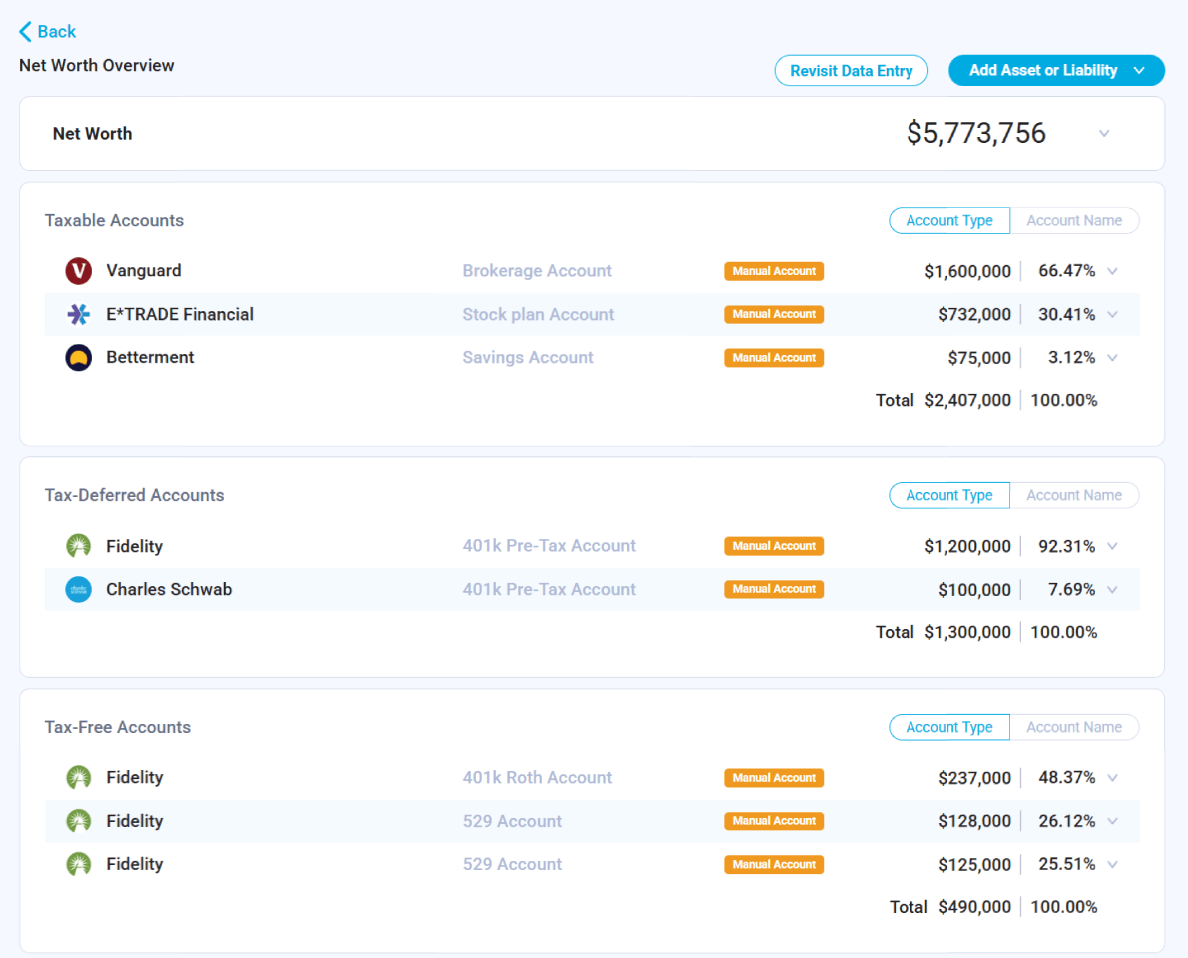
Nauma aggregates your accounts and shows how each goal's actual allocation compares to its target — so you can see where drift has occurred and what may need attention.
Get Started for Free