'%3e%3cpath%20d='M136%2043.0521C135.893%2043.4991%20131.298%2041.3697%20123.51%2041.5186C120.787%2041.5712%20109.626%2040.8001%20104.06%2049.4228C101.316%2053.664%20102.266%2056.2491%20100.601%2061.5769C95.2065%2078.8661%2087.7394%2075.1856%2062.5302%2088.5228C54.5058%2092.764%2045.1595%20101.562%2043.5589%20103.087C31.9403%20114.163%2025.1664%20123.189%2025.1521%20123.171C25.1378%20123.162%2034.1912%20104.357%2047.7676%2082.7655C60.6795%2062.2429%2063.8235%2070.0769%2079.7722%2049.1336C81.7015%2046.6011%2084.8526%2037.6805%2089.683%2036.1032C93.6345%2034.815%2098.6148%2036.6114%20100.065%2038.5568C101.044%2039.8712%20101.459%2040.765%20103.831%2040.4408C110.048%2039.5996%20113.613%2039.8625%20115.492%2039.7748C116.95%2039.7047%20119.751%2039.915%20120.509%2039.9939C130.419%2040.9753%20136.15%2042.4563%20136.007%2043.0434L136%2043.0521Z'%20fill='%23127398'/%3e%3cpath%20d='M22.1867%2043.6392C30.3968%2055.0923%2031.5544%2062.348%2040.6506%2068.6923C45.9954%2072.4253%2053.4839%2075.4134%2058.2928%2075.5361C61.9084%2075.6325%2063.7305%2075.2557%2064.6023%2074.949C64.8524%2074.8614%2065.1025%2074.8351%2065.3597%2074.8263L76.0636%2070.6727C76.8068%2066.8871%2076.1637%2063.4784%2076.1065%2063.1892C75.0561%2058.0103%2072.3337%2053.3835%2070.5402%2051.2542C55.4561%2033.3428%2055.8062%2034.298%2046.5814%2028.0237C26.7884%2014.5902%20-1.22192%2021.3464%200.0428309%2022.0562C0.55016%2022.3454%2010.2394%2026.9634%2022.1867%2043.6392Z'%20fill='%23127398'/%3e%3cpath%20d='M79.8366%2044.0161C81.33%2046.4784%2083.4093%2051.5784%2083.7666%2056.8975C83.7952%2057.3094%2084.1667%2064.0393%2080.4654%2068.4733C78.5004%2070.8217%2076.2281%2071.5403%2075.585%2071.7506C61.487%2076.5264%2028.4319%20116.196%2023.3515%20133.494C23.2229%20133.941%2022.6227%20136.026%2022.5655%20136C22.3797%20135.921%2023.5373%20120.753%2028.925%20106.303C28.925%20106.303%2033.7196%2090.5295%2046.7387%2073.9326C49.1896%2070.8042%2052.8052%2067.0362%2052.8052%2067.0362C54.2414%2065.1434%2059.8006%2068.3068%2066.1887%2068.482C69.9401%2068.5872%2073.2198%2067.6846%2073.2055%2067.3604C73.2055%2067.2377%2073.0698%2067.0712%2072.8911%2066.9047C72.3195%2066.3702%2071.5907%2066.1423%2070.8761%2066.2475C69.9758%2066.379%2068.1323%2066.3877%2064.5738%2065.5903C59.8435%2064.5212%2052.8481%2060.096%2048.0534%2055.364C39.9076%2047.3109%2039.7147%2039.9238%2033.1051%2026.9985C23.4944%208.17586%2014.0767%201.32328%2014.0767%201.32328C17.285%20-1.64734%2041.451%20-0.788575%2059.229%2016.3692C67.5177%2024.3697%2067.2962%2023.3619%2079.8366%2044.0073V44.0161Z'%20fill='%23EF9920'/%3e%3c/g%3e%3cdefs%3e%3cclipPath%20id='clip0_882_3310'%3e%3crect%20width='136'%20height='136'%20fill='white'/%3e%3c/clipPath%3e%3c/defs%3e%3c/svg%3e)
Roth Conversion for Tech Workers
How to Move Pre-Tax Retirement Savings to Tax-Free — Strategy, Timing, TurboTax Reporting, and the Role of Financial Projections
A Roth conversion is the process of moving money from a traditional IRA or pre-tax 401(k) into a Roth IRA. The amount converted is added to your taxable income in the year of conversion and taxed as ordinary income — you pay the tax now, and in exchange, the money grows tax-free and can be withdrawn tax-free in retirement. No required minimum distributions. No tax on future gains. No tax on withdrawals.
For tech workers, the Roth conversion is one of the most powerful and most frequently misused tools in retirement planning. Used correctly — converting at the right amounts in the right years — it can save tens of thousands of dollars over a 30- to 40-year retirement by front-loading taxes at a lower rate than you would pay later. Used incorrectly — converting too much in a single year, or ignoring how conversions interact with ACA subsidies, IRMAA, and Social Security taxation — it creates avoidable tax bills that eliminate the benefit entirely.
Why Roth Conversions Matter for Tech Workers
Most senior software engineers and tech professionals accumulate the majority of their retirement savings in pre-tax accounts: traditional 401(k)s with annual contributions of $24,500+, plus employer matching, often for a decade or more. A 15-year FAANG career with consistent 401(k) contributions and strong investment returns can easily produce a traditional account balance of $1,500,000–$3,000,000 by the time someone retires in their 40s.
Every dollar in a traditional account is a future tax liability. When you withdraw — whether voluntarily or as a Required Minimum Distribution beginning at age 73 — the full withdrawal is taxed as ordinary income. A $2,000,000 traditional IRA growing at 6% per year produces RMDs of $80,000–$120,000+ per year by the mid-70s, even if you do not need the money. Those distributions stack on top of Social Security, taxable account income, and any other income — pushing marginal rates back toward the levels you paid during your working years, and triggering IRMAA surcharges on Medicare premiums.
The Roth conversion strategy exploits the gap between your tax rate during early retirement and your tax rate in later retirement. A tech worker who retires at 44 with no earned income faces a dramatically lower marginal rate than they did at $350,000 total compensation — potentially 12% or 22% federal instead of 37%. Converting traditional IRA funds to Roth at those lower rates, in the years before Social Security, RMDs, and Medicare all converge, permanently moves assets from the high-tax bucket to the tax-free bucket at a fraction of what it would have cost to do it later.
How a Roth Conversion Works
The mechanics are simple. You instruct your brokerage or IRA custodian to transfer a specified amount from a traditional IRA to a Roth IRA. The custodian moves the assets — either as cash or as in-kind shares — and reports the conversion to the IRS on Form 1099-R. The converted amount is included in your gross income for the year of conversion, taxed at your ordinary income rate, and then grows tax-free in the Roth account going forward.
Key mechanical details:
- The conversion can be partial or full. You choose the amount. You can convert $10,000, $50,000, or the entire balance in a single year. The right amount is determined by your tax situation, not by the account balance.
- No contribution limit applies. Roth conversions are not subject to the annual Roth IRA contribution limit ($7,500 in 2026). You can convert $200,000 in a single year if the tax makes sense.
- There is no income limit on conversions. Unlike direct Roth IRA contributions, which phase out above $246,000 MAGI for married filing jointly in 2026, Roth conversions are available at any income level. This is the mechanism behind the backdoor Roth IRA and the mega backdoor Roth.
- The conversion is irrevocable. Prior to 2018, you could "recharacterize" (undo) a Roth conversion if the market fell or your tax situation changed. The Tax Cuts and Jobs Act eliminated recharacterization of conversions permanently. Once converted, the decision is final for that tax year.
- Tax is due in the year of conversion. The IRS does not withhold automatically — you should pay the tax from non-IRA funds (a savings account or taxable brokerage account) to avoid reducing the converted amount and potentially triggering a 10% early withdrawal penalty on the withheld portion if under 59½.
- Converted funds follow the 5-year rule. Roth conversions are accessible penalty-free after 5 years from January 1 of the conversion year, regardless of age. Separate 5-year clocks run for each conversion year. This is critical for early retirees building a Roth conversion ladder to access funds before 59½.
The Roth Conversion Ladder: Accessing Funds Before 59½
For tech workers who retire well before 59½, the Roth conversion ladder is the primary mechanism for penalty-free access to retirement account funds. The mechanics:
- In year 1 of early retirement, convert a portion of the traditional IRA to Roth. Pay income tax on the converted amount from taxable account funds.
- Wait 5 years. During those 5 years, live on taxable account funds, Roth contribution basis, or bond ladder proceeds.
- In year 6, access the converted amount from year 1, penalty-free and tax-free.
- Repeat each year: the conversion done in year 2 becomes accessible in year 7, year 3 in year 8, and so on.
The ladder requires 5 years of bridge funding before the first rung is accessible — typically covered by taxable brokerage accounts built from years of RSU proceeds. A tech worker who retires at 44 and starts a conversion ladder immediately can access penalty-free Roth funds by age 49, before the standard 59½ threshold, with no early withdrawal penalty and no tax on withdrawal.
The amount to convert each year for the ladder is the amount you need to spend in the corresponding future year — not the maximum that fits within a tax bracket. If you plan to spend $90,000 in year 6 of retirement, convert approximately $90,000 in year 1, plus an estimate for the tax on the conversion. The ladder is a cash flow plan as much as a tax optimization strategy.
How Much to Convert Each Year: The Bracket-Filling Strategy
The core Roth conversion optimization is bracket filling: converting enough to use a low tax bracket fully without crossing into a higher one, or without triggering a threshold that creates a secondary cost. The decision is nuanced because conversion income interacts with multiple simultaneous calculations:
- Federal income tax brackets. In 2026, the 22% federal bracket for married filing jointly runs from approximately $96,950 to $206,700 of taxable income. If your other income puts you at $80,000 of taxable income, you have room to convert approximately $16,950 before hitting the 22% bracket ceiling. Converting $40,000 instead pushes $23,050 into the 24% bracket — not catastrophic, but the incremental tax cost rises.
- ACA premium subsidy thresholds. For early retirees not yet on Medicare, Roth conversions increase MAGI, which reduces ACA premium tax credits. For a couple in 2026, crossing 400% FPL (approximately $79,840) begins reducing subsidies. A $30,000 Roth conversion that pushes MAGI from $75,000 to $105,000 might cost $8,000 in lost ACA subsidies on top of the income tax — making the effective marginal rate on the conversion much higher than the headline bracket rate.
- IRMAA tiers. Medicare IRMAA surcharges are triggered by MAGI from two years prior. Converting heavily in 2026 affects 2028 Medicare premiums. The first IRMAA tier for MFJ begins at $212,000 MAGI; crossing it adds $1,776+/year in Medicare premiums per couple. Conversions must be modeled against IRMAA two years forward, not just the current year's tax bill.
- Social Security combined income. For retirees already receiving Social Security, conversion income flows into the combined income calculation and can push a greater portion of benefits from the 50% taxable tier to the 85% taxable tier. Each additional $1 of conversion can generate an additional $0.85 of taxable income — creating an effective marginal rate spike that makes conversion at that level inefficient.
- The 0% long-term capital gains bracket. In 2026, the 0% LTCG rate applies up to $98,900 of taxable income for MFJ. Conversion income counts as ordinary income that stacks under capital gains. A large Roth conversion can push capital gains that would have been taxed at 0% into the 15% bracket — an interaction that inflates the effective cost of the conversion.
- State income taxes. Conversions are taxed by the state of residence in the year of conversion. A California resident converting $100,000 pays up to 13.3% California income tax on the converted amount in addition to federal tax — making large conversions while still a California resident significantly more expensive than waiting until after establishing domicile in a no-income-tax state.
These interactions make the optimal annual conversion amount impossible to determine by intuition alone. The right answer requires modeling your full income picture — all sources, all thresholds, all downstream effects — for every year from now through your mid-80s. Nauma builds exactly this kind of multi-decade financial projection for tech workers, showing the impact of different conversion amounts on your cumulative lifetime tax bill, year-by-year AGI, ACA subsidy eligibility, IRMAA exposure, and Social Security taxation — so you can see the optimal conversion target for each year rather than guessing.
When Roth Conversions Are Most Valuable
The benefit of a Roth conversion depends entirely on the rate differential — the difference between the rate you pay now on conversion and the rate you would have paid later on withdrawal. The conversion is most valuable when:
- You have retired early and income has dropped sharply. The gap between a $350,000 tech salary (37% marginal federal rate) and a $60,000 early retirement income (12%–22% rate) is the largest tax differential most people will ever see. The years immediately after leaving a high-paying tech job are the prime conversion window.
- You are in a low-income gap year. Between jobs, on sabbatical, or in a year with no RSU vests and no large capital gain realizations, marginal rates are temporarily low. A tech worker who leaves a job in June and does not start a new one until the following year has a partial year of income — a natural conversion opportunity.
- Before Social Security starts. Once Social Security begins, combined income rises, potentially taxing 85% of benefits as ordinary income. Every dollar of traditional IRA balance converted before Social Security starts is a dollar that will not contribute to that combined income calculation.
- Before RMDs begin at 73. Required Minimum Distributions force taxable income that cannot be avoided. Converting in the 10–20 years before RMDs are due reduces the traditional account balance that generates those distributions. A $1,000,000 traditional IRA converted over 20 years eliminates the RMD obligation on that balance entirely.
- After relocating from a high-tax state. A tech worker who moves from California to Texas before beginning conversions saves up to 13.3% state income tax on every converted dollar. On a $100,000 annual conversion over 15 years, that is $199,500 in avoided California state tax alone.
How to Report a Roth Conversion in TurboTax
Roth conversions are reported on your federal tax return using Form 8606 (Nondeductible IRAs), which flows through to Form 1040. Your IRA custodian will send you a Form 1099-R in January following the conversion year, which is the starting point for entering the data in TurboTax. Here is the step-by-step process:
Step 1: Locate Your Form 1099-R
Your IRA custodian (Fidelity, Vanguard, Schwab, etc.) issues a Form 1099-R reporting the distribution from the traditional IRA. For a Roth conversion, Box 1 shows the gross distribution amount (the total converted), Box 2a shows the taxable amount, and Box 7 shows a distribution code. For a direct Roth conversion, Box 7 typically shows code 2 (early distribution, exception applies) if you are under 59½, or code 7 (normal distribution) if you are 59½ or older. Code G appears for direct rollovers from a 401(k) to a Roth IRA.
Step 2: Enter the 1099-R in TurboTax
- In TurboTax, navigate to Federal > Wages & Income > Retirement Plans and Social Security > IRA, 401(k), Pension Plan Withdrawals (1099-R).
- Click Add Another 1099-R (or start a new one if this is your first).
- Enter the information from your Form 1099-R exactly as shown: payer name, EIN, gross distribution (Box 1), taxable amount (Box 2a), and the distribution code from Box 7.
- When TurboTax asks "What did you do with the money from this 1099-R?", select "I moved the money to another retirement account (or returned it to the same account)".
- On the next screen, select "I converted all of this money to a Roth IRA" (or "I converted part of this money" if you did a partial conversion).
Step 3: Confirm the Taxable Amount
TurboTax will ask whether the full amount in Box 2a is taxable. For a conversion from a traditional IRA funded entirely with pre-tax contributions, the answer is yes — the full converted amount is taxable. If your traditional IRA contains any after-tax (non-deductible) contributions tracked on prior-year Form 8606s, TurboTax will ask about your total IRA basis and apply the pro-rata rule to determine the taxable portion. Enter your IRA basis carefully — it is the cumulative total of non-deductible contributions you have made over the years, as shown on your most recent Form 8606.
Step 4: Form 8606 Is Generated Automatically
TurboTax generates Form 8606 automatically based on your 1099-R entries and IRA basis information. Form 8606 tracks: your non-deductible IRA contributions (Part I), Roth conversions and the taxable portion (Part II), and Roth IRA distributions (Part III). You do not need to complete Form 8606 manually — TurboTax handles it — but you should review the completed form to confirm the taxable amount matches your expectation before filing.
Step 5: Verify the Impact on Your Tax Return
After entering the 1099-R, check your federal tax summary in TurboTax to confirm the conversion amount has been added to your taxable income. The converted amount appears on Form 1040, Line 4b (IRA distributions, taxable amount). Review that your total tax owed reflects the conversion correctly and that estimated tax payments or withholding are sufficient to avoid an underpayment penalty. For large conversions, the IRS requires quarterly estimated tax payments — a $100,000 conversion in January creates a tax liability due throughout the year, not just at April 15.
Common TurboTax Mistakes for Roth Conversions
- Not entering IRA basis from prior Form 8606s. If you have made non-deductible IRA contributions in prior years (as part of the backdoor Roth process), your IRA basis reduces the taxable portion of the conversion. TurboTax asks for this basis — if you skip it or enter zero when basis exists, you will overpay tax on the conversion.
- Selecting the wrong answer when asked what you did with the distribution. If you select "I took the money out" instead of "I converted it to a Roth IRA," TurboTax will treat the full amount as a taxable distribution, potentially adding a 10% early withdrawal penalty that does not apply to a conversion.
- Forgetting state tax reporting. Most states that tax income also tax Roth conversions as ordinary income in the year of conversion. TurboTax handles the state return automatically once the federal 1099-R is entered correctly, but confirm that your state return reflects the conversion income before filing.
- Not paying estimated taxes on large conversions. If a large conversion significantly increases your tax liability beyond what withholding covers, you owe estimated taxes quarterly. TurboTax will flag an underpayment penalty at tax time but cannot retroactively make the quarterly payments that would have avoided it. Plan ahead.
Using Nauma to Determine the Right Conversion Amount Each Year
The most consequential Roth conversion decisions are not mechanical — they are strategic. How much should you convert this year? Does the answer change if you plan to start Social Security at 67 instead of 70? What happens to your lifetime tax bill if you convert aggressively in your 40s versus spreading conversions through your 60s? Is it worth converting while on ACA subsidies, or should you pause conversions to preserve the subsidy and convert more aggressively after Medicare eligibility at 65?
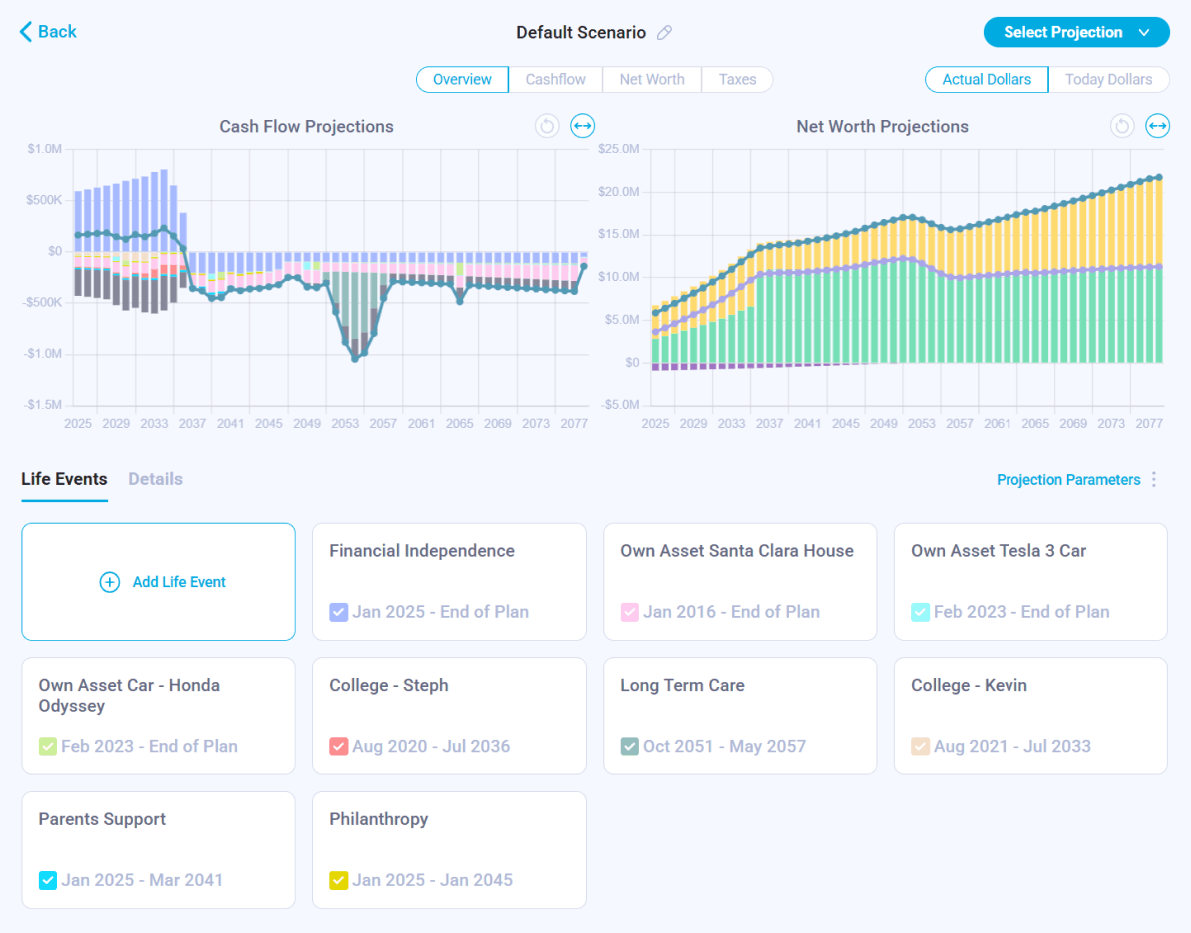
These questions require modeling your complete financial picture over multiple decades — all account types, all income sources, all tax thresholds — simultaneously. A spreadsheet can approximate parts of this; a proper financial planning tool does it correctly. Nauma is built specifically for this purpose. It constructs a year-by-year financial projection for your situation — your RSU vesting history, your 401(k) and IRA balances, your planned Social Security start date, your state of residence, your ACA coverage years — and models how different Roth conversion strategies play out across your entire retirement.
Within Nauma, you can explore questions like:
- What is the optimal annual conversion amount to fill the 22% bracket without crossing into 24%, accounting for dividends and capital gains from my taxable account?
- How does a $60,000/year conversion strategy from age 44 to 65 compare to a $120,000/year strategy from age 44 to 55, in terms of total lifetime taxes paid?
- At what MAGI level does a Roth conversion start costing more in ACA subsidy losses than it saves in future tax deferral?
- What is my projected RMD in 2047, and how does aggressively converting now reduce it?
- If I relocate from California to Texas before converting, how much do I save in state taxes over a 20-year conversion window?
The projection built in Nauma integrates all of these variables — federal and state tax rates, ACA subsidy thresholds, IRMAA tiers, Social Security combined income, RMD projections, and Roth 5-year laddering schedules — into a single forward-looking model. Instead of optimizing one year in isolation, you can see the optimal conversion amount for every year from now through your late 70s, and understand the cumulative lifetime tax impact of each scenario.
The Pro-Rata Rule: The Most Important Roth Conversion Trap
If you have any pre-tax money in traditional IRAs — including rollover IRAs from former 401(k)s — the IRS applies the pro-rata rule to every Roth conversion. You cannot selectively convert only after-tax (non-deductible) contributions; every conversion is treated as a proportional mix of pre-tax and after-tax dollars across all your traditional IRA balances.
Example: You have $93,500 in a rollover IRA (all pre-tax) and $6,500 in a non-deductible traditional IRA (all after-tax). Total IRA balance: $100,000. After-tax basis: 6.5%. If you convert $6,500 to Roth, only 6.5% of the conversion ($423) is tax-free — the remaining $6,077 is taxable. The non-deductible basis does not convert cleanly; it gets averaged across the entire IRA pool.
For tech workers who have been doing the backdoor Roth IRA while also holding a large rollover IRA from a former employer, this rule creates an immediate problem. The solution: roll the pre-tax rollover IRA into your current employer's 401(k) plan (if the plan accepts incoming rollovers) before the end of the calendar year in which you do the backdoor conversion. With the rollover IRA balance at zero, the pro-rata calculation applies only to the non-deductible contribution and the conversion is fully tax-free. This is one of the most important and least-known interactions in tax-advantaged account management.
Roth Conversions and the 5-Year Rules
There are actually two separate 5-year rules for Roth IRAs, and they serve different purposes:
- The 5-year rule for Roth IRA earnings: Roth IRA earnings (investment growth) cannot be withdrawn tax-free until the Roth IRA has been open for at least 5 years AND you are at least 59½. The 5-year clock starts January 1 of the first year you made any Roth IRA contribution or conversion. If you opened your first Roth IRA in 2021, the clock runs out January 1, 2026 — and after 59½, all earnings are permanently tax-free.
- The 5-year rule for Roth conversions (early retirees): Each Roth conversion has its own 5-year clock for the purpose of the 10% early withdrawal penalty. If you are under 59½ and withdraw converted funds within 5 years of the conversion, the 10% penalty applies to the converted amount (but not the earnings, which are governed by the first rule). Conversions done in January 2026 are accessible penalty-free starting January 1, 2031. This is the rule that governs the Roth conversion ladder described earlier.
The practical implication for early retirees: if you retire at 44 and begin a conversion ladder, you need 5 years of bridge funding from other sources before the first conversion rung is accessible. If you have been contributing to a Roth IRA for years, those contribution dollars (not earnings) can be withdrawn any time without tax or penalty — a separate pool of accessible funds that does not have a holding period.
Frequently Asked Questions
Find Your Optimal Roth Conversion Amount
Nauma builds your year-by-year Roth conversion projection — modeling bracket targets, ACA subsidy thresholds, IRMAA tiers, RMD reduction, and lifetime tax savings — so you convert the right amount every year, not just a rough estimate.
Get Started for Free