'%3e%3cpath%20d='M136%2043.0521C135.893%2043.4991%20131.298%2041.3697%20123.51%2041.5186C120.787%2041.5712%20109.626%2040.8001%20104.06%2049.4228C101.316%2053.664%20102.266%2056.2491%20100.601%2061.5769C95.2065%2078.8661%2087.7394%2075.1856%2062.5302%2088.5228C54.5058%2092.764%2045.1595%20101.562%2043.5589%20103.087C31.9403%20114.163%2025.1664%20123.189%2025.1521%20123.171C25.1378%20123.162%2034.1912%20104.357%2047.7676%2082.7655C60.6795%2062.2429%2063.8235%2070.0769%2079.7722%2049.1336C81.7015%2046.6011%2084.8526%2037.6805%2089.683%2036.1032C93.6345%2034.815%2098.6148%2036.6114%20100.065%2038.5568C101.044%2039.8712%20101.459%2040.765%20103.831%2040.4408C110.048%2039.5996%20113.613%2039.8625%20115.492%2039.7748C116.95%2039.7047%20119.751%2039.915%20120.509%2039.9939C130.419%2040.9753%20136.15%2042.4563%20136.007%2043.0434L136%2043.0521Z'%20fill='%23127398'/%3e%3cpath%20d='M22.1867%2043.6392C30.3968%2055.0923%2031.5544%2062.348%2040.6506%2068.6923C45.9954%2072.4253%2053.4839%2075.4134%2058.2928%2075.5361C61.9084%2075.6325%2063.7305%2075.2557%2064.6023%2074.949C64.8524%2074.8614%2065.1025%2074.8351%2065.3597%2074.8263L76.0636%2070.6727C76.8068%2066.8871%2076.1637%2063.4784%2076.1065%2063.1892C75.0561%2058.0103%2072.3337%2053.3835%2070.5402%2051.2542C55.4561%2033.3428%2055.8062%2034.298%2046.5814%2028.0237C26.7884%2014.5902%20-1.22192%2021.3464%200.0428309%2022.0562C0.55016%2022.3454%2010.2394%2026.9634%2022.1867%2043.6392Z'%20fill='%23127398'/%3e%3cpath%20d='M79.8366%2044.0161C81.33%2046.4784%2083.4093%2051.5784%2083.7666%2056.8975C83.7952%2057.3094%2084.1667%2064.0393%2080.4654%2068.4733C78.5004%2070.8217%2076.2281%2071.5403%2075.585%2071.7506C61.487%2076.5264%2028.4319%20116.196%2023.3515%20133.494C23.2229%20133.941%2022.6227%20136.026%2022.5655%20136C22.3797%20135.921%2023.5373%20120.753%2028.925%20106.303C28.925%20106.303%2033.7196%2090.5295%2046.7387%2073.9326C49.1896%2070.8042%2052.8052%2067.0362%2052.8052%2067.0362C54.2414%2065.1434%2059.8006%2068.3068%2066.1887%2068.482C69.9401%2068.5872%2073.2198%2067.6846%2073.2055%2067.3604C73.2055%2067.2377%2073.0698%2067.0712%2072.8911%2066.9047C72.3195%2066.3702%2071.5907%2066.1423%2070.8761%2066.2475C69.9758%2066.379%2068.1323%2066.3877%2064.5738%2065.5903C59.8435%2064.5212%2052.8481%2060.096%2048.0534%2055.364C39.9076%2047.3109%2039.7147%2039.9238%2033.1051%2026.9985C23.4944%208.17586%2014.0767%201.32328%2014.0767%201.32328C17.285%20-1.64734%2041.451%20-0.788575%2059.229%2016.3692C67.5177%2024.3697%2067.2962%2023.3619%2079.8366%2044.0073V44.0161Z'%20fill='%23EF9920'/%3e%3c/g%3e%3cdefs%3e%3cclipPath%20id='clip0_882_3310'%3e%3crect%20width='136'%20height='136'%20fill='white'/%3e%3c/clipPath%3e%3c/defs%3e%3c/svg%3e)
Social Security for Tech Workers
Early Retirement, Taxation by State, and How to Optimize Benefits as a Software Engineer or Tech Professional
Social Security is the federal retirement income program that most Americans pay into throughout their working lives and draw from in retirement. For tech workers planning early retirement, Social Security is often an afterthought — overshadowed by RSU vesting schedules, 401(k) limits, and FIRE projections. That is a mistake. Even a tech worker who retires at 40 after a 15-year career at a FAANG company has accumulated meaningful Social Security credits, and the eventual benefit — starting as early as 62, or deferred to 70 — can represent hundreds of thousands of dollars of lifetime income. Understanding how it works, when to claim, how it is taxed federally and by individual states, and how it fits into a long early-retirement income plan is essential financial planning.
How Social Security Benefits Are Calculated
Your Social Security retirement benefit is based on your earnings history — specifically, your 35 highest-earning years, indexed for inflation. The Social Security Administration takes those 35 years of indexed earnings, averages them, and applies a progressive formula to calculate your Primary Insurance Amount (PIA) — the monthly benefit you would receive if you claim at your full retirement age (FRA).
For workers born in 1960 or later — which includes most tech workers in their 30s and 40s today — the full retirement age is 67. The progressive formula in 2026 provides:
- 90% of the first $1,226 of average indexed monthly earnings (AIME)
- 32% of AIME between $1,226 and $7,391
- 15% of AIME above $7,391
Because the formula is heavily weighted toward lower earners, high-income tech workers receive a benefit that is significant in absolute terms but modest as a percentage of their pre-retirement income. A software engineer who averaged $250,000 per year over a 15-year career might receive a PIA of $2,800–$3,400 per month at full retirement age — roughly 14–16% of their prior income, compared to 40–50% for a median earner. The benefit is real money, but it is a floor, not a replacement for the portfolio.
The Impact of Early Retirement on Your Benefit
Social Security requires 40 quarters of coverage (10 years of work) to qualify for any retirement benefit. Beyond that minimum, the benefit calculation uses 35 years — and any year with no earnings counts as a zero in the average. This is the most important Social Security mechanic for tech workers who retire in their 30s or 40s.
A tech worker who retires at 38 after 15 working years has 15 years of high earnings and 20 zeros in their 35-year average. Those zeros pull the average down and reduce the benefit. Consider two workers both earning $300,000 per year:
- Retires at 38 after 15 years: 15 high-earning years + 20 zeros averaged in → lower AIME → lower benefit
- Retires at 62 after 40 years: 35 high-earning years + 5 zeros → higher AIME → meaningfully higher benefit
Working even a modest number of additional years — or returning to any paid work during the Barista FIRE or Coast FIRE phase — replaces zeros in the calculation with real earnings and increases the eventual benefit. Each additional year of earnings above zero replaces the lowest year in the 35-year average, incrementally raising the benefit with no cliff or cutoff. This is one financial reason why a partial semi-retirement in your 40s and 50s can produce better lifetime outcomes than a hard stop at 38.
When to Claim: The Early Retirement Trade-Off
You can begin claiming Social Security as early as 62 or defer it as late as 70. Each choice carries a different monthly benefit:
- Age 62 (earliest): Benefit reduced by up to 30% below your PIA
- Age 67 (full retirement age, born 1960+): 100% of your PIA
- Age 70 (maximum deferral): Benefit increased by 24% above your PIA (8% per year from 67 to 70)
For tech workers who retire early and have a large portfolio, the claiming decision is rarely about cash flow — they do not need Social Security at 62 to pay the bills. It is primarily a longevity and tax optimization question. Deferring to 70 produces a significantly higher monthly payment that functions as longevity insurance: the longer you live, the more the deferred benefit pays relative to early claiming. The breakeven age — the point at which total lifetime benefits equalize between claiming at 62 vs. 70 — is typically around 80–82. If you expect to live past your early 80s, deferring is generally the better financial choice.
For tech workers with large traditional IRA balances, deferring Social Security to 70 also creates a valuable window for Roth conversions. The years from early retirement to age 70 — when income is lower and Social Security has not yet started — are the ideal time to convert traditional IRA funds to Roth at lower marginal rates. Once Social Security begins at 70, ordinary income rises, marginal rates may increase, and the conversion window narrows.
Federal Taxation of Social Security Benefits
Social Security benefits are not tax-free. The federal government taxes up to 85% of your Social Security benefit depending on your "combined income" — a specific IRS calculation defined as Adjusted Gross Income + non-taxable interest + 50% of your annual Social Security benefit. The thresholds:
- Combined income below $32,000 (married filing jointly): 0% of benefits taxable
- Combined income $32,000–$44,000 (MFJ): Up to 50% of benefits taxable
- Combined income above $44,000 (MFJ): Up to 85% of benefits taxable
For single filers, the thresholds are $25,000 and $34,000. These thresholds have not been indexed for inflation since 1983, which means they capture a growing share of retirees each year. Most tech workers with significant retirement portfolios will have combined income well above $44,000 in any year they are drawing from traditional accounts, taking capital gains, or receiving any other income — putting them squarely in the 85% taxable range.
The practical impact: if you receive $40,000/year in Social Security at 70 and your combined income is above $44,000, approximately $34,000 of that benefit is taxable as ordinary income. At a 22% marginal federal rate, that is $7,480 in federal tax on your Social Security benefit alone. Minimizing other sources of ordinary income — drawing from Roth accounts, realizing long-term capital gains rather than IRA distributions — can reduce combined income and lower the share of Social Security subject to tax.
How States Tax Social Security
Federal taxation of Social Security is uniform, but state taxation varies widely. This is a critical consideration for tech workers deciding where to retire — or for Geo FIRE retirees establishing state domicile before they begin receiving benefits. As of 2026, states fall into three categories:
States That Do Not Tax Social Security
The majority of U.S. states exempt Social Security benefits from state income tax entirely. The most relevant for tech workers include:
- Texas — No state income tax at all. No Social Security tax.
- Florida — No state income tax. No Social Security tax.
- Washington — No state income tax on wages or retirement income. No Social Security tax. (Note: Washington does tax capital gains above $270,000 at 7%–9.9%.)
- Nevada — No state income tax. No Social Security tax.
- Tennessee — No state income tax on wages or retirement income. No Social Security tax.
- Arizona — Exempts Social Security benefits from state income tax.
- Georgia — Exempts Social Security benefits.
- North Carolina — Exempts Social Security benefits.
- Pennsylvania — Exempts Social Security benefits and most retirement income.
- Illinois — Exempts Social Security benefits and retirement income.
- Oregon — Exempts Social Security benefits from state income tax.
States That Partially Tax Social Security
A smaller group of states tax Social Security benefits but with income-based exemptions that exclude most or all benefits for lower- and moderate-income retirees:
- Colorado — Allows taxpayers 65+ to deduct up to $24,000 of Social Security and retirement income; partial taxation for higher-income retirees.
- Connecticut — Exempts benefits for single filers below $75,000 AGI and joint filers below $100,000; taxes benefits above those thresholds at a partial rate.
- Kansas — Exempts benefits for residents with AGI under $75,000; fully taxable above that.
- Missouri — Phases out the exemption above $85,000 AGI (single) or $100,000 (joint).
- Montana — Uses the federal combined income thresholds but applies Montana's own income tax rates.
- Nebraska — Phasing out Social Security taxation; complete exemption scheduled by 2025–2026.
- New Mexico — Exempts benefits for lower-income retirees; taxes higher earners at partial rates.
- Rhode Island — Exempts benefits below specific income thresholds; taxes higher earners.
- Vermont — Exempts benefits for taxpayers below $65,000 AGI (single) or $85,000 (joint); taxes benefits at Vermont rates above those thresholds.
- West Virginia — Phasing in a full exemption; most benefits now exempt.
States That Fully Tax Social Security
A shrinking minority of states tax Social Security benefits similarly to how the federal government does — at ordinary income tax rates without special exemptions:
- Minnesota — Taxes Social Security at Minnesota income tax rates (up to 9.85%), though with some income-based deductions for lower earners. One of the most significant state Social Security tax burdens in the country.
- Utah — Taxes Social Security at Utah's flat 4.85% rate, with a partial income-based credit for lower earners.
California
California is frequently cited as a high-tax state, but it is one of the states that does not tax Social Security benefits at the state level. California does not conform to the federal rule that taxes up to 85% of benefits — Social Security income is completely exempt from California state income tax. This is one of the few retirement-friendly aspects of California's tax code and is often overlooked when tech workers are deciding whether to leave the state before or after retirement.
Social Security and Roth Conversion Strategy
For tech workers with large traditional IRA or 401(k) balances, the interaction between Social Security and Roth conversions is one of the most important retirement tax planning considerations. The mechanics:
Once Social Security begins, it adds to your combined income — pushing more of your portfolio withdrawals into higher tax brackets and potentially increasing the taxable portion of your Social Security benefit itself. This creates a feedback loop: higher traditional IRA withdrawals increase combined income, which increases taxable Social Security, which raises the effective tax rate on each additional dollar of IRA distribution. For retirees with $2M–$5M in traditional accounts, this interaction can create marginal effective tax rates that substantially exceed the headline bracket rate.
The solution is front-loading Roth conversions in the years before Social Security starts. If you retire at 45 and defer Social Security to 70, you have 25 years of potentially low combined income — a window to convert traditional IRA funds to Roth at 12%–22% federal rates, reducing the balance that will be forced out as RMDs at 73 and reducing the combined income that triggers Social Security taxation. Each dollar converted in this window is a dollar that will not inflate your combined income in the years you are receiving Social Security benefits. Proper financial projections are essential for modeling this interaction — tools like Nauma can model your Roth conversion ladder alongside Social Security start date scenarios to identify the optimal strategy year by year.
Using Financial Projections to Estimate Social Security Taxes
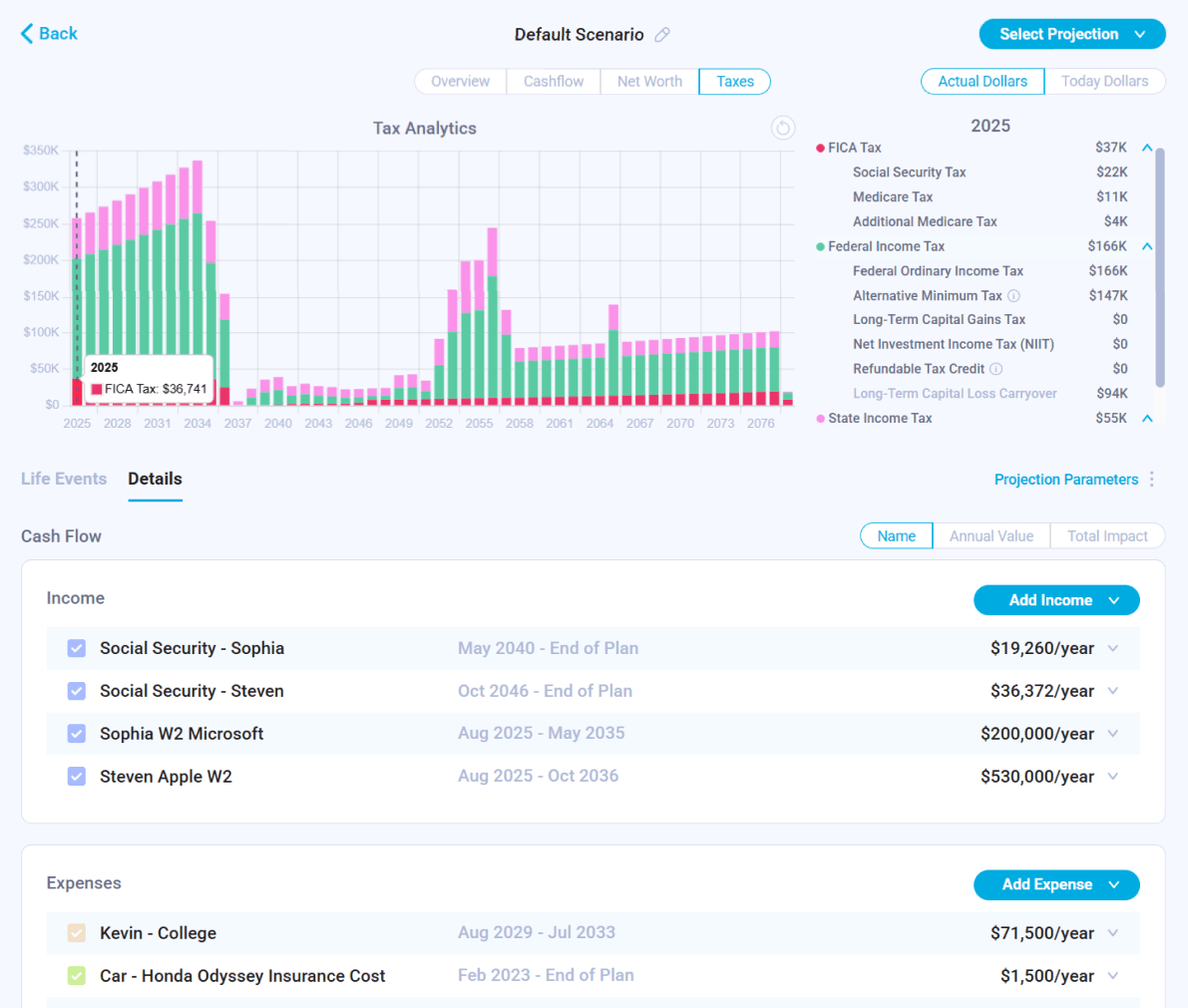
The federal formula for taxing Social Security benefits is straightforward to state but surprisingly complex to optimize in practice. Your Social Security tax depends on the composition of all your other income — ordinary income from traditional account withdrawals, capital gains, Roth distributions (which are not counted in combined income), interest, and dividend income. The interaction of these sources determines whether 0%, 50%, or 85% of your Social Security benefit is taxable, and at what marginal rate.
A financial projection that incorporates Social Security taxation needs to model:
- The Social Security benefit amount based on your earnings history and claiming age
- All sources of retirement income by year: traditional IRA/401(k) withdrawals, Roth distributions, taxable account capital gains, interest, and dividends
- The combined income calculation (AGI + non-taxable interest + 50% of Social Security) and which threshold bracket it falls into each year
- The interaction with RMDs, which begin at 73 and can sharply increase combined income in later retirement years
- State-level Social Security taxation based on your state of domicile in each year
- IRMAA brackets, which use a two-year lookback on MAGI to set Medicare Part B and D premiums — a secondary consequence of high combined income that is easily modeled but rarely shown in simple calculators
Static calculations — "I will receive $3,000/month at 70 and pay tax at 22%" — miss the dynamic interactions entirely. A projection that shows you what your combined income, taxable Social Security, RMD, Roth conversion space, and effective tax rate looks like in each year from retirement to age 90 allows you to make deliberate decisions: whether to defer Social Security to 70 or take it at 67, how aggressively to convert in years before benefits start, which accounts to draw from first to manage combined income below the 50% threshold in early benefit years. Nauma builds these multi-decade projections for tech workers — integrating RSU vesting history, account balances across all account types, planned Roth conversions, and Social Security start date scenarios — so you can see the full tax picture rather than estimating each piece in isolation.
Spousal and Survivor Benefits
Social Security includes spousal and survivor benefits that are particularly relevant for tech worker households where one partner has significantly higher lifetime earnings than the other — a common pattern where one partner paused their career for family or pursued a lower-paying field.
A spouse who earned little or nothing of their own can claim up to 50% of their partner's PIA at full retirement age. This benefit is available regardless of whether the lower-earning spouse ever worked. If the higher-earning tech worker defers to 70, the spousal benefit remains based on the PIA at full retirement age, not the 70-year-old enhanced benefit. Survivor benefits, however, are based on the actual benefit the deceased spouse was receiving — meaning deferring to 70 permanently raises the survivor benefit, which provides important longevity insurance for the lower-earning spouse who may outlive the higher earner.
Social Security and the Tech FIRE Plan: Putting It Together
For a tech worker who retires at 42 with a $3,000,000 portfolio and plans to claim Social Security at 70, the benefit is not irrelevant — it is a significant late-career income source that reshapes the entire withdrawal plan. Modeling it correctly requires treating Social Security as a deferred annuity that begins at a specific date, taxed at a rate that depends on all other income sources in that year, and whose optimal start date is not 62 but depends on the size and composition of the portfolio.
The high-level principles:
- Retire with at least 10 years (40 quarters) of Social Security coverage to qualify for any benefit
- Additional years of earnings, even at lower Barista FIRE rates, replace zeros in the 35-year average and increase the eventual benefit
- Defer claiming to at least full retirement age (67) — and ideally 70 — unless health, cash flow, or survivorship considerations argue otherwise
- Use the years between early retirement and age 70 as the primary Roth conversion window
- Structure post-70 withdrawals to minimize combined income and keep Social Security taxation in the 0%–50% range rather than the 85% range
- Retire to a state that does not tax Social Security — or confirm that your target state exempts it before establishing domicile
- Model the full interaction in a financial projection tool before locking in any of these decisions
Frequently Asked Questions
Model Your Social Security Strategy
Nauma builds your personalized Social Security projection — integrating claiming age scenarios, Roth conversion windows, RMD interactions, and state tax rules — so you can see the full tax picture across your entire retirement.
Get Started for Free