'%3e%3cpath%20d='M136%2043.0521C135.893%2043.4991%20131.298%2041.3697%20123.51%2041.5186C120.787%2041.5712%20109.626%2040.8001%20104.06%2049.4228C101.316%2053.664%20102.266%2056.2491%20100.601%2061.5769C95.2065%2078.8661%2087.7394%2075.1856%2062.5302%2088.5228C54.5058%2092.764%2045.1595%20101.562%2043.5589%20103.087C31.9403%20114.163%2025.1664%20123.189%2025.1521%20123.171C25.1378%20123.162%2034.1912%20104.357%2047.7676%2082.7655C60.6795%2062.2429%2063.8235%2070.0769%2079.7722%2049.1336C81.7015%2046.6011%2084.8526%2037.6805%2089.683%2036.1032C93.6345%2034.815%2098.6148%2036.6114%20100.065%2038.5568C101.044%2039.8712%20101.459%2040.765%20103.831%2040.4408C110.048%2039.5996%20113.613%2039.8625%20115.492%2039.7748C116.95%2039.7047%20119.751%2039.915%20120.509%2039.9939C130.419%2040.9753%20136.15%2042.4563%20136.007%2043.0434L136%2043.0521Z'%20fill='%23127398'/%3e%3cpath%20d='M22.1867%2043.6392C30.3968%2055.0923%2031.5544%2062.348%2040.6506%2068.6923C45.9954%2072.4253%2053.4839%2075.4134%2058.2928%2075.5361C61.9084%2075.6325%2063.7305%2075.2557%2064.6023%2074.949C64.8524%2074.8614%2065.1025%2074.8351%2065.3597%2074.8263L76.0636%2070.6727C76.8068%2066.8871%2076.1637%2063.4784%2076.1065%2063.1892C75.0561%2058.0103%2072.3337%2053.3835%2070.5402%2051.2542C55.4561%2033.3428%2055.8062%2034.298%2046.5814%2028.0237C26.7884%2014.5902%20-1.22192%2021.3464%200.0428309%2022.0562C0.55016%2022.3454%2010.2394%2026.9634%2022.1867%2043.6392Z'%20fill='%23127398'/%3e%3cpath%20d='M79.8366%2044.0161C81.33%2046.4784%2083.4093%2051.5784%2083.7666%2056.8975C83.7952%2057.3094%2084.1667%2064.0393%2080.4654%2068.4733C78.5004%2070.8217%2076.2281%2071.5403%2075.585%2071.7506C61.487%2076.5264%2028.4319%20116.196%2023.3515%20133.494C23.2229%20133.941%2022.6227%20136.026%2022.5655%20136C22.3797%20135.921%2023.5373%20120.753%2028.925%20106.303C28.925%20106.303%2033.7196%2090.5295%2046.7387%2073.9326C49.1896%2070.8042%2052.8052%2067.0362%2052.8052%2067.0362C54.2414%2065.1434%2059.8006%2068.3068%2066.1887%2068.482C69.9401%2068.5872%2073.2198%2067.6846%2073.2055%2067.3604C73.2055%2067.2377%2073.0698%2067.0712%2072.8911%2066.9047C72.3195%2066.3702%2071.5907%2066.1423%2070.8761%2066.2475C69.9758%2066.379%2068.1323%2066.3877%2064.5738%2065.5903C59.8435%2064.5212%2052.8481%2060.096%2048.0534%2055.364C39.9076%2047.3109%2039.7147%2039.9238%2033.1051%2026.9985C23.4944%208.17586%2014.0767%201.32328%2014.0767%201.32328C17.285%20-1.64734%2041.451%20-0.788575%2059.229%2016.3692C67.5177%2024.3697%2067.2962%2023.3619%2079.8366%2044.0073V44.0161Z'%20fill='%23EF9920'/%3e%3c/g%3e%3cdefs%3e%3cclipPath%20id='clip0_882_3310'%3e%3crect%20width='136'%20height='136'%20fill='white'/%3e%3c/clipPath%3e%3c/defs%3e%3c/svg%3e)
Retirement Withdrawal Order: Which Accounts First
The Sequence of Withdrawals Determines as Much of Your Lifetime Tax Bill as the Amounts Themselves
Most retirement planning focuses on accumulation: how much to save, where to invest, what rate of return to assume. Far less attention goes to decumulation — the sequence in which you draw down accounts once work ends. That sequence matters enormously. Withdraw from the wrong account in the wrong year and you can push yourself into a higher bracket, trigger IRMAA Medicare surcharges, cause Social Security benefits to become taxable, or surrender ACA premium subsidies you were entitled to. Withdraw in the right order and you preserve tax-advantaged growth, minimize lifetime taxes, and keep more of what you saved.
For tech workers retiring with three distinct pools of money — taxable brokerage accounts built from RSU proceeds, large pre-tax 401(k) and IRA balances from years of maximum contributions, and Roth accounts funded through conversions or direct contributions — the withdrawal sequence decision is one of the most consequential financial choices of retirement. This guide provides the framework for making it deliberately.
The Three Buckets and Their Tax Treatment
Every dollar you hold in retirement falls into one of three tax categories, and understanding them is the starting point for sequencing decisions.
Taxable accounts — brokerage accounts, taxable investment accounts, bank accounts — contain money that has already been taxed. When you sell investments in a taxable account, you owe capital gains tax on the appreciation: 0% if your taxable income is below $98,900 (MFJ, 2026), 15% up to $613,700, and 20% above that. Dividends and interest generate income each year regardless of whether you sell. For early retirees in a low-income year, much of the gain from a taxable account can be harvested at 0% — permanently avoiding any federal capital gains tax on that appreciation. Withdrawals from taxable accounts do not count as ordinary income and do not directly push you into higher ordinary income brackets, though gains do affect MAGI.
Traditional (pre-tax) accounts — traditional IRAs, rollover IRAs, 401(k)s, 403(b)s, 457(b)s — contain money that was contributed pre-tax and has grown tax-deferred. Every dollar withdrawn is taxed as ordinary income in the year of withdrawal, stacked on top of all other income. There are no options, no rate reductions, no preferential treatment — ordinary income tax at your marginal rate. These accounts also generate Required Minimum Distributions beginning at age 73 (born 1951–1959) or 75 (born 1960 or later), forcing taxable withdrawals whether you need the money or not. For a detailed treatment of how those mandatory withdrawals interact with your tax rate, see How RMDs Affect Your Retirement Tax Rate.
Roth accounts — Roth IRAs and Roth 401(k)s — contain money that was taxed before contribution and has grown entirely tax-free. Qualified withdrawals are completely tax-free: no ordinary income tax, no capital gains tax, no NIIT, no effect on MAGI for Social Security taxation or IRMAA calculations. Roth IRAs have no RMDs during the original owner's lifetime. Roth 401(k)s no longer have RMDs either, following the SECURE 2.0 change effective 2024. Roth accounts are the most valuable asset in retirement from a tax perspective — and because of that, they are typically the last to be spent.
The Four Income Sources That Interact With Withdrawals
Before setting a withdrawal sequence, it helps to map all income sources in retirement and understand how they interact:
Social Security is ordinary income once it exceeds the combined income thresholds — AGI plus tax-exempt interest plus half of benefits. Up to 85% of benefits can be taxable. Crucially, Social Security income is fixed once you start claiming and cannot be reduced or timed differently. The decision of when to claim (62 through 70) is made once and affects every subsequent year. See Social Security for the claiming strategy and benefit calculation.
Required Minimum Distributions from traditional accounts are mandatory and non-negotiable starting at age 73 or 75. They add ordinary income that interacts with every other income source. The Tax Torpedo — the spike in effective marginal rates when RMDs push Social Security benefits into taxable territory — is the single most significant tax risk in retirement for tech workers with large pre-tax balances.
Investment income from taxable accounts — dividends, interest, capital gain distributions from mutual funds — occurs automatically whether or not you sell anything. It adds to MAGI every year. For retirees with large taxable brokerage accounts built from years of RSU liquidations, this baseline investment income can be $20,000–$60,000 per year before any additional withdrawals.
Pension or annuity income, if present, is fixed ordinary income that stacks on everything else and cannot be timed.
The Default Rule — and Why It Fails Tech Workers
The conventional wisdom in retirement planning follows a three-step sequence: spend taxable accounts first, then traditional accounts, then Roth accounts last. The logic is that Roth accounts grow tax-free indefinitely, so preserve them as long as possible.
This default makes sense in specific circumstances — particularly for retirees who retire close to traditional retirement age (62–65), have modest pre-tax balances, and have limited opportunity for Roth conversion before RMDs begin.
For many tech workers, the default is exactly backwards in the critical early retirement years. Here is why:
A software engineer who retires at 45 with $1,800,000 in a traditional 401(k), $400,000 in Roth IRAs, and $600,000 in taxable brokerage accounts faces 28 years before RMDs begin at 73. If that traditional balance grows at 6% annually with no withdrawals, it reaches approximately $9,200,000 by age 73 — generating RMDs of $347,000 in the first year alone, all taxed as ordinary income, all stacked on top of Social Security, all pushing Medicare premiums into the highest IRMAA tiers.
The problem is not the withdrawal order at age 73. The problem is what happened between age 45 and 73: the traditional account was left to compound untouched while the retiree spent taxable and Roth funds. By the time RMDs are mandatory, the damage is done.
The correct strategy for early retirees with large pre-tax balances inverts the default: spend some taxable accounts, convert traditional accounts to Roth aggressively in the low-income years before Social Security and RMDs arrive, and preserve Roth accounts for later. The Roth conversion is not an alternative to the withdrawal sequence — it is the withdrawal sequence for the pre-RMD years.
The Five Phases of Retirement Withdrawals
Rather than a single sequence, retirement withdrawals are best understood as five distinct phases, each with different income sources, different tax opportunities, and different optimal strategies.
Phase 1: Early Retirement Before Medicare (Age 45–65)
This is the highest-value tax planning window for tech workers who retire early. Earned income has dropped to zero or near-zero. Social Security has not started. RMDs are 8–30 years away. The marginal tax rate is at its lifetime low.
Priority in this phase: Roth conversions, not spending down taxable accounts.
The optimal approach is to convert traditional IRA and 401(k) balances to Roth up to the top of a low bracket — typically the 22% or 24% federal bracket — each year. The converted amount is taxable income, but it permanently moves assets from the future high-tax bucket (ordinary income forced by RMDs) to the tax-free bucket (Roth). A tech worker who converts $80,000–$100,000 per year from age 45 to 65 reduces the traditional balance by $1,600,000–$2,000,000 before RMDs begin, dramatically lowering future mandatory distributions and their downstream effects.
For living expenses during this phase, use taxable brokerage account withdrawals — specifically, selling positions with long-term gains that fall in the 0% capital gains bracket. In 2026, the 0% rate applies to taxable income up to $98,900 for MFJ. A couple with $80,000 of Roth conversion income and $32,200 standard deduction has taxable income of about $47,800 — well within the 0% LTCG zone. They can realize $30,000–$40,000 in long-term capital gains on top of the conversion at zero federal tax. This is one of the most powerful tax strategies in early retirement.
ACA interaction: Before Medicare at 65, health insurance typically comes from the ACA marketplace. ACA premium tax credits phase out as MAGI rises. Roth conversion income counts toward MAGI and reduces subsidies. For couples at $55,000–$80,000 MAGI receiving $15,000–$20,000 in ACA credits, a large Roth conversion is expensive. The ACA subsidy constraint is real and must be modeled carefully. Some early retirees deliberately hold Roth conversions to modest amounts during ACA years to preserve subsidies, then convert more aggressively after Medicare eligibility at 65. See Roth Conversions for the detailed ACA and bracket interaction analysis.
Phase 2: Early Medicare Years Before Social Security (Age 65–70)
Medicare begins at 65, eliminating the ACA subsidy constraint. Social Security has not yet started — especially for those maximizing benefits by delaying to 70. This is often the second-best Roth conversion window, with earned income still zero and Social Security not yet contributing to MAGI.
Priority: Continue aggressive Roth conversions, now up to IRMAA Tier 1 boundary.
The first IRMAA tier for MFJ begins at $218,000 MAGI in 2026 (based on 2024 income under the two-year lookback). A couple converting $150,000–$180,000 per year — filling the 24% bracket — can make enormous progress reducing the pre-tax balance while staying below the IRMAA threshold that would add Medicare surcharges. The two-year IRMAA lookback is critical here: a large conversion in 2026 affects 2028 premiums, so conversions in the years just before Medicare eligibility require forward planning.
Living expenses continue to come from taxable account proceeds and Roth contribution basis (direct Roth IRA contributions, not conversions, can be withdrawn any time without penalty or tax).
Phase 3: Social Security Begins (Age 62–70, Whenever You Claim)
Once Social Security starts, combined income rises permanently by approximately half the annual benefit. For a couple receiving $48,000 in combined benefits, combined income for SS taxation purposes rises by $24,000 (½ × $48,000) regardless of whether benefits are taxable that year. This narrows the Roth conversion window — every conversion dollar must now clear a higher base of combined income before approaching the torpedo thresholds.
Priority: Balance Roth conversions against Social Security torpedo risk.
For retirees who delayed Social Security to 70, Phase 3 coincides with ages 70–73 (before RMDs begin). This is often the tightest planning window: large Social Security benefits have just begun, RMDs are 3 years away, and the conversion window is closing. Conversions in this phase should target the gap between current taxable income and the torpedo zone — typically smaller annual amounts than Phase 1 or 2.
Living expenses in Phase 3 can increasingly come from Social Security itself, reducing the need to sell taxable or Roth assets. The income from Social Security covers a growing share of spending without generating additional withdrawal-related tax events.
Phase 4: RMD Years (Age 73/75 Onward)
RMDs begin and cannot be avoided. Every year, the IRS requires a minimum withdrawal from traditional accounts — approximately 3.8%–6%+ of the balance depending on age, growing each year. The sequencing question in this phase is not whether to withdraw from traditional accounts but what else to pair with the mandatory withdrawals.
Priority: Cover spending needs from RMDs first, supplement with Roth for tax management.
For retirees whose RMDs exceed their spending needs, the excess after-tax RMD proceeds go into a taxable brokerage account — invested in low-cost, tax-efficient index funds where future growth compounds with minimal ongoing tax drag. This is not avoidable; it is simply managing the aftermath.
For retirees whose RMDs fall short of spending needs, Roth IRA withdrawals cover the gap. Roth withdrawals are tax-free and — critically — do not count toward MAGI. Using Roth funds to supplement RMDs keeps MAGI lower, potentially avoiding the next IRMAA tier, keeping more Social Security tax-free, and avoiding NIIT on investment income. The Roth accounts function as a tax pressure valve: spend them down in high-income years when traditional income is already forcing rates up.
Qualified Charitable Distributions are also available from age 70½ onward: up to $111,000 per person per year can be transferred directly from a traditional IRA to charity, satisfying the RMD obligation for that amount while excluding it from AGI entirely. For retirees with charitable intent, QCDs are the most tax-efficient way to both manage RMD income and fulfill philanthropic goals.
Phase 5: Late Retirement and Estate Considerations (Age 80+)
In late retirement, the interplay of declining health expenses, estate planning goals, and diminishing life expectancy changes the calculus.
Priority: Balance consumption, legacy, and final tax minimization.
Roth accounts pass to heirs income-tax-free (though heirs must distribute inherited Roth IRAs within 10 years under the SECURE Act). Traditional accounts inherited by non-spouse beneficiaries must also be distributed within 10 years — and those distributions are ordinary income for the heirs. A large traditional IRA left to heirs in a high-income tax bracket can generate enormous tax liability concentrated in 10 years. Converting to Roth before death — or spending down traditional accounts — is often more tax-efficient for the combined family unit than preserving traditional balances for heirs.
Stepped-up basis at death applies to taxable accounts: heirs receive the assets at fair market value on the date of death, wiping out embedded capital gains permanently. This makes taxable accounts with large unrealized gains the most tax-efficient to pass to heirs — they receive a full reset of basis. Conversely, taxable accounts should generally be spent before death rather than Roth accounts, since heirs can receive the taxable account's gains tax-free via stepped-up basis, while Roth accounts are already tax-free and can be inherited without the same urgency.
Putting It Together: A Decision Framework
In early retirement before Medicare (under 65): Live on taxable brokerage proceeds using 0% capital gains harvesting. Convert traditional IRA to Roth up to your bracket ceiling. Stay below ACA subsidy cliffs if ACA coverage matters. Prioritize converting the highest-balance, highest-growth traditional assets first.
In early retirement on Medicare, before Social Security (65–70): Expand Roth conversions — ACA constraint is gone. Convert up to IRMAA Tier 1 boundary ($218,000 MAGI for MFJ). If below that threshold, consider converting into the 24% bracket. Continue taxable account spending for living expenses.
After Social Security starts: Convert modestly — only to fill the gap between current income and torpedo thresholds. Let Social Security cover operating expenses. Reduce taxable account draws.
In RMD years: Take RMDs first. Cover additional spending from Roth. Use QCDs for charitable giving. Reinvest excess RMD proceeds in taxable accounts.
In late retirement: Spend traditional accounts and taxable accounts preferentially. Preserve Roth for the highest-income years and for heirs unless you have large charitable bequests planned.
The Most Common Sequencing Mistakes
Leaving the traditional account untouched in early retirement. The most expensive mistake. Every year of 6–8% compounding in a traditional account is a year of future RMD growth that cannot be undone. The window for converting at low rates is finite — once RMDs begin and Social Security is in payment, the rates are locked in high.
Converting too aggressively while on ACA. A $100,000 conversion that destroys $18,000 in ACA subsidies is often a losing trade. The effective rate on the conversion may exceed 40% once subsidy loss is included — higher than the future rate the conversion was meant to avoid.
Ignoring the two-year IRMAA lookback. A large conversion or capital gain realization in 2026 sets Medicare premiums in 2028. Retirees who model only the current year's tax bill miss the two-year shadow that falls on Medicare costs.
Spending Roth accounts early for living expenses. Using Roth funds at 50 to avoid a modest amount of tax in the current year, only to face RMD-forced income at 75 with no Roth buffer left, is a common sequencing error among early retirees who did not model the full trajectory.
Taking Social Security early to avoid drawing down accounts. Claiming at 62 instead of 70 permanently reduces the benefit by up to 30%. The lower benefit is ordinary income forever — a permanent reduction in guaranteed income in exchange for preserving a few years of portfolio withdrawals. For most tech workers with substantial portfolios, delaying Social Security and spending down accounts in the interim is more valuable than claiming early.
Frequently Asked Questions
Model Your Withdrawal Sequence
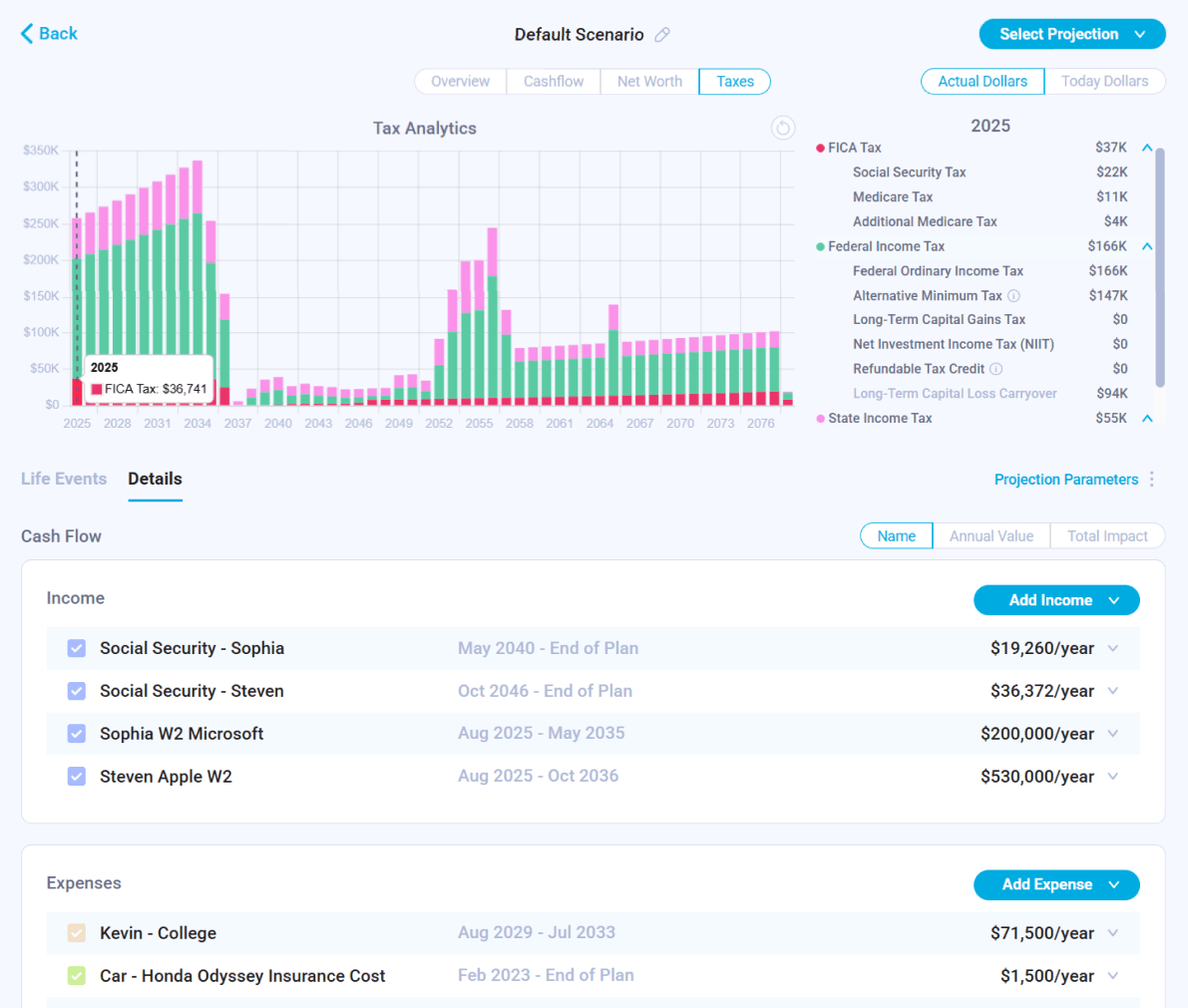
See how different withdrawal sequences — taxable first, Roth conversions now versus later, Social Security timing — affect your year-by-year tax rate and lifetime tax bill in Nauma's retirement projections.
Get Started for Free