'%3e%3cpath%20d='M136%2043.0521C135.893%2043.4991%20131.298%2041.3697%20123.51%2041.5186C120.787%2041.5712%20109.626%2040.8001%20104.06%2049.4228C101.316%2053.664%20102.266%2056.2491%20100.601%2061.5769C95.2065%2078.8661%2087.7394%2075.1856%2062.5302%2088.5228C54.5058%2092.764%2045.1595%20101.562%2043.5589%20103.087C31.9403%20114.163%2025.1664%20123.189%2025.1521%20123.171C25.1378%20123.162%2034.1912%20104.357%2047.7676%2082.7655C60.6795%2062.2429%2063.8235%2070.0769%2079.7722%2049.1336C81.7015%2046.6011%2084.8526%2037.6805%2089.683%2036.1032C93.6345%2034.815%2098.6148%2036.6114%20100.065%2038.5568C101.044%2039.8712%20101.459%2040.765%20103.831%2040.4408C110.048%2039.5996%20113.613%2039.8625%20115.492%2039.7748C116.95%2039.7047%20119.751%2039.915%20120.509%2039.9939C130.419%2040.9753%20136.15%2042.4563%20136.007%2043.0434L136%2043.0521Z'%20fill='%23127398'/%3e%3cpath%20d='M22.1867%2043.6392C30.3968%2055.0923%2031.5544%2062.348%2040.6506%2068.6923C45.9954%2072.4253%2053.4839%2075.4134%2058.2928%2075.5361C61.9084%2075.6325%2063.7305%2075.2557%2064.6023%2074.949C64.8524%2074.8614%2065.1025%2074.8351%2065.3597%2074.8263L76.0636%2070.6727C76.8068%2066.8871%2076.1637%2063.4784%2076.1065%2063.1892C75.0561%2058.0103%2072.3337%2053.3835%2070.5402%2051.2542C55.4561%2033.3428%2055.8062%2034.298%2046.5814%2028.0237C26.7884%2014.5902%20-1.22192%2021.3464%200.0428309%2022.0562C0.55016%2022.3454%2010.2394%2026.9634%2022.1867%2043.6392Z'%20fill='%23127398'/%3e%3cpath%20d='M79.8366%2044.0161C81.33%2046.4784%2083.4093%2051.5784%2083.7666%2056.8975C83.7952%2057.3094%2084.1667%2064.0393%2080.4654%2068.4733C78.5004%2070.8217%2076.2281%2071.5403%2075.585%2071.7506C61.487%2076.5264%2028.4319%20116.196%2023.3515%20133.494C23.2229%20133.941%2022.6227%20136.026%2022.5655%20136C22.3797%20135.921%2023.5373%20120.753%2028.925%20106.303C28.925%20106.303%2033.7196%2090.5295%2046.7387%2073.9326C49.1896%2070.8042%2052.8052%2067.0362%2052.8052%2067.0362C54.2414%2065.1434%2059.8006%2068.3068%2066.1887%2068.482C69.9401%2068.5872%2073.2198%2067.6846%2073.2055%2067.3604C73.2055%2067.2377%2073.0698%2067.0712%2072.8911%2066.9047C72.3195%2066.3702%2071.5907%2066.1423%2070.8761%2066.2475C69.9758%2066.379%2068.1323%2066.3877%2064.5738%2065.5903C59.8435%2064.5212%2052.8481%2060.096%2048.0534%2055.364C39.9076%2047.3109%2039.7147%2039.9238%2033.1051%2026.9985C23.4944%208.17586%2014.0767%201.32328%2014.0767%201.32328C17.285%20-1.64734%2041.451%20-0.788575%2059.229%2016.3692C67.5177%2024.3697%2067.2962%2023.3619%2079.8366%2044.0073V44.0161Z'%20fill='%23EF9920'/%3e%3c/g%3e%3cdefs%3e%3cclipPath%20id='clip0_882_3310'%3e%3crect%20width='136'%20height='136'%20fill='white'/%3e%3c/clipPath%3e%3c/defs%3e%3c/svg%3e)
What Is the Bucket Strategy?
A Time-Segmented Approach to Retirement Income That Separates Short-Term Needs From Long-Term Growth
This article provides general information about retirement income planning concepts and is intended for educational purposes only. It does not constitute personalized financial, tax, or investment advice.
The bucket strategy — also called time segmentation or the time-segmented approach — is a retirement income framework that divides a portfolio into distinct pools based on when the money will be needed. Each pool, or bucket, holds assets appropriate for its time horizon: short-term money is held in stable, liquid instruments; money needed further out is held in assets that can tolerate volatility in exchange for higher expected returns.
The result is a portfolio structure designed to answer a specific problem: how to stay invested in growth assets for the long term while knowing with confidence that near-term spending needs will not require selling equities at an inopportune moment.
The Problem the Bucket Strategy Solves
The challenge for a retiree withdrawing from a portfolio is timing. Equities are expected to outperform bonds and cash over long periods, but they do so with significant short-term volatility. A retiree who needs $8,000 per month to live on and holds most of their savings in equities faces an uncomfortable situation when markets fall 30%: selling equities at depressed prices to fund current expenses, locking in losses that cannot recover.
This is the mechanism behind sequence of return risk — the specific danger that early retirement losses permanently impair a portfolio because withdrawals force selling at the worst time. See What Is Sequence of Return Risk? for a full explanation of why early-retirement losses are disproportionately damaging.
The bucket strategy directly addresses this problem: by keeping short-term expenses in cash or near-cash instruments that are unaffected by equity market volatility, the retiree is never forced to sell growth assets during a downturn. The equities can decline, and the retiree still has the funds to pay their bills.
The Three-Bucket Structure
The classic bucket strategy uses three buckets, each with a different time horizon and asset composition.
Bucket 1: Immediate Needs (Years 1–2)
Bucket 1 holds 1–2 years of living expenses in cash or cash equivalents: money market accounts, high-yield savings accounts, short-term Treasury bills, or certificates of deposit. This bucket has no market risk. Its purpose is not to generate returns — it is to provide certainty. When the monthly withdrawal is needed, it comes from Bucket 1 without any selling of other assets and without any dependency on market conditions.
Many financial professionals suggest holding 1–3 years of total expenses in Bucket 1, though practitioners differ on the precise amount. A larger Bucket 1 provides more cushion and more time for other buckets to recover from market stress; a smaller Bucket 1 minimizes the drag of holding low-returning cash. It is worth noting that Bucket 1 is subject to inflation risk — cash held over 2–3 years will lose some purchasing power if inflation is elevated, which is a real cost of the liquidity buffer.
Bucket 2: Medium-Term Income (Years 3–10)
Bucket 2 holds 3–10 years of expenses in income-producing assets: intermediate-term bonds, bond funds, dividend-paying stocks, or a bond ladder. This bucket is designed to generate income and preserve capital, with modest return expectations. Its volatility is lower than equities but its return is higher than cash.
Bucket 2 serves two functions: it provides the next layer of withdrawal funds after Bucket 1 is depleted, and it refills Bucket 1 over time. When Bucket 1 runs low, assets from Bucket 2 are sold or distributed to refill it. This maintains the cash buffer without requiring equity liquidation.
A bond ladder — a sequence of bonds maturing in successive years — is a natural Bucket 2 instrument because it provides predictable cash flows at defined dates, matching the systematic refilling of Bucket 1. See Bond Ladder for how this implementation works in practice.
Bucket 3: Long-Term Growth (Years 10+)
Bucket 3 holds everything beyond the medium-term: equities, real estate investment trusts, and other growth assets with long time horizons. This bucket is invested for maximum long-term growth, accepting short-term volatility because the money is not needed for at least 10 years. During market downturns, Bucket 3 is not touched — it is allowed to decline and recover on its own timeline.
It is important to acknowledge that Bucket 3, as an equity-heavy portfolio, can lose significant value and may remain at depressed levels for extended periods. The strategy does not eliminate investment risk — it provides a time buffer that reduces the likelihood of being forced to sell Bucket 3 assets at a loss.
Over time, Bucket 3 refills Bucket 2: as equity markets recover and Bucket 3 grows, assets are periodically transferred to Bucket 2 to rebuild the medium-term reserve.
The Refilling Sequence
The mechanics of bucket refilling are central to how the strategy functions over time.
During normal market conditions, Bucket 3 is periodically "harvested" — a portion of equity gains is realized and transferred to Bucket 2, which in turn funds the ongoing refilling of Bucket 1. This buy-high/sell-high cycle is built into the system: Bucket 3 is harvested during good equity years, and left alone during bad ones.
During market downturns, the refilling sequence reverses: Bucket 1 is spent down normally; Bucket 2 refills Bucket 1 from bond income and maturing bond positions; Bucket 3 is left completely undisturbed. If the downturn extends for several years, Bucket 2 absorbs the withdrawal pressure for the duration. By the time Bucket 2 needs refilling, equity markets have typically recovered enough for Bucket 3 to contribute without realizing losses.
This is the core behavioral benefit of the bucket strategy: a clearly defined rule for what to do in a market downturn that does not require selling equities. Without a framework, the pressure to reduce risk after a major market decline — selling equities to "stop the bleeding" — is a common and costly behavioral mistake. The bucket strategy makes the correct action (hold Bucket 3, spend Bucket 1) the default action.
Does the Bucket Strategy Improve Returns?
Research on whether the bucket strategy mathematically outperforms a single balanced portfolio with systematic withdrawal is mixed — and this is an important nuance.
Studies including work by Morningstar researcher Christine Benz and financial planner Michael Kitces have found that the bucket strategy does not consistently produce better mathematical outcomes than a single balanced portfolio with equivalent overall asset allocation and the same withdrawal rate. A retiree with a 30% bond allocation who implements a three-bucket structure is not necessarily doing better mathematically than one who holds a 70/30 portfolio and withdraws systematically. The cash drag from holding Bucket 1 in low-returning instruments is a real cost, and the bucket structure does not change the underlying math of withdrawal sustainability.
What the bucket strategy does provide — and what research consistently confirms — is a behavioral and psychological benefit that may be worth more than any incremental mathematical advantage. Retirees using the bucket strategy report significantly lower anxiety about market volatility because they can clearly see that short-term needs are protected. This behavioral benefit reduces the likelihood of panic selling during downturns, which is one of the most damaging financial behaviors in retirement.
The strategy also provides a clear, actionable decision rule during market stress: look at Bucket 1. If it's funded, do nothing. This clarity has real value.
The Bucket Strategy and Dynamic Withdrawal
The bucket strategy and dynamic withdrawal are compatible frameworks that address different aspects of retirement income management. The bucket strategy addresses the structural question of how assets are organized and accessed. Dynamic withdrawal addresses the question of how much is withdrawn in total each year.
A retiree can use both simultaneously: the bucket structure determines which pool funds the current withdrawal; the dynamic withdrawal rules determine how large that withdrawal should be in a given year based on portfolio conditions. In a year when Bucket 3 has declined 20%, both the bucket strategy (spend Bucket 1, don't touch Bucket 3) and a dynamic withdrawal rule (reduce spending modestly this year) point in the same direction. See What Is Dynamic Withdrawal? for how spending rules interact with the bucket structure.
Practical Implementation
How Large Should Each Bucket Be?
A common framework involves the following sizing, though the right amounts depend on individual circumstances:
Bucket 1 (1–3 years of expenses): For a retiree spending $120,000 per year, Bucket 1 is $120,000–$360,000 in cash or near-cash.
Bucket 2 (3–10 years of expenses): The same retiree would hold $360,000–$1,200,000 in bonds or a bond ladder. Many practitioners target approximately 5–7 years of expenses in Bucket 2.
Bucket 3 (the remainder): Everything above Bucket 1 and Bucket 2 is held in equities and growth assets.
Illustrative example: On a $3,000,000 portfolio with $120,000 in annual expenses: Bucket 1 = $240,000 (2 years), Bucket 2 = $720,000 (6 years), Bucket 3 = $2,040,000. The resulting equity allocation is approximately 68% — a reasonable growth-oriented allocation for a 65-year-old with a 30-year horizon. Individual circumstances will differ.
When to Refill
Most practitioners recommend reviewing and refilling buckets annually or after significant market movements. A specific trigger used by some advisors: refill Bucket 1 when it falls to 6 months of expenses; refill Bucket 2 when it falls below the 3-year target. These triggers prevent the buckets from running dry before the investor acts.
Account Types and Tax Efficiency
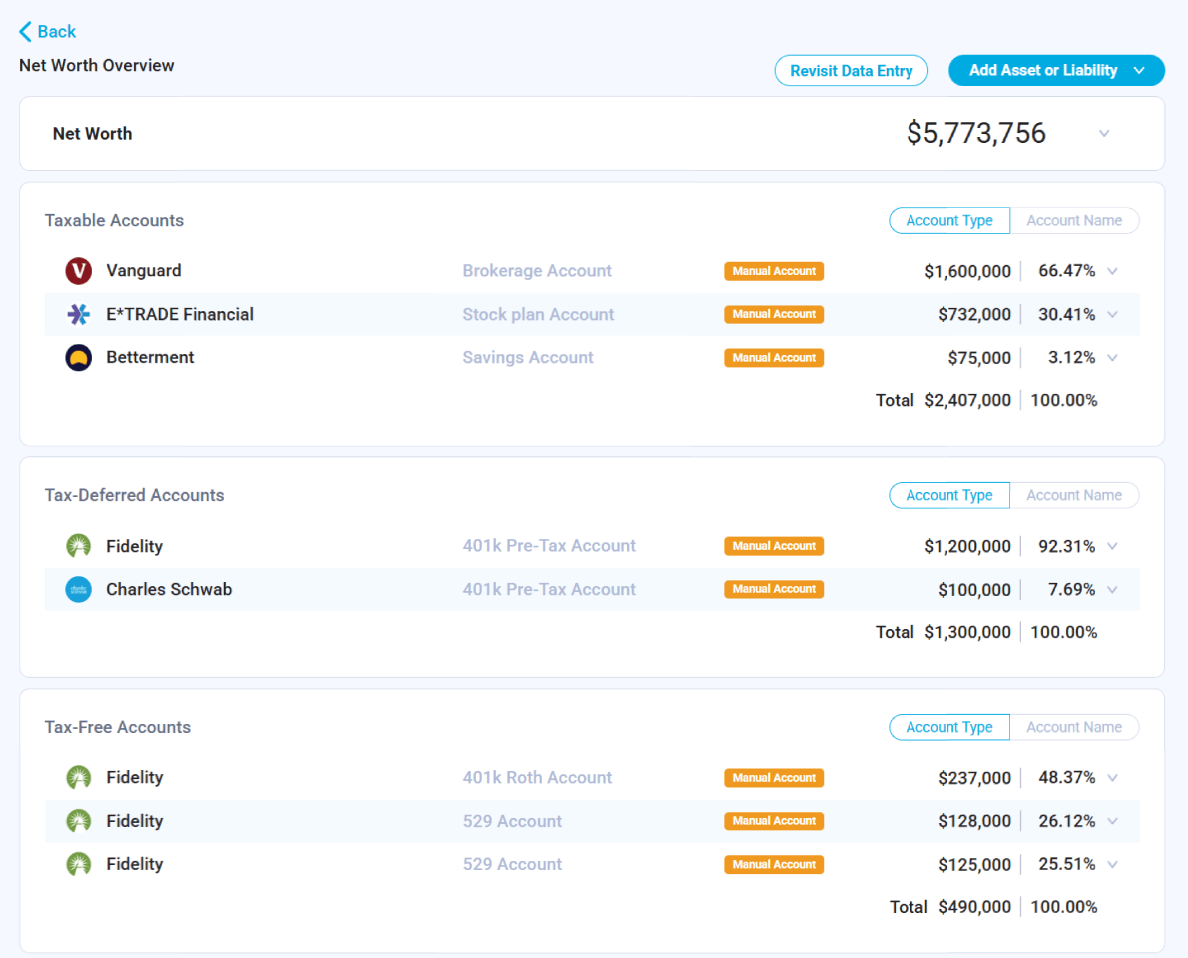
The bucket structure should account for account type. Bucket 1 is naturally held in a taxable account (for immediate access). Bucket 2 bonds can be held in either a taxable or tax-advantaged account — holding them in a traditional IRA is often efficient since bond interest is taxed as ordinary income regardless, and the IRA defers that tax. Bucket 3 equities can be held across account types, with tax-advantaged placement for the highest-expected-return assets and tax-efficient funds (broad index ETFs) in the taxable account to minimize annual tax drag.
California Note
For California investors, the bucket strategy has specific tax implications at the refilling stage. When Bucket 3 equities are harvested to refill Bucket 2, those sales in a taxable account realize capital gains taxable as ordinary income in California at rates up to 13.3% (as of 2026, including the Mental Health Services Act surtax on income over $1 million). California does not have a separate preferential rate for long-term capital gains — all gains are taxed as ordinary income at the state level. Tax law is subject to legislative change, so confirming current rates with a tax professional is advisable.
Strategic refilling — selling from Bucket 3 in years when taxable income is lower, or pairing harvesting with available tax losses — can reduce the California tax cost of maintaining the bucket structure. Prioritizing Bucket 3 refilling from tax-advantaged accounts (selling within a 401(k) or IRA) is the most straightforward way to avoid taxable events entirely at the refilling stage.
This article is for educational purposes only and does not constitute investment, tax, or financial advice. Portfolio strategies involve risk, and all investments may lose value — including those in Bucket 3, which can decline significantly over extended periods. Past performance does not guarantee future results. Tax rates and brackets described reflect California and federal law as of 2026 and are subject to future legislative change. Individual circumstances significantly affect which approach may be appropriate. Always consult a qualified financial advisor and tax professional before making retirement income decisions.
Frequently Asked Questions
See How Your Portfolio Is Positioned Across Goals and Time Horizons
Nauma organizes your assets by goal and shows how each portfolio is allocated — so you can evaluate your bucket structure against your actual spending timeline.
Get Started for Free