'%3e%3cpath%20d='M136%2043.0521C135.893%2043.4991%20131.298%2041.3697%20123.51%2041.5186C120.787%2041.5712%20109.626%2040.8001%20104.06%2049.4228C101.316%2053.664%20102.266%2056.2491%20100.601%2061.5769C95.2065%2078.8661%2087.7394%2075.1856%2062.5302%2088.5228C54.5058%2092.764%2045.1595%20101.562%2043.5589%20103.087C31.9403%20114.163%2025.1664%20123.189%2025.1521%20123.171C25.1378%20123.162%2034.1912%20104.357%2047.7676%2082.7655C60.6795%2062.2429%2063.8235%2070.0769%2079.7722%2049.1336C81.7015%2046.6011%2084.8526%2037.6805%2089.683%2036.1032C93.6345%2034.815%2098.6148%2036.6114%20100.065%2038.5568C101.044%2039.8712%20101.459%2040.765%20103.831%2040.4408C110.048%2039.5996%20113.613%2039.8625%20115.492%2039.7748C116.95%2039.7047%20119.751%2039.915%20120.509%2039.9939C130.419%2040.9753%20136.15%2042.4563%20136.007%2043.0434L136%2043.0521Z'%20fill='%23127398'/%3e%3cpath%20d='M22.1867%2043.6392C30.3968%2055.0923%2031.5544%2062.348%2040.6506%2068.6923C45.9954%2072.4253%2053.4839%2075.4134%2058.2928%2075.5361C61.9084%2075.6325%2063.7305%2075.2557%2064.6023%2074.949C64.8524%2074.8614%2065.1025%2074.8351%2065.3597%2074.8263L76.0636%2070.6727C76.8068%2066.8871%2076.1637%2063.4784%2076.1065%2063.1892C75.0561%2058.0103%2072.3337%2053.3835%2070.5402%2051.2542C55.4561%2033.3428%2055.8062%2034.298%2046.5814%2028.0237C26.7884%2014.5902%20-1.22192%2021.3464%200.0428309%2022.0562C0.55016%2022.3454%2010.2394%2026.9634%2022.1867%2043.6392Z'%20fill='%23127398'/%3e%3cpath%20d='M79.8366%2044.0161C81.33%2046.4784%2083.4093%2051.5784%2083.7666%2056.8975C83.7952%2057.3094%2084.1667%2064.0393%2080.4654%2068.4733C78.5004%2070.8217%2076.2281%2071.5403%2075.585%2071.7506C61.487%2076.5264%2028.4319%20116.196%2023.3515%20133.494C23.2229%20133.941%2022.6227%20136.026%2022.5655%20136C22.3797%20135.921%2023.5373%20120.753%2028.925%20106.303C28.925%20106.303%2033.7196%2090.5295%2046.7387%2073.9326C49.1896%2070.8042%2052.8052%2067.0362%2052.8052%2067.0362C54.2414%2065.1434%2059.8006%2068.3068%2066.1887%2068.482C69.9401%2068.5872%2073.2198%2067.6846%2073.2055%2067.3604C73.2055%2067.2377%2073.0698%2067.0712%2072.8911%2066.9047C72.3195%2066.3702%2071.5907%2066.1423%2070.8761%2066.2475C69.9758%2066.379%2068.1323%2066.3877%2064.5738%2065.5903C59.8435%2064.5212%2052.8481%2060.096%2048.0534%2055.364C39.9076%2047.3109%2039.7147%2039.9238%2033.1051%2026.9985C23.4944%208.17586%2014.0767%201.32328%2014.0767%201.32328C17.285%20-1.64734%2041.451%20-0.788575%2059.229%2016.3692C67.5177%2024.3697%2067.2962%2023.3619%2079.8366%2044.0073V44.0161Z'%20fill='%23EF9920'/%3e%3c/g%3e%3cdefs%3e%3cclipPath%20id='clip0_882_3310'%3e%3crect%20width='136'%20height='136'%20fill='white'/%3e%3c/clipPath%3e%3c/defs%3e%3c/svg%3e)
What Is a Flexible Spending Account (FSA)?
How an FSA Reduces Your Taxable Income for Healthcare and Dependent Care — and Why the Rules Are Different for California Residents
A flexible spending account (FSA) is an employer-sponsored benefit that lets you set aside a portion of your paycheck before taxes to pay for qualified medical expenses or dependent care costs. The money you contribute to an FSA is deducted from your gross pay before federal income tax, Social Security tax, and Medicare tax are calculated — and before California state income tax for healthcare FSAs, unlike HSAs, which California does not recognize. You spend the money on eligible expenses during the plan year, and those dollars are never taxed. Done correctly, an FSA is a straightforward way to pay for predictable healthcare and childcare costs with pre-tax dollars, effectively giving you a discount equal to your combined marginal tax rate.
FSAs are offered by employers — you cannot open one on your own. If your employer offers an FSA during open enrollment, you elect how much to contribute for the coming year, and that amount is withheld from your paycheck in equal installments. The full annual contribution is available to you on day one of the plan year, before your contributions have all been collected. That front-loaded availability is one of the features that makes FSAs useful but also one of the reasons the rules around them require care.
The Two Types of FSA
The term "FSA" covers two distinct accounts with different purposes, different eligible expenses, and different annual limits. Confusing them is a common mistake at open enrollment.
Healthcare FSA (also called a health FSA or medical FSA). The standard FSA most people mean when they say "FSA." Funds can be used for qualified medical expenses for you, your spouse, and your dependents — deductibles, copays, coinsurance, prescription drugs, dental and vision care, and a wide range of over-the-counter items. The 2026 contribution limit is $3,400 per employee — see FSA Contribution Limits for the full breakdown including rollover and grace period rules. Your employer may also contribute to your healthcare FSA, though employer contributions are less common than with HSAs.
Dependent Care FSA (DCFSA). A separate account for dependent care expenses — primarily daycare, after-school programs, summer day camps, and similar care that allows you and your spouse to work or look for work. The qualifying dependent must be a child under age 13 or a spouse or dependent who is physically or mentally incapable of self-care. The 2026 contribution limit is $7,500 per household (or $3,750 if married filing separately). Dependent care FSAs are separate from healthcare FSAs — you can hold both simultaneously, and the contribution limits are independent.
A third type — the limited-purpose FSA (LPFSA) — exists specifically for employees enrolled in a High-Deductible Health Plan (HDHP) who are also contributing to a Health Savings Account (HSA). Because most FSAs disqualify HSA contributions, the LPFSA is restricted to dental and vision expenses only. This restriction is what makes it HSA-compatible. If your employer offers both an HDHP with HSA and an FSA option at open enrollment, the FSA they offer alongside the HDHP will typically be a limited-purpose FSA — not a full healthcare FSA. See What Is an HSA? for a full explanation of why a general-purpose healthcare FSA disqualifies HSA contributions.
How the Use-It-or-Lose-It Rule Works
The most important FSA rule — and the one that catches people off-guard — is the use-it-or-lose-it rule: money left in a healthcare FSA at the end of the plan year is forfeited. It does not roll over the way HSA funds do. If you elect $3,400 and spend only $2,100, the remaining $1,200 goes back to your employer. This is a defining feature of the FSA structure and the primary reason that careful contribution planning matters.
Employers have the option — but not the obligation — to soften this rule in one of two ways:
Grace period. The employer extends the deadline for using prior-year funds to up to 2.5 months after the plan year ends. If your plan year ends December 31, you have until March 15 to spend the prior year's balance. The unused amount after the grace period is forfeited.
Rollover provision. The employer allows you to carry forward up to $680 of unused healthcare FSA funds into the next plan year (2026 rollover limit). Only the amount above $680 is forfeited.
An employer can offer a grace period or a rollover — not both. Many employers offer neither, applying the basic use-it-or-lose-it rule strictly. Check your Summary Plan Description each year, as employers can and do change this provision. The rollover and grace period provisions apply to healthcare FSAs only — dependent care FSAs are subject to strict use-it-or-lose-it rules with no rollover or grace period option.
What a Healthcare FSA Can Pay For
The IRS defines qualified medical expenses for healthcare FSAs under Section 213(d) of the Internal Revenue Code — the same definition that applies to HSAs and HRAs. The list is broad:
Always eligible: Doctor and specialist visits, hospital care, prescription drugs, dental care (including orthodontia), vision care (including glasses and contact lenses), mental health services, physical therapy, chiropractic care, hearing aids, medical equipment, and most over-the-counter medications and menstrual care products (the CARES Act of 2020 restored OTC eligibility without a prescription requirement, and this treatment was made permanent by subsequent legislation).
Eligible for dependent care FSA: Daycare centers, in-home daycare providers, after-school care, summer day camps (not overnight camps), and preschool tuition for children under 13. Expenses must be for care that enables you and your spouse to work or actively look for work.
Not eligible for healthcare FSA: Health insurance premiums, gym memberships (unless prescribed for a specific medical condition), cosmetic procedures not medically necessary, vitamins and supplements without a medical recommendation, and non-prescription sunscreen (with limited exceptions). Unlike an HSA, a healthcare FSA cannot be used to pay COBRA premiums. See What Is COBRA? for details on coverage options after leaving an employer.
FSA vs. HSA: The Core Difference
The FSA and the Health Savings Account (HSA) are both tax-advantaged accounts for healthcare expenses, but they work differently in almost every other respect. The most important distinction: an HSA requires enrollment in a High-Deductible Health Plan (HDHP), and a healthcare FSA does not. You can open an FSA with any employer-sponsored health plan — an HMO, a PPO, or an HDHP (though in that case you would typically use a limited-purpose FSA, not a full healthcare FSA). See What Is an HDHP? for a full explanation of HDHP requirements.
The other major differences:
Rollover. HSA funds roll over indefinitely with no limit and no deadline. FSA funds are subject to use-it-or-lose-it with limited rollover provisions.
Portability. Your HSA belongs to you and moves with you when you change jobs or retire. Your FSA belongs to your employer — when you leave, your access to unused funds ends (subject to COBRA continuation rules for FSAs).
Investment growth. HSAs can be invested in mutual funds, ETFs, and other securities, allowing tax-free growth. FSAs hold cash only — there is no investment component.
Contribution limits. The 2026 HSA limit is $4,300 for individual coverage and $8,550 for family coverage — significantly higher than the $3,400 FSA limit. See HSA Contribution Limits for the full breakdown.
For a detailed side-by-side comparison and guidance on which to choose at open enrollment, see HSA vs. FSA: What's the Difference?
California State Tax Treatment
This is the most important California-specific fact about FSAs, and it runs opposite to what most people expect:
Healthcare FSA contributions ARE deductible for California state income tax. California conforms to federal law for healthcare FSAs — your pre-tax FSA contributions reduce your California taxable income, just as they reduce your federal taxable income.
This is meaningfully different from HSAs, which California does not recognize as tax-advantaged at the state level. For a California tech worker in the 9.3% state bracket, the state tax benefit on an FSA contribution is real money — $316 in state tax savings on a full $3,400 contribution.
Dependent care FSA contributions are also deductible for California state income tax. California conforms for DCFSA purposes as well. If you are using a DCFSA for childcare costs, the full $7,500 reduces both your federal and California state taxable income.
How Much to Contribute: Avoiding the Forfeiture Trap
The use-it-or-lose-it rule means that over-contributing to an FSA has a hard cost — unused funds are simply gone. The right approach is to estimate your predictable healthcare spending for the year conservatively, then contribute that amount.
Useful inputs for the estimate: last year's out-of-pocket healthcare costs (deductibles, copays, prescriptions), any planned procedures in the coming year (dental work, glasses, a scheduled surgery), and the portion of those costs you expect to pay out of pocket rather than through insurance. Do not include insurance premiums — those are not FSA-eligible.
A practical approach for families in their first year with an FSA: contribute a conservative amount — perhaps $1,000 to $1,500 — to avoid forfeiture, then increase contributions in future years as you develop a clearer picture of your spending patterns.
Mid-year adjustments to your FSA election are generally not permitted outside of qualifying life events. A change in job, a marriage, a divorce, a new child, or a change in your spouse's benefit coverage are the most common qualifying events that allow a mid-year election change.
Qualifying Life Events and Mid-Year Changes
You can change your FSA contribution election outside of open enrollment only if you experience a qualifying life event as defined by IRS Section 125. Common qualifying events include:
Marriage or divorce. Birth or adoption of a child. Death of a spouse or dependent. A change in your or your spouse's employment status that affects eligibility for benefits. A significant change in the cost or coverage of your or your spouse's health plan. Loss of coverage under another plan.
The election change must be consistent with the qualifying event — you cannot use a qualifying event as an excuse to make an unrelated change. If you get married and your spouse has employer-sponsored coverage, you could reduce your healthcare FSA contribution; you could not use that event to change your DCFSA contribution unless the event also affects your dependent care situation.
One notable exception applies specifically to dependent care FSAs: a significant change in the cost of care — for example, a daycare center raises its rates, or you switch to a different provider with a different fee — can qualify as a mid-year election change event for a DCFSA even without a broader qualifying life event. This exception does not apply if the care provider is a relative. Parents who pay for daycare or after-school care should check with their benefits administrator if their provider costs change mid-year.
FSA and COBRA: What Happens When You Leave Your Job
When you leave an employer — voluntarily or through a layoff — your FSA access ends on your last day of employment, subject to any grace period your plan offers. However, if you elect COBRA continuation coverage for your employer's health plan, you may also be eligible to elect COBRA continuation for your healthcare FSA. COBRA FSA continuation allows you to access your full annual FSA election (minus what you have already been reimbursed) through the end of the plan year, in exchange for paying the remaining contribution installments plus a 2% administrative fee.
Whether COBRA FSA continuation makes sense depends on how much is in your FSA account. If you have already been reimbursed for more than you have contributed — which is possible because the full annual election is available on day one — you have effectively received a no-interest loan from your employer, and no COBRA continuation is needed. If you have contributed more than you have spent, COBRA continuation lets you access the remaining balance. See What Is COBRA? for a full discussion of costs and alternatives.
Frequently Asked Questions
See How Your FSA Fits Your Full Tax Picture
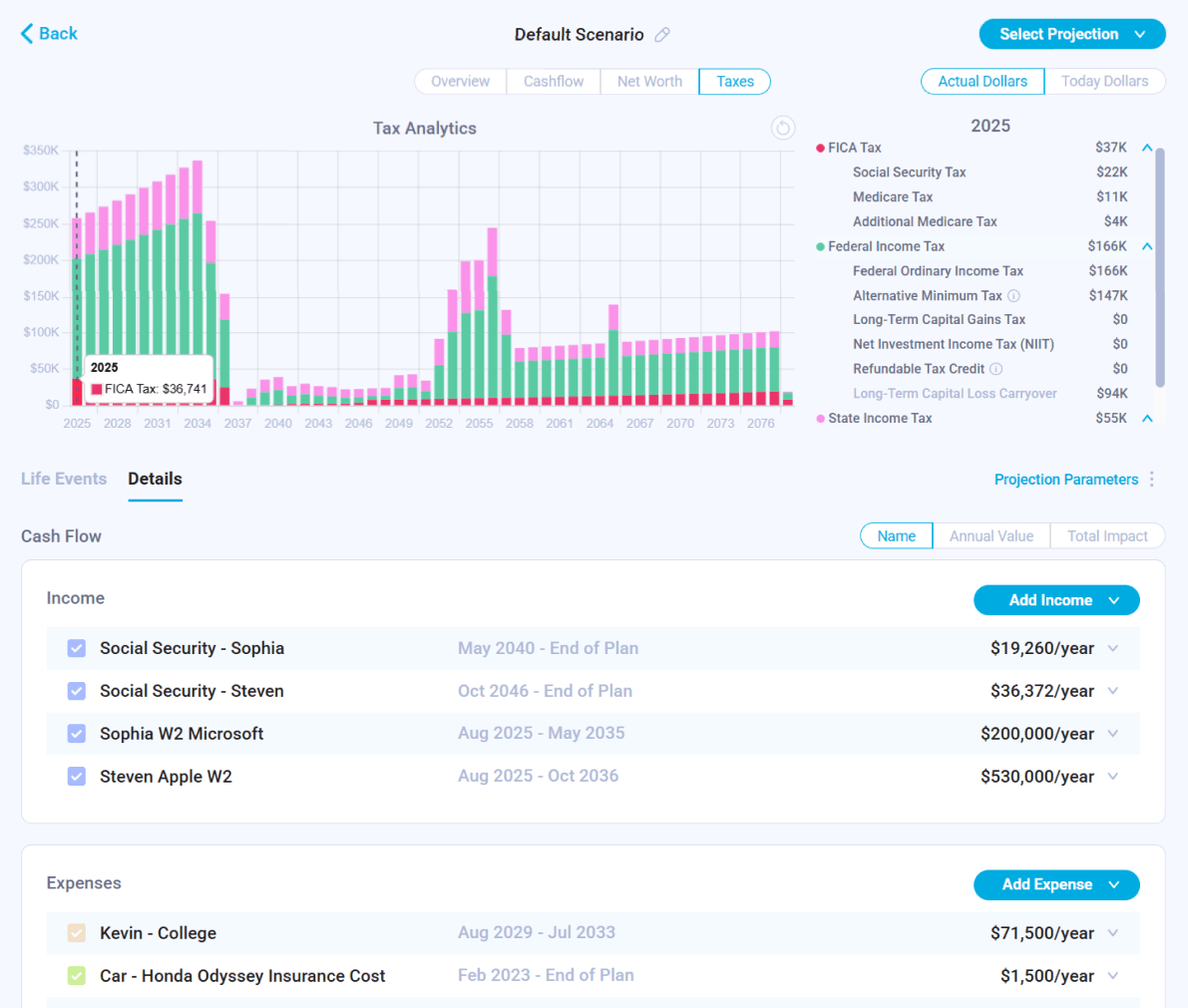
Nauma's financial projections model your salary, benefits elections, and tax situation together — so you can see exactly how an FSA, HSA, or DCFSA affects your take-home pay and annual tax bill.
Get Started for Free