'%3e%3cpath%20d='M136%2043.0521C135.893%2043.4991%20131.298%2041.3697%20123.51%2041.5186C120.787%2041.5712%20109.626%2040.8001%20104.06%2049.4228C101.316%2053.664%20102.266%2056.2491%20100.601%2061.5769C95.2065%2078.8661%2087.7394%2075.1856%2062.5302%2088.5228C54.5058%2092.764%2045.1595%20101.562%2043.5589%20103.087C31.9403%20114.163%2025.1664%20123.189%2025.1521%20123.171C25.1378%20123.162%2034.1912%20104.357%2047.7676%2082.7655C60.6795%2062.2429%2063.8235%2070.0769%2079.7722%2049.1336C81.7015%2046.6011%2084.8526%2037.6805%2089.683%2036.1032C93.6345%2034.815%2098.6148%2036.6114%20100.065%2038.5568C101.044%2039.8712%20101.459%2040.765%20103.831%2040.4408C110.048%2039.5996%20113.613%2039.8625%20115.492%2039.7748C116.95%2039.7047%20119.751%2039.915%20120.509%2039.9939C130.419%2040.9753%20136.15%2042.4563%20136.007%2043.0434L136%2043.0521Z'%20fill='%23127398'/%3e%3cpath%20d='M22.1867%2043.6392C30.3968%2055.0923%2031.5544%2062.348%2040.6506%2068.6923C45.9954%2072.4253%2053.4839%2075.4134%2058.2928%2075.5361C61.9084%2075.6325%2063.7305%2075.2557%2064.6023%2074.949C64.8524%2074.8614%2065.1025%2074.8351%2065.3597%2074.8263L76.0636%2070.6727C76.8068%2066.8871%2076.1637%2063.4784%2076.1065%2063.1892C75.0561%2058.0103%2072.3337%2053.3835%2070.5402%2051.2542C55.4561%2033.3428%2055.8062%2034.298%2046.5814%2028.0237C26.7884%2014.5902%20-1.22192%2021.3464%200.0428309%2022.0562C0.55016%2022.3454%2010.2394%2026.9634%2022.1867%2043.6392Z'%20fill='%23127398'/%3e%3cpath%20d='M79.8366%2044.0161C81.33%2046.4784%2083.4093%2051.5784%2083.7666%2056.8975C83.7952%2057.3094%2084.1667%2064.0393%2080.4654%2068.4733C78.5004%2070.8217%2076.2281%2071.5403%2075.585%2071.7506C61.487%2076.5264%2028.4319%20116.196%2023.3515%20133.494C23.2229%20133.941%2022.6227%20136.026%2022.5655%20136C22.3797%20135.921%2023.5373%20120.753%2028.925%20106.303C28.925%20106.303%2033.7196%2090.5295%2046.7387%2073.9326C49.1896%2070.8042%2052.8052%2067.0362%2052.8052%2067.0362C54.2414%2065.1434%2059.8006%2068.3068%2066.1887%2068.482C69.9401%2068.5872%2073.2198%2067.6846%2073.2055%2067.3604C73.2055%2067.2377%2073.0698%2067.0712%2072.8911%2066.9047C72.3195%2066.3702%2071.5907%2066.1423%2070.8761%2066.2475C69.9758%2066.379%2068.1323%2066.3877%2064.5738%2065.5903C59.8435%2064.5212%2052.8481%2060.096%2048.0534%2055.364C39.9076%2047.3109%2039.7147%2039.9238%2033.1051%2026.9985C23.4944%208.17586%2014.0767%201.32328%2014.0767%201.32328C17.285%20-1.64734%2041.451%20-0.788575%2059.229%2016.3692C67.5177%2024.3697%2067.2962%2023.3619%2079.8366%2044.0073V44.0161Z'%20fill='%23EF9920'/%3e%3c/g%3e%3cdefs%3e%3cclipPath%20id='clip0_882_3310'%3e%3crect%20width='136'%20height='136'%20fill='white'/%3e%3c/clipPath%3e%3c/defs%3e%3c/svg%3e)
What Is the Sharpe Ratio?
How to Measure Whether a Portfolio's Returns Justify the Risk Taken to Earn Them — and What the Number Actually Tells You
The Sharpe ratio is a measure of risk-adjusted return. It answers a specific question: how much excess return does a portfolio earn per unit of risk taken? A portfolio with high returns achieved by taking enormous risk is not necessarily better than one with lower returns achieved with much lower risk. The Sharpe ratio provides a single number that normalizes return by risk, making portfolios with different risk levels comparable on the same scale.
The ratio was developed by Nobel laureate William Sharpe and introduced in his 1966 paper "Mutual Fund Performance." It remains the most widely used single metric for evaluating portfolio efficiency in both professional and individual investor contexts.
The Formula
Sharpe Ratio = (Portfolio Return − Risk-Free Rate) ÷ Standard Deviation of Portfolio Returns
Each component has a specific meaning:
Portfolio Return is the annualized total return of the portfolio over the measurement period.
Risk-Free Rate is the return available from a riskless investment — in practice, the yield on short-term US Treasury bills or the effective federal funds rate. The risk-free rate represents the baseline return available without taking any market risk. As of April 2026, the US federal funds rate target sits at 3.5%–3.75%, and the 3-month Treasury bill yield is near 3.5%. These are the reference rates used in Sharpe ratio calculations at current market conditions.
Standard Deviation measures the volatility of the portfolio's returns over the measurement period. It captures how much the portfolio's returns fluctuate around their average. A portfolio with consistent, stable returns has low standard deviation; one with large swings has high standard deviation.
The numerator — portfolio return minus risk-free rate — is called the excess return or risk premium. It measures how much return the portfolio earned above what was available without risk. The denominator translates that excess return into a per-unit-of-risk measure.
How to Interpret the Number
A higher Sharpe ratio indicates more excess return per unit of risk taken — context and comparison to a relevant benchmark are needed to interpret the number meaningfully. But the number itself requires context to be meaningful.
Commonly cited reference ranges used in practitioner discussions:
| Sharpe Ratio | General Interpretation |
|---|---|
| Below 1.0 | Below average — the portfolio is not generating sufficient return for the risk being taken |
| 1.0 – 1.99 | Good — a reasonable level of risk-adjusted return for most diversified portfolios |
| 2.0 – 2.99 | Very good — difficult to sustain over long periods for most asset classes |
| 3.0 and above | Excellent — rarely achieved consistently; warrants scrutiny of the measurement period |
These ranges are reference points, not definitive thresholds. What constitutes a "good" Sharpe ratio is relative — it depends heavily on the asset class, the investment strategy, the time period measured, and the prevailing risk-free rate. Past performance is not indicative of future results.
These ranges require context to be meaningful. A Sharpe ratio that is "good" depends heavily on the asset class, the time period measured, and the risk-free rate used. During periods of low risk-free rates (as in 2020–2021, when the federal funds rate was near zero), Sharpe ratios across most asset classes appeared elevated because the hurdle rate was very low. At current rates (3.5%–3.75%), the bar for excess return is meaningfully higher.
A Sharpe ratio must always be compared to a relevant benchmark or peer group, not evaluated in isolation. A Sharpe ratio of 0.9 for an all-equity portfolio during a volatile market period may represent good performance; the same ratio for a bond-heavy conservative portfolio might be below expectations.
The Sharpe Ratio and the Efficient Frontier
The Sharpe ratio has a precise geometric interpretation within Modern Portfolio Theory: it measures the slope of the line from the risk-free rate to the portfolio on the risk-return graph. The steeper the slope — the more return per unit of risk — the higher the Sharpe ratio.
This directly connects to the efficient frontier concept. When a risk-free asset is available, the optimal risky portfolio for all investors is the one with the highest Sharpe ratio — the portfolio where the line from the risk-free rate is tangent to the efficient frontier. This tangency portfolio is the single most efficient combination of risky assets, in the sense of delivering the maximum excess return per unit of risk.
In practice, this means that the Sharpe ratio can be used to select among portfolios on the efficient frontier: given multiple portfolios with different risk levels, the one with the highest Sharpe ratio represents the most efficient use of risk capacity. See What Is the Efficient Frontier? for how this tangency relationship works, and Modern Portfolio Theory in Plain English for the underlying framework.
Limitations of the Sharpe Ratio
The Sharpe ratio is widely used and genuinely useful, but it has well-documented limitations that matter in practice.
It assumes returns are normally distributed. Standard deviation as a risk measure is appropriate only if returns follow a normal bell curve. In reality, asset returns exhibit fat tails — large negative events occur more frequently than a normal distribution predicts. A portfolio with a high Sharpe ratio calculated on normal-distribution assumptions may still carry significant tail risk not captured in the metric.
It penalizes upside volatility equally with downside volatility. Standard deviation measures all fluctuations from the mean, positive and negative. A portfolio with large positive return spikes will have a higher standard deviation — and therefore a lower Sharpe ratio — than a portfolio with the same average return but more muted performance. Most investors care only about downside volatility (losses), not upside (gains). This means the Sharpe ratio can understate the efficiency of aggressive growth portfolios that achieve high returns through large positive swings. The Sortino ratio, a variant, addresses this by using only downside standard deviation in the denominator.
It is sensitive to the measurement period. Sharpe ratios calculated over different time horizons can differ substantially for the same portfolio. A portfolio that performed strongly over the past 3 years but poorly over the past 10 years will show a very different Sharpe ratio depending on which period is used. Relying on a Sharpe ratio calculated over a single, favorable period can be misleading.
It can be gamed. A manager can artificially inflate the Sharpe ratio by using strategies that generate consistent small gains but carry rare, large losses — such as selling options. The small gains produce low reported standard deviation; the rare large losses don't show up in the measurement period. This is why the Sharpe ratio should always be evaluated alongside other risk metrics and an understanding of the strategy.
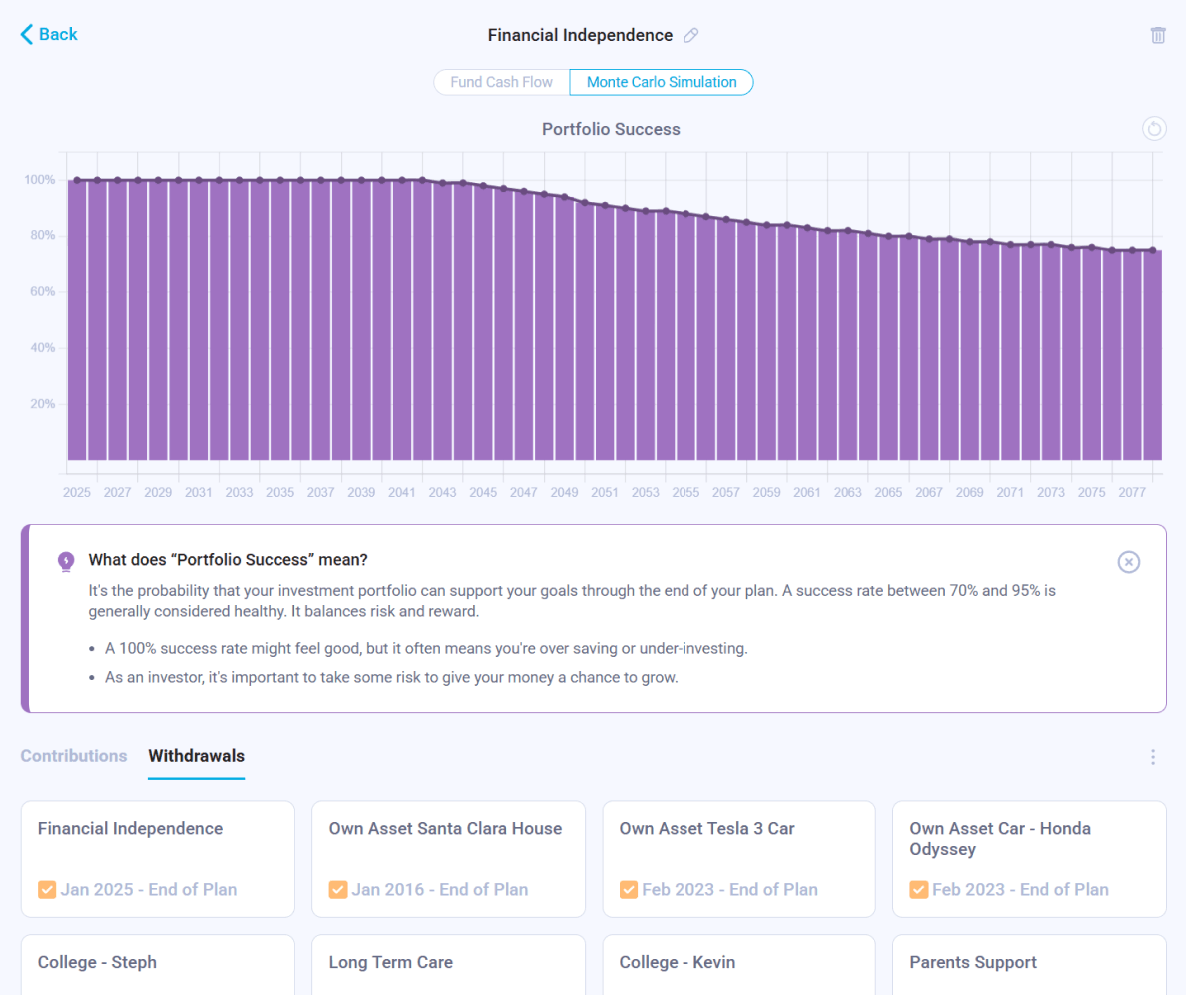
It does not model the probability of funding a specific goal. For individual investors managing portfolios against specific financial goals — retire by age 62 with $150,000 per year in spending — the Sharpe ratio answers the wrong question. It measures risk-adjusted return in the abstract, not the probability that the portfolio will fund the goal. Monte Carlo simulation complements the Sharpe ratio by modeling the full range of outcomes against the specific goal. See What Is Monte Carlo Simulation? for how probability of success works alongside the Sharpe ratio.
What a Good Sharpe Ratio Looks Like for a Retirement Portfolio
For a long-horizon retirement portfolio at current market conditions (April 2026), with a risk-free rate of approximately 3.5%, the Sharpe ratio question becomes: is the portfolio's equity-and-bond mix generating sufficient excess return above the 3.5% risk-free baseline to justify the volatility it is taking on?
A broadly diversified 70/30 equity-bond portfolio with a historical long-term return in the 6%–8% range and annualized volatility in the 11%–13% range would have a Sharpe ratio in approximately the 0.8–1.2 range using current risk-free rates — a reasonable range for a diversified multi-asset portfolio in a normal market environment. In periods of equity market stagnation or elevated volatility, even a well-constructed portfolio may see its Sharpe ratio fall below 0.5 without necessarily indicating poor construction. These are general historical reference points; actual future returns are uncertain and may differ materially.
A pure equity portfolio may have a similar or higher Sharpe ratio over long periods (equities have historically been well-compensated for their risk), but with substantially higher volatility. Whether that is appropriate depends on the goal's time horizon and the investor's ability to tolerate the higher intermediate-term swings without abandoning the strategy.
Sharpe Ratio in Practice: Comparing Two Portfolios
A worked example illustrates how the Sharpe ratio makes portfolios with different risk levels comparable.
Portfolio A has returned 9% annually with a standard deviation of 14%. At a risk-free rate of 3.5%, its Sharpe ratio is (9% − 3.5%) ÷ 14% = 0.39.
Portfolio B has returned 6.5% annually with a standard deviation of 7%. Its Sharpe ratio is (6.5% − 3.5%) ÷ 7% = 0.43.
Portfolio A has higher raw returns, but Portfolio B has the better Sharpe ratio — it is generating more excess return per unit of risk. Whether Portfolio B is the better choice depends on whether the investor needs the higher return that Portfolio A provides, and whether they can tolerate Portfolio A's higher volatility.
These figures are illustrative examples only and do not represent any specific investment product or expected future returns.
California Note
The Sharpe ratio is a calculation methodology, not a tax category, and California has no state-specific Sharpe ratio framework. However, for California investors, the after-tax Sharpe ratio — which accounts for California's tax treatment of investment returns — is more relevant than the pre-tax figure. California taxes capital gains (including long-term gains) and bond interest as ordinary income at rates up to 13.3%. For a California investor in the top bracket, after-tax returns are materially lower than pre-tax returns, which reduces the numerator (excess return) in the Sharpe ratio calculation. A portfolio that appears efficient on a pre-tax Sharpe basis may be less compelling after accounting for California's tax drag. Tax-efficient portfolio construction — holding tax-efficient assets in taxable accounts, using tax-loss harvesting to offset gains — preserves more of the gross Sharpe ratio on an after-tax basis. See Capital Gains Taxes for California's specific treatment.
This article is for educational purposes only and does not constitute investment, tax, or financial advice. This material does not consider your specific investment objectives, financial situation, or individual needs. Portfolio construction involves risk, and all investments may lose value. Past performance does not guarantee future results. Always consult a qualified financial advisor before making investment decisions.
Frequently Asked Questions
See Your Portfolio's Risk-Adjusted Performance
Nauma models your portfolio's performance across your goals — so you can see how each allocation is working relative to what each goal actually needs.
Get Started for Free