'%3e%3cpath%20d='M136%2043.0521C135.893%2043.4991%20131.298%2041.3697%20123.51%2041.5186C120.787%2041.5712%20109.626%2040.8001%20104.06%2049.4228C101.316%2053.664%20102.266%2056.2491%20100.601%2061.5769C95.2065%2078.8661%2087.7394%2075.1856%2062.5302%2088.5228C54.5058%2092.764%2045.1595%20101.562%2043.5589%20103.087C31.9403%20114.163%2025.1664%20123.189%2025.1521%20123.171C25.1378%20123.162%2034.1912%20104.357%2047.7676%2082.7655C60.6795%2062.2429%2063.8235%2070.0769%2079.7722%2049.1336C81.7015%2046.6011%2084.8526%2037.6805%2089.683%2036.1032C93.6345%2034.815%2098.6148%2036.6114%20100.065%2038.5568C101.044%2039.8712%20101.459%2040.765%20103.831%2040.4408C110.048%2039.5996%20113.613%2039.8625%20115.492%2039.7748C116.95%2039.7047%20119.751%2039.915%20120.509%2039.9939C130.419%2040.9753%20136.15%2042.4563%20136.007%2043.0434L136%2043.0521Z'%20fill='%23127398'/%3e%3cpath%20d='M22.1867%2043.6392C30.3968%2055.0923%2031.5544%2062.348%2040.6506%2068.6923C45.9954%2072.4253%2053.4839%2075.4134%2058.2928%2075.5361C61.9084%2075.6325%2063.7305%2075.2557%2064.6023%2074.949C64.8524%2074.8614%2065.1025%2074.8351%2065.3597%2074.8263L76.0636%2070.6727C76.8068%2066.8871%2076.1637%2063.4784%2076.1065%2063.1892C75.0561%2058.0103%2072.3337%2053.3835%2070.5402%2051.2542C55.4561%2033.3428%2055.8062%2034.298%2046.5814%2028.0237C26.7884%2014.5902%20-1.22192%2021.3464%200.0428309%2022.0562C0.55016%2022.3454%2010.2394%2026.9634%2022.1867%2043.6392Z'%20fill='%23127398'/%3e%3cpath%20d='M79.8366%2044.0161C81.33%2046.4784%2083.4093%2051.5784%2083.7666%2056.8975C83.7952%2057.3094%2084.1667%2064.0393%2080.4654%2068.4733C78.5004%2070.8217%2076.2281%2071.5403%2075.585%2071.7506C61.487%2076.5264%2028.4319%20116.196%2023.3515%20133.494C23.2229%20133.941%2022.6227%20136.026%2022.5655%20136C22.3797%20135.921%2023.5373%20120.753%2028.925%20106.303C28.925%20106.303%2033.7196%2090.5295%2046.7387%2073.9326C49.1896%2070.8042%2052.8052%2067.0362%2052.8052%2067.0362C54.2414%2065.1434%2059.8006%2068.3068%2066.1887%2068.482C69.9401%2068.5872%2073.2198%2067.6846%2073.2055%2067.3604C73.2055%2067.2377%2073.0698%2067.0712%2072.8911%2066.9047C72.3195%2066.3702%2071.5907%2066.1423%2070.8761%2066.2475C69.9758%2066.379%2068.1323%2066.3877%2064.5738%2065.5903C59.8435%2064.5212%2052.8481%2060.096%2048.0534%2055.364C39.9076%2047.3109%2039.7147%2039.9238%2033.1051%2026.9985C23.4944%208.17586%2014.0767%201.32328%2014.0767%201.32328C17.285%20-1.64734%2041.451%20-0.788575%2059.229%2016.3692C67.5177%2024.3697%2067.2962%2023.3619%2079.8366%2044.0073V44.0161Z'%20fill='%23EF9920'/%3e%3c/g%3e%3cdefs%3e%3cclipPath%20id='clip0_882_3310'%3e%3crect%20width='136'%20height='136'%20fill='white'/%3e%3c/clipPath%3e%3c/defs%3e%3c/svg%3e)
Modern Portfolio Theory in Plain English
What Harry Markowitz Got Right in 1952 That Most Investors Still Get Wrong — and How It Changes the Way You Should Think About Building a Portfolio
Most investors think about building a portfolio by selecting individual assets: this stock looks good, that fund has a strong track record, this sector is undervalued. Modern Portfolio Theory says that framing is fundamentally wrong — not because individual assets don't matter, but because the portfolio as a whole behaves differently from any of its parts. The asset that looks risky in isolation may actually reduce your portfolio's risk when combined with the right other assets. And the safest-looking individual assets, all held together, may produce a portfolio far riskier than any of them alone.
This is the insight that Harry Markowitz published in 1952 and that earned him the Nobel Prize in Economics in 1990. It is foundational to how institutional investors approach portfolio construction today — including the methods used by pension funds, university endowments, and the financial platforms that tech workers use to manage their equity compensation and retirement savings. Understanding it does not require advanced mathematics. It requires seeing why the portfolio is the right unit of analysis, not the individual asset.
The Problem: Why Individual Asset Selection Gets You the Wrong Answer
Suppose you are choosing between two investments. Asset A returns 9% annually with high volatility — some years it is up 30%, other years down 20%. Asset B returns 4% annually with very low volatility. The obvious conclusion: Asset A is better if you can stomach the swings.
Note: These return figures are hypothetical examples for illustrative purposes only and do not represent actual or expected investment performance.
Now suppose you learn that Asset A and Asset B are negatively correlated — when A goes up, B tends to go down, and vice versa. Combining them in a portfolio produces something unexpected: a portfolio with an expected return between 4% and 9%, but with volatility that is lower than either asset alone. In the extreme case of perfect negative correlation, the two assets can be combined to produce a portfolio with near-zero volatility.
This is not intuition — it is mathematics. The key variable is not the expected return or the volatility of each asset individually. It is how they move in relation to each other. Markowitz formalized this relationship as covariance (or its normalized form, correlation), and showed that a portfolio's risk is determined by the covariance structure of its components, not by the average of their individual risks.
The practical implication: an investment cannot be fully evaluated in isolation. The relevant question in portfolio construction is not "is this a good asset?" — it is "does this asset improve the portfolio it is being added to?"
The Efficient Frontier: The Map of All Possible Portfolios
Given a set of assets and estimates of their expected returns and correlations, Modern Portfolio Theory asks: what is the best possible portfolio that can be constructed from these assets? The answer is not a single portfolio — it is a set of portfolios, each representing the best risk-return combination available at a specific level of risk.
This set is the efficient frontier: a curve in a graph where the horizontal axis represents risk (standard deviation of returns) and the vertical axis represents expected return. Every point on the curve is a portfolio that cannot be improved — there is no combination of the same assets that offers higher expected return at the same risk, or the same expected return at lower risk.
Portfolios below the efficient frontier are inefficient. A portfolio below the curve could be replaced with a better one — one that offers more return for the same risk, or less risk for the same return — without changing the universe of assets under consideration. This framing makes the concept of a suboptimal portfolio precise: it is not one that performs poorly in the market, but one that was inefficient given the available assets and their correlations.
The shape of the efficient frontier depends entirely on the correlations between assets. When correlations are low — when the assets tend to move independently — the frontier bows significantly to the left, offering substantial diversification benefit. When correlations are high, the frontier is nearly a straight line, and diversification provides little help.
This is why the search for diversification is really a search for low or negative correlation — not just for "different" assets. Holding five US equity funds is not diversification in the MPT sense, because those funds are highly correlated with each other. Their prices move together, and combining them produces a portfolio that behaves almost identically to any one of them alone.
See What Is the Efficient Frontier? for a complete explanation of how the frontier is constructed and what it means to be on or off it. See What Is Correlation in Investing? for why correlation is the central input that determines how much diversification actually helps.
Where MPT Works and Where It Breaks Down
Markowitz's framework has three assumptions that are reasonable approximations in some contexts but fail in others.
Assumption 1: Returns are normally distributed. The math behind efficient frontier construction assumes that returns follow a bell-curve distribution — and that standard deviation captures everything meaningful about risk. In reality, financial markets exhibit fat tails: extreme events (large crashes, liquidity crises, black swans) occur more frequently than a normal distribution predicts. A portfolio optimized on standard deviation assumptions may look efficient in normal markets but carry hidden tail risk that the math underestimates. For this reason, many institutional practitioners supplement standard deviation with Conditional Value at Risk (CVaR), which explicitly measures the expected loss in the worst-case tail scenarios.
Assumption 2: Correlations are stable. The efficient frontier is computed from historical correlation estimates. These correlations change over time — and they change most dramatically during market crises, when correlations between previously uncorrelated risky assets tend to spike toward 1.0. During the 2008–2009 financial crisis and the March 2020 COVID selloff, diversified portfolios that appeared well-constructed based on historical correlations lost significantly more value than their MPT analysis had suggested, because correlations collapsed toward unity when selling became indiscriminate. Historical correlations are not indicative of future results.
Assumption 3: Expected returns can be reliably estimated. This is the most practically significant limitation. Small changes in expected return inputs produce dramatically different optimal portfolios — the optimization is extremely sensitive to estimation error. In practice, expected returns are not known; they are estimated from historical data or model forecasts, both of which are imprecise. The optimizer treats these imprecise estimates as precise inputs, producing portfolios that are theoretically optimal for the assumed inputs but may be far from optimal in practice. Modern approaches such as Black-Litterman and machine learning-based forecasting methods aim to reduce this estimation error — but they do not eliminate it.
These limitations do not invalidate MPT — they define the boundaries of where it can be applied directly and where refinements are needed. The diversification insight is robust. The specific optimal portfolio produced by classical Markowitz optimization is much less reliable.
Black-Litterman: How the Biggest Problem Gets Fixed
The most widely used institutional approach to the input estimation problem is the Black-Litterman model, developed at Goldman Sachs in the early 1990s. Instead of asking investors to supply expected returns from scratch — which produces large estimation errors — Black-Litterman starts from market equilibrium.
The logic: if markets are reasonably efficient, the current market-capitalization weights of a global portfolio represent the consensus of all investors about how assets should be held in aggregate. The model reverse-engineers the expected returns implied by those market weights — called equilibrium returns. These serve as a neutral starting point.
Investors then express specific views — beliefs about certain assets or asset classes that deviate from the equilibrium — along with a confidence level for each view. The model blends these views with the equilibrium returns through Bayesian statistics, producing adjusted expected returns that reflect both market consensus and the investor's specific beliefs. The output is fed into the optimizer to produce the final portfolio.
The result: more stable, more diversified portfolios that do not exhibit the extreme concentrations of classical Markowitz optimization. An investor with no views at all — expressing no deviations from market consensus — gets the market-cap-weighted index portfolio, the same conclusion reached by passive indexing advocates. An investor with high-conviction views gets portfolios that tilt toward those views in proportion to their actual conviction.
See What Is the Black-Litterman Model? for a full explanation of how the model works and how it differs from classical optimization.
From Theory to Practice: Goal-Based Investing
The most important practical extension of MPT for individual investors is goal-based investing: the recognition that a single portfolio is not the right structure for managing multiple financial goals with different time horizons, return requirements, and risk tolerances.
A tech worker at age 45 might have: a retirement goal 17 years away, a college funding goal 6 years away for their first child, and a home renovation goal 2 years away. These three goals have fundamentally different investment requirements.
The retirement goal has a 17-year time horizon. Historical equity markets have delivered positive real returns over 17-year periods in the vast majority of scenarios. Historically, a high equity allocation has been considered consistent with that goal's time horizon and expected return requirements. Intermediate-term volatility, in the form of market drawdowns, can be tolerated because the time horizon provides room for recovery.
The college funding goal has a 6-year horizon. The risk of a significant equity drawdown that cannot be recovered before the tuition bills arrive is meaningful. A balanced or moderately conservative allocation is appropriate — not because equities are bad, but because this goal cannot tolerate a 40% drawdown in year 5.
The home renovation goal has a 2-year horizon. Many investors hold assets for this type of goal primarily in capital-preservation instruments: money market funds, short-term Treasury bills, high-yield savings. The short time horizon leaves limited room to recover from a market drawdown.
Mixing these three goals into a single portfolio — managed to a single allocation — produces an average that is probably inappropriate for all three. The retirement assets are too conservative; the renovation funds are overexposed to market risk.
It is worth noting that diversification, even when applied correctly, does not guarantee protection from losses. During systemic market crises, correlations across asset classes tend to rise simultaneously, limiting the protective effect of diversification precisely when it is needed most.
The MPT connection: each goal has its own efficient frontier, constructed from the assets appropriate to its time horizon. The retirement goal's frontier includes equities heavily; the renovation goal's frontier is built from preservation instruments only. Assigning each goal its own allocation based on its own efficient frontier is the direct application of MPT's insights to individual financial planning.
The Glide Path: How Efficient Allocation Changes as Goals Approach
As a goal's time horizon shortens, its efficient allocation changes. The assets appropriate for a goal with a 20-year horizon are not appropriate for the same goal 3 years before funding. This gradual shift from growth-oriented to preservation-oriented allocation as a goal date approaches is called the glide path.
Target-date funds automate this shift for retirement: a 2045 target-date fund holds a high equity allocation today and automatically shifts toward bonds and cash as 2045 approaches. The mechanism is exactly the MPT framework applied dynamically: at each time horizon, the efficient allocation is different, and the portfolio adjusts to match.
For individual investors managing goals explicitly through goal-based planning, the glide path is applied at the goal level: the allocation for each goal is updated as its time horizon shortens, not just once at retirement.
What Nauma Uses from MPT
Nauma's approach to portfolio construction is informed by these MPT principles: each financial goal is associated with an allocation based on its specific time horizon and required return, assets are evaluated in portfolio context (not individually), and the allocation for each goal is expected to shift as the goal's time horizon shortens. The goal funding ratio — the ratio of current assets to the present value of what the goal requires — tracks progress in a way that integrates the MPT framework with practical financial planning.
See What Is a Goal Funding Ratio? for how Nauma measures goal progress, What Is Asset Allocation? for how time horizon translates into target allocations, and What Is Portfolio Rebalancing? for how target allocations are maintained over time.
California Note
Modern Portfolio Theory is agnostic about taxes, and its direct California implications are most relevant in the context of implementation. In California, where capital gains are taxed as ordinary income at rates up to 13.3% for the highest earners (including the 1% Mental Health Services Tax, which applies to income above $1,000,000) on top of federal rates, the after-tax efficient frontier for a taxable account investor is different from the pre-tax frontier. Rebalancing a portfolio toward its theoretically efficient allocation generates realized capital gains in taxable accounts — a cost that the classical MPT framework does not account for. California investors working with significant taxable accounts often incorporate tax-loss harvesting, asset location optimization, and wider rebalancing thresholds in taxable accounts to minimize the tax drag on after-tax portfolio efficiency. See Capital Gains Taxes for how California taxes investment income, and Tax-Loss Harvesting for how losses can be systematically realized to offset rebalancing gains.
This article is for educational purposes only and does not constitute investment, tax, or financial advice. Portfolio construction involves risk, and all investments may lose value. Past performance does not guarantee future results. This model is a mathematical framework and does not account for all market complexities, including transaction costs and liquidity constraints. Historical correlations are not indicative of future results. Always consult a qualified financial advisor before making investment decisions.
Frequently Asked Questions
See How Nauma Models Your Portfolio and Goals
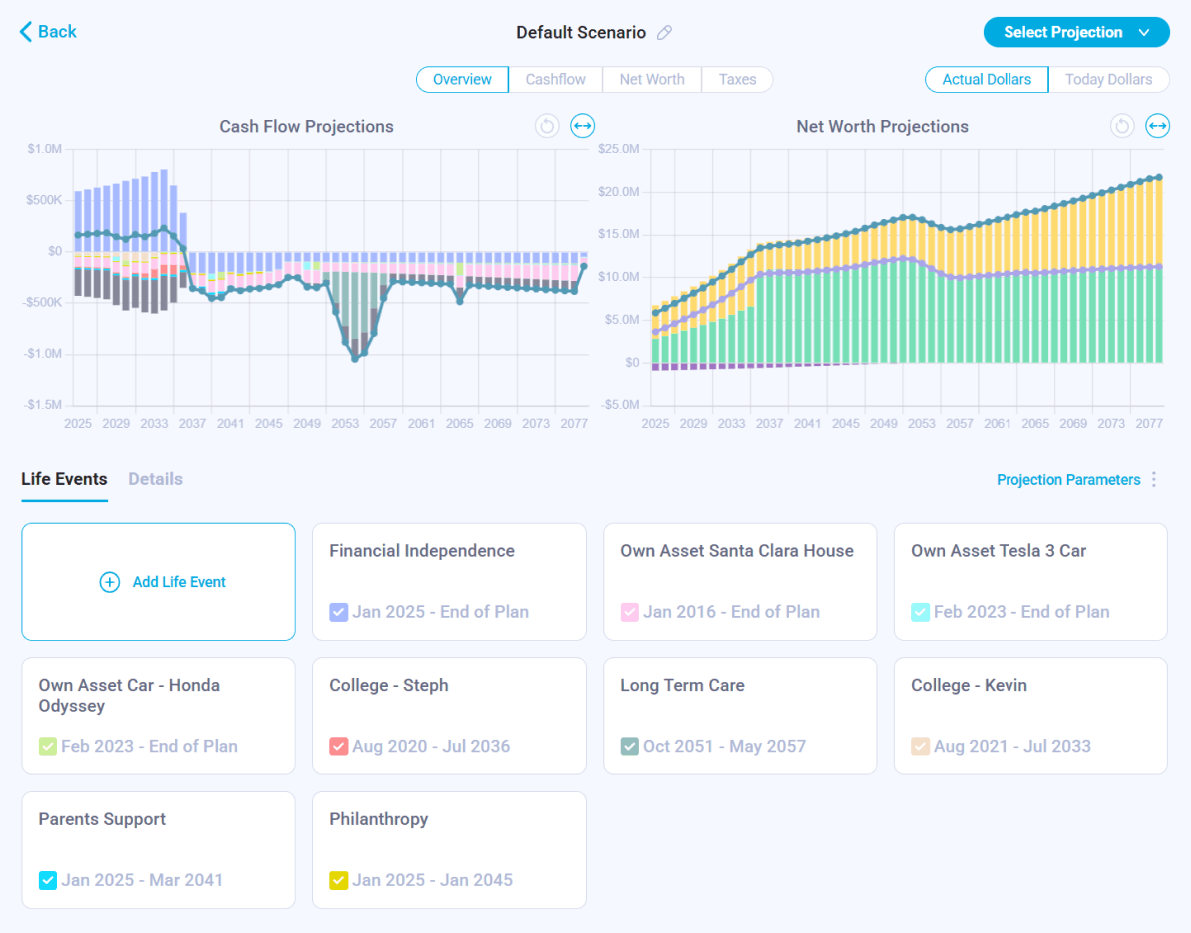
Nauma builds a goal-by-goal view of your financial plan — showing the allocation appropriate for each goal's time horizon, your current portfolio's position relative to that target, and how each goal is progressing toward funding.
Get Started for Free