'%3e%3cpath%20d='M136%2043.0521C135.893%2043.4991%20131.298%2041.3697%20123.51%2041.5186C120.787%2041.5712%20109.626%2040.8001%20104.06%2049.4228C101.316%2053.664%20102.266%2056.2491%20100.601%2061.5769C95.2065%2078.8661%2087.7394%2075.1856%2062.5302%2088.5228C54.5058%2092.764%2045.1595%20101.562%2043.5589%20103.087C31.9403%20114.163%2025.1664%20123.189%2025.1521%20123.171C25.1378%20123.162%2034.1912%20104.357%2047.7676%2082.7655C60.6795%2062.2429%2063.8235%2070.0769%2079.7722%2049.1336C81.7015%2046.6011%2084.8526%2037.6805%2089.683%2036.1032C93.6345%2034.815%2098.6148%2036.6114%20100.065%2038.5568C101.044%2039.8712%20101.459%2040.765%20103.831%2040.4408C110.048%2039.5996%20113.613%2039.8625%20115.492%2039.7748C116.95%2039.7047%20119.751%2039.915%20120.509%2039.9939C130.419%2040.9753%20136.15%2042.4563%20136.007%2043.0434L136%2043.0521Z'%20fill='%23127398'/%3e%3cpath%20d='M22.1867%2043.6392C30.3968%2055.0923%2031.5544%2062.348%2040.6506%2068.6923C45.9954%2072.4253%2053.4839%2075.4134%2058.2928%2075.5361C61.9084%2075.6325%2063.7305%2075.2557%2064.6023%2074.949C64.8524%2074.8614%2065.1025%2074.8351%2065.3597%2074.8263L76.0636%2070.6727C76.8068%2066.8871%2076.1637%2063.4784%2076.1065%2063.1892C75.0561%2058.0103%2072.3337%2053.3835%2070.5402%2051.2542C55.4561%2033.3428%2055.8062%2034.298%2046.5814%2028.0237C26.7884%2014.5902%20-1.22192%2021.3464%200.0428309%2022.0562C0.55016%2022.3454%2010.2394%2026.9634%2022.1867%2043.6392Z'%20fill='%23127398'/%3e%3cpath%20d='M79.8366%2044.0161C81.33%2046.4784%2083.4093%2051.5784%2083.7666%2056.8975C83.7952%2057.3094%2084.1667%2064.0393%2080.4654%2068.4733C78.5004%2070.8217%2076.2281%2071.5403%2075.585%2071.7506C61.487%2076.5264%2028.4319%20116.196%2023.3515%20133.494C23.2229%20133.941%2022.6227%20136.026%2022.5655%20136C22.3797%20135.921%2023.5373%20120.753%2028.925%20106.303C28.925%20106.303%2033.7196%2090.5295%2046.7387%2073.9326C49.1896%2070.8042%2052.8052%2067.0362%2052.8052%2067.0362C54.2414%2065.1434%2059.8006%2068.3068%2066.1887%2068.482C69.9401%2068.5872%2073.2198%2067.6846%2073.2055%2067.3604C73.2055%2067.2377%2073.0698%2067.0712%2072.8911%2066.9047C72.3195%2066.3702%2071.5907%2066.1423%2070.8761%2066.2475C69.9758%2066.379%2068.1323%2066.3877%2064.5738%2065.5903C59.8435%2064.5212%2052.8481%2060.096%2048.0534%2055.364C39.9076%2047.3109%2039.7147%2039.9238%2033.1051%2026.9985C23.4944%208.17586%2014.0767%201.32328%2014.0767%201.32328C17.285%20-1.64734%2041.451%20-0.788575%2059.229%2016.3692C67.5177%2024.3697%2067.2962%2023.3619%2079.8366%2044.0073V44.0161Z'%20fill='%23EF9920'/%3e%3c/g%3e%3cdefs%3e%3cclipPath%20id='clip0_882_3310'%3e%3crect%20width='136'%20height='136'%20fill='white'/%3e%3c/clipPath%3e%3c/defs%3e%3c/svg%3e)
When Should You Claim Social Security?
The Claiming Decision Framework for High-Income Retirees — Beyond the Breakeven Calculation
When to claim Social Security is one of the most consequential financial decisions in retirement — and one of the most commonly oversimplified. The conventional framing asks: when do you break even? If you delay from 62 to 70, how long do you have to live to come out ahead? Break even at 80, live past 80, delay was the right choice. Live to 78, claiming early was better.
This framing is mathematically correct in isolation. It is incomplete as a planning framework. The claiming decision interacts with portfolio withdrawal rates, Roth conversion windows, sequence of return risk, survivor benefits, and income tax exposure in ways that the breakeven calculation entirely ignores — and for many retirees, those interactions dominate the decision.
This page focuses on the claiming decision framework as it applies to retirement income strategy — particularly for early retirees and high-income households. For a full explanation of how Social Security benefits are calculated, eligibility requirements, and spousal benefit mechanics, see Social Security.
The Claiming Window: Ages 62 to 70
Social Security retirement benefits can be claimed any time between ages 62 and 70. The full retirement age (FRA) depends on birth year: for anyone born in 1960 or later, FRA is 67.
Claiming at 62 (earliest eligible): Permanently reduces the benefit by 30% from the FRA amount. The reduction is irreversible — it applies to every benefit payment for the rest of the claimant's life, including the annual COLA adjustments that apply to the reduced base. Note that if you claim before FRA and continue working, the Social Security Earnings Test applies: in 2026, SSA withholds $1 in benefits for every $2 earned above $24,480 per year (for those under FRA for the entire year), and $1 for every $3 earned above $65,160 in the year FRA is reached. These limits are indexed annually — verify current figures at ssa.gov. Importantly, withheld amounts are not lost permanently: SSA recredits them after FRA by recalculating the benefit upward to account for the months benefits were withheld. The interaction with earned income remains a material consideration for anyone considering early claiming while still working part-time or consulting.
Claiming at FRA (age 67 for most current retirees): Receives 100% of the primary insurance amount (PIA) as calculated by the Social Security Administration based on the individual's earnings history.
Claiming at 70 (maximum delay): Permanently increases the benefit by 24% above the FRA amount (8% per year of delay from FRA, for 3 years of delay). No additional increase occurs after age 70 — there is no benefit to waiting past 70.
For a retiree with a projected FRA benefit of $3,000 per month, the range is approximately $2,100/month at 62 versus $3,720/month at 70. These figures are illustrative only — your actual benefit depends on your 35 highest-earning years adjusted for inflation, as calculated by SSA. Over a 25-year retirement, the cumulative difference in nominal payments is substantial — and the per-month difference grows each year because the COLA adjustment applies to the higher base.
The Breakeven Analysis — and Its Limitations
The standard breakeven calculation for delay from 62 to 70 works as follows. In the delay period (years 62–70), the early claimant receives 8 years of payments that the late claimant does not. The late claimant then receives a higher monthly payment for the rest of their life. The breakeven age is approximately 80–82: at that point, the cumulative payments to the late claimant equal those of the early claimant, and thereafter the late claimant is ahead.
What the breakeven calculation gets right: It accurately captures the nominal dollar trade-off between claiming early and claiming late, all else being equal.
What the breakeven calculation misses:
Portfolio interaction. A retiree who delays Social Security to 70 must fund 3–8 additional years of living expenses from the portfolio before SS income begins. Those additional withdrawals expose the portfolio to sequence of return risk during the delay period. A significant market decline during the delay years reduces the portfolio at a time when it is being drawn down rapidly — potentially costing more in portfolio losses than the higher SS benefit ever recovers. This interaction must be modeled explicitly, not assumed away.
Roth conversion window. For early retirees with large traditional IRA balances, the years between retirement and the start of Social Security are often the optimal Roth conversion window: income is low, the tax bracket is favorable, and converting pre-tax assets to Roth meaningfully reduces future RMDs and their tax consequences. Every year of SS delay extends this window. A retiree who retires at 60 and delays SS to 70 has 10 years of low-income Roth conversion opportunity; one who claims at 62 has only 2 years before SS income arrives and narrows the conversion space. This is a significant planning benefit of delay that the breakeven calculation does not capture. See Roth Conversion and Retirement Withdrawal Order for how this works in detail.
Inflation and longevity hedge value. The breakeven calculation typically uses nominal dollars without adjusting for inflation. Social Security includes an annual COLA adjustment — the higher base benefit generates a larger inflation adjustment each year. Over a 25-year retirement with 3% average inflation, the difference between a $2,100 and $3,720 monthly benefit compounds meaningfully. The delayed benefit is a better inflation hedge, and this hedge value is not captured in simple breakeven math.
Tax implications. Social Security benefits are included in combined income for federal taxation purposes — up to 85% of benefits may be taxable depending on total income. A higher SS benefit in a year with significant other income (RMDs, pension, investment income) can push more of the benefit into taxable territory. The after-tax breakeven may differ from the pre-tax calculation.
The Survivor Benefit: Why It Changes the Couples' Decision
For married couples, the Social Security claiming decision has a dimension the individual calculation entirely misses: the survivor benefit. When one spouse dies, the surviving spouse receives the higher of the two spouses' benefit amounts. The lower benefit stops.
This means the higher earner's claiming age is simultaneously a decision about the surviving spouse's income for the rest of their life. If the higher earner claims at 62 with a $2,100/month benefit and dies at 75, the surviving spouse receives $2,100/month for the rest of their life. If the higher earner delays to 70 with a $3,720/month benefit and dies at 75, the surviving spouse receives $3,720/month for the rest of their life.
For a surviving spouse who lives to 90 or 95, the difference is substantial — potentially $200,000–$400,000 in cumulative additional income. This is why many financial planners consider the survivor benefit dimension one of the most important factors in the higher earner's claiming analysis, and why the individual breakeven calculation alone often understates the value of delay for couples.
The lower earner's claiming age has more flexibility. Claiming the lower earner's benefit earlier — at 62 or FRA — provides some household income during the delay years without sacrificing the higher earner's maximum delayed benefit.
The Portfolio Withdrawal Rate Interaction
The claiming decision has a direct and significant effect on the portfolio withdrawal rate required during retirement.
Consider two retirees, both with $2,000,000 in investable assets and $120,000 per year in annual spending needs. Retiree A claims Social Security at 62 at $2,100/month ($25,200/year). Retiree B delays to 70 at $3,720/month ($44,640/year). These are illustrative figures; actual benefit amounts depend on individual earnings histories.
Retiree A withdraws $94,800 per year from the portfolio (4.7% withdrawal rate). Retiree B, once SS begins at 70, withdraws $75,360 per year (3.8% withdrawal rate). The lower withdrawal rate for Retiree B meaningfully reduces portfolio depletion risk over a long retirement.
During the delay years (before 70), Retiree B withdraws more from the portfolio — up to $120,000/year, or 6% — because Social Security has not yet started. This is where sequence of return risk is most acute: a major market decline in those years with a 6% withdrawal rate is a serious stress test for the plan. The withdrawal rate compression after 70 is the payoff; the elevated withdrawal rate during the delay years is the cost.
Whether the payoff exceeds the cost depends on the return sequence experienced, the portfolio size, and the flexibility of spending during the delay years.
The ACA Interaction for Early Retirees
Retirees who retire before Medicare eligibility at 65 typically obtain health insurance from the ACA marketplace. ACA premium tax credits are calculated based on MAGI — and Social Security benefits count toward MAGI for this purpose.
A retiree who delays Social Security and keeps MAGI low during the pre-Medicare years may qualify for meaningful ACA premium tax credits that would be reduced or eliminated if Social Security income began. For some early retirees, the ACA subsidy value during the years before Medicare is substantial enough to factor into the claiming analysis — one more dimension the breakeven calculation does not capture.
Practical Decision Framework
Rather than a simple breakeven calculation, the Social Security claiming decision is more usefully approached as a multi-variable analysis that weighs several factors together:
For single retirees: Health and expected longevity are typically central to the analysis. Research suggests that longer-horizon scenarios tend to favor delay, while health concerns or a shorter expected lifespan shift the calculus toward earlier claiming. The portfolio interaction also matters: if delaying creates a high withdrawal rate during the gap years, a partial delay (to FRA rather than 70) may better balance the trade-offs than either extreme.
For the higher earner in a couple: The survivor benefit consideration adds significant weight to the delay analysis, because the higher earner's benefit amount becomes the surviving spouse's benefit for the rest of their life. Many financial planners note that this dimension often changes the analysis compared to an individual calculation — though the right answer still depends on the couple's full financial picture, health, and other income sources.
For the lower earner in a couple: There is generally more flexibility, since the lower earner's benefit does not typically become the survivor benefit. Claiming at 62 or FRA while the higher earner delays is one approach that provides household income during the gap years — though the trade-offs depend on the specific benefit amounts and overall income needs.
For those with a large traditional IRA balance: The Roth conversion window interaction is worth factoring into the analysis. Each year of SS delay may extend the period of lower taxable income available for conversions. A financial advisor can help model how these decisions interact in the context of the full retirement income plan.
California Note
California does not tax Social Security benefits. Under California Revenue and Taxation Code §17085, Social Security retirement benefits are fully exempt from California state income tax regardless of income level or filing status — residents subtract Social Security income when calculating their state taxable income on Schedule CA (540). This makes Social Security a particularly valuable income source in California: the full benefit amount is retained without state-level reduction, in contrast to states that do impose a state income tax on SS benefits.
For California residents evaluating the claiming decision alongside Roth conversion planning, the relevant state tax consideration is the conversion income itself: California taxes IRA distributions and Roth conversion income at ordinary income rates up to 13.3%. The years between early retirement and the start of Social Security — when SS income is absent and the Roth conversion window is open — are also the years when conversions are taxed at California rates. The state tax cost of conversions during the delay period should be factored into the full analysis alongside the federal tax benefit of reducing future RMDs.
This article is for educational purposes only and does not constitute investment, tax, or financial advice. Social Security benefit amounts, earnings test limits, and IRMAA thresholds are subject to annual adjustment and legislative change; always verify current figures at ssa.gov and cms.gov. ACA premium tax credit eligibility and amounts are subject to change. Individual circumstances — including health, marital status, portfolio size, and other income sources — significantly affect the optimal claiming decision. Always consult a qualified financial advisor before making Social Security claiming decisions.
Frequently Asked Questions
Model Your Social Security Claiming Decision Alongside Your Full Plan
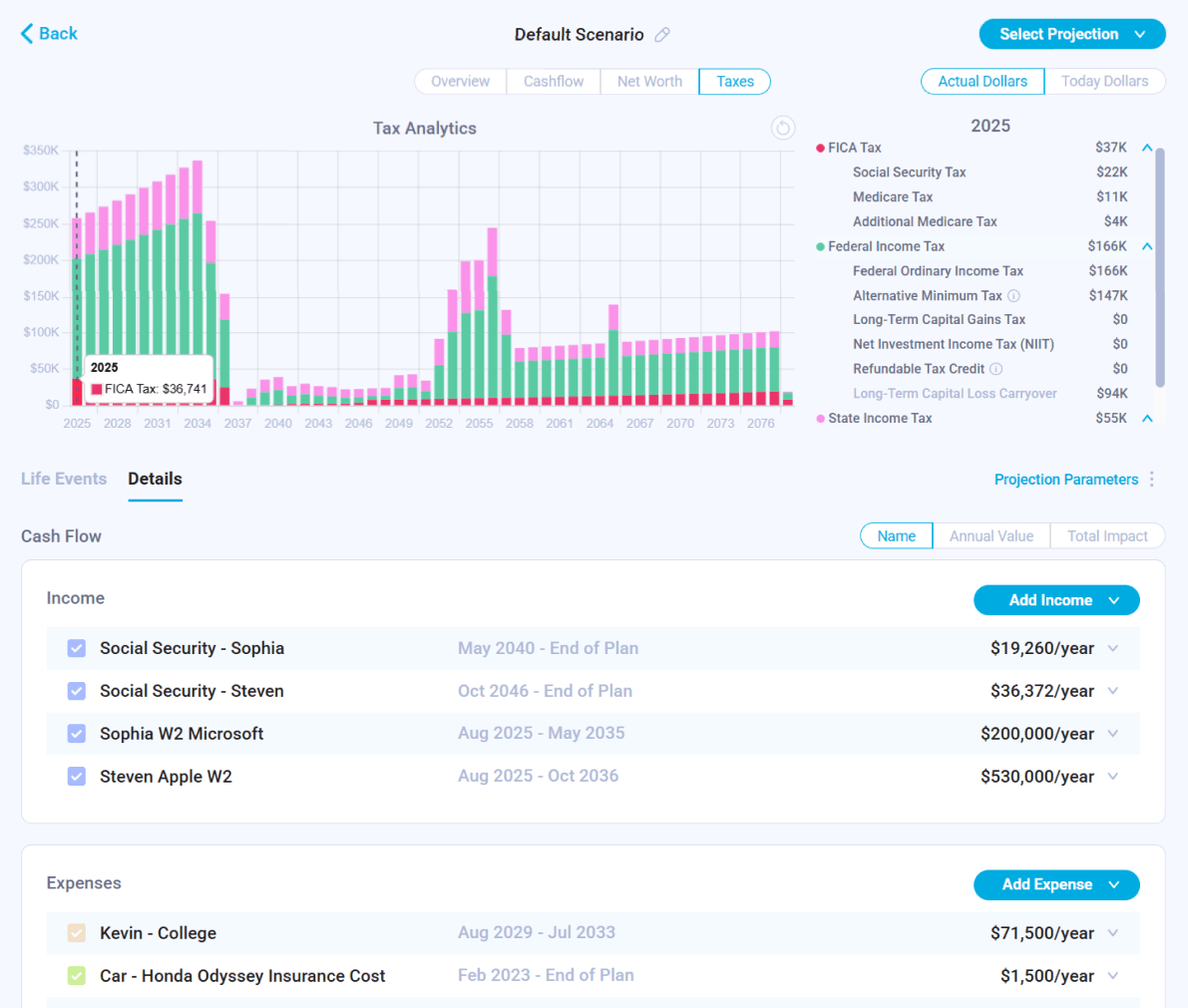
Nauma shows how different Social Security claiming ages affect your cash flow, tax exposure, and portfolio longevity across your complete retirement projection.
Get Started for Free