'%3e%3cpath%20d='M136%2043.0521C135.893%2043.4991%20131.298%2041.3697%20123.51%2041.5186C120.787%2041.5712%20109.626%2040.8001%20104.06%2049.4228C101.316%2053.664%20102.266%2056.2491%20100.601%2061.5769C95.2065%2078.8661%2087.7394%2075.1856%2062.5302%2088.5228C54.5058%2092.764%2045.1595%20101.562%2043.5589%20103.087C31.9403%20114.163%2025.1664%20123.189%2025.1521%20123.171C25.1378%20123.162%2034.1912%20104.357%2047.7676%2082.7655C60.6795%2062.2429%2063.8235%2070.0769%2079.7722%2049.1336C81.7015%2046.6011%2084.8526%2037.6805%2089.683%2036.1032C93.6345%2034.815%2098.6148%2036.6114%20100.065%2038.5568C101.044%2039.8712%20101.459%2040.765%20103.831%2040.4408C110.048%2039.5996%20113.613%2039.8625%20115.492%2039.7748C116.95%2039.7047%20119.751%2039.915%20120.509%2039.9939C130.419%2040.9753%20136.15%2042.4563%20136.007%2043.0434L136%2043.0521Z'%20fill='%23127398'/%3e%3cpath%20d='M22.1867%2043.6392C30.3968%2055.0923%2031.5544%2062.348%2040.6506%2068.6923C45.9954%2072.4253%2053.4839%2075.4134%2058.2928%2075.5361C61.9084%2075.6325%2063.7305%2075.2557%2064.6023%2074.949C64.8524%2074.8614%2065.1025%2074.8351%2065.3597%2074.8263L76.0636%2070.6727C76.8068%2066.8871%2076.1637%2063.4784%2076.1065%2063.1892C75.0561%2058.0103%2072.3337%2053.3835%2070.5402%2051.2542C55.4561%2033.3428%2055.8062%2034.298%2046.5814%2028.0237C26.7884%2014.5902%20-1.22192%2021.3464%200.0428309%2022.0562C0.55016%2022.3454%2010.2394%2026.9634%2022.1867%2043.6392Z'%20fill='%23127398'/%3e%3cpath%20d='M79.8366%2044.0161C81.33%2046.4784%2083.4093%2051.5784%2083.7666%2056.8975C83.7952%2057.3094%2084.1667%2064.0393%2080.4654%2068.4733C78.5004%2070.8217%2076.2281%2071.5403%2075.585%2071.7506C61.487%2076.5264%2028.4319%20116.196%2023.3515%20133.494C23.2229%20133.941%2022.6227%20136.026%2022.5655%20136C22.3797%20135.921%2023.5373%20120.753%2028.925%20106.303C28.925%20106.303%2033.7196%2090.5295%2046.7387%2073.9326C49.1896%2070.8042%2052.8052%2067.0362%2052.8052%2067.0362C54.2414%2065.1434%2059.8006%2068.3068%2066.1887%2068.482C69.9401%2068.5872%2073.2198%2067.6846%2073.2055%2067.3604C73.2055%2067.2377%2073.0698%2067.0712%2072.8911%2066.9047C72.3195%2066.3702%2071.5907%2066.1423%2070.8761%2066.2475C69.9758%2066.379%2068.1323%2066.3877%2064.5738%2065.5903C59.8435%2064.5212%2052.8481%2060.096%2048.0534%2055.364C39.9076%2047.3109%2039.7147%2039.9238%2033.1051%2026.9985C23.4944%208.17586%2014.0767%201.32328%2014.0767%201.32328C17.285%20-1.64734%2041.451%20-0.788575%2059.229%2016.3692C67.5177%2024.3697%2067.2962%2023.3619%2079.8366%2044.0073V44.0161Z'%20fill='%23EF9920'/%3e%3c/g%3e%3cdefs%3e%3cclipPath%20id='clip0_882_3310'%3e%3crect%20width='136'%20height='136'%20fill='white'/%3e%3c/clipPath%3e%3c/defs%3e%3c/svg%3e)
What Is the Floor-and-Upside Strategy?
How Separating Essential Income From Portfolio Growth Can Reduce Retirement Anxiety — and Change How You Invest the Rest
This article provides a theoretical framework for retirement income planning and is intended for educational purposes only. It does not consider your specific financial situation, tax circumstances, or investment objectives.
The floor-and-upside strategy is a retirement income framework that divides spending needs into two distinct layers and manages each differently. The floor is a guaranteed, reliable income stream sufficient to cover essential living expenses — housing, food, healthcare, utilities — regardless of what financial markets do. The upside is the remaining portfolio, invested for long-term growth and used to fund discretionary spending: travel, entertainment, gifts, experiences.
The separation is the key idea. Once essential expenses are covered by income sources that do not depend on portfolio performance, the rest of the portfolio can be invested more aggressively — because losses in the upside portion affect only discretionary spending, not survival. The investor who has floored their essential expenses can watch the market fall 30% without facing a crisis, because their bills are paid regardless.
This contrasts with a pure systematic withdrawal approach, in which all spending — essential and discretionary alike — depends on portfolio performance. In that structure, a severe market decline forces a choice between cutting essential expenses or continuing to draw down a stressed portfolio.
The Floor: What It Is and What Builds It
The floor is income that arrives reliably, regardless of market conditions. It is not derived from selling portfolio assets. It does not fluctuate with equity returns. It continues for life, or for a defined period long enough to cover a specific essential expense.
Social Security is the primary floor-building instrument for most retirees. A household receiving $4,500 per month in combined Social Security benefits — covering housing, food, utilities, and basic healthcare — has effectively floored those expenses for life, with inflation protection built in. (Note that $4,500/month in combined household benefits represents a higher-than-average outcome; the average individual Social Security retirement benefit is approximately $1,900/month as of 2026.) Social Security is backed by the federal government, adjusts annually for inflation via COLA, and continues regardless of portfolio performance. For many retirees, Social Security — particularly when the higher earner delays claiming — represents a substantial portion of the income floor. See When Should You Claim Social Security? for how the claiming decision interacts with retirement income strategy.
Defined benefit pensions, where available, function similarly to Social Security: a fixed monthly payment for life, unaffected by markets. For those who have access to a pension through a public sector employer or a legacy private-sector plan, the pension may already cover most or all essential expenses, making the floor-and-upside structure the natural default.
Income annuities (SPIA and DIA) allow retirees to purchase a floor using portfolio assets. A single premium immediate annuity (SPIA) converts a lump sum into a guaranteed monthly payment for life. A deferred income annuity (DIA) or qualified longevity annuity contract (QLAC) provides income beginning at a future age — typically 80 or 85 — as protection against the tail risk of a very long life. Annuities transfer longevity risk to the insurance company: the insurer must keep paying regardless of how long the annuitant lives. See Annuities for a full breakdown of types, costs, tax treatment, and when they are appropriate.
TIPS ladders (Treasury Inflation-Protected Securities) can build a floor for a defined period — particularly useful in the years between retirement and the start of Social Security or a pension. A TIPS ladder of 5–10 years provides inflation-adjusted, principal-guaranteed income for that window, allowing the equity portfolio to grow undisturbed during those years.
The Upside: What It Is and How It Changes With a Floor in Place
The upside portfolio is everything not allocated to floor-building instruments. It is invested for long-term growth and used to fund discretionary spending — the spending that enhances life but is not required to sustain it.
The critical insight is that having a secure floor changes the risk profile of the upside portfolio. A retiree whose essential expenses are fully covered by Social Security and a small pension has no forced selling obligation tied to essential spending — a market decline does not threaten housing, food, or healthcare. This is why some financial planners argue that a well-floored retiree can hold a more growth-oriented allocation in the upside portfolio than a standard conservative retirement allocation would suggest, though the right allocation still depends on individual circumstances, time horizon, and risk tolerance.
This is the paradox the floor-and-upside framework resolves: securing the floor can enable a more aggressive investment posture in the upside portfolio, potentially generating more long-term wealth than a blended conservative approach applied to the entire portfolio. The portfolio does not need to be defensively positioned if the defense is provided by the floor instruments themselves.
This relationship with sequence of return risk is significant. Sequence risk — the danger that early retirement losses permanently impair a portfolio — is most destructive when withdrawals are forced regardless of market conditions. A fully floored essential budget eliminates forced selling on the floor portion entirely. The upside portfolio can be allowed to recover from a downturn without continuous liquidation during the decline. See What Is Sequence of Return Risk? for why this protection matters.
How to Build a Floor: A Decision Framework
The floor-building process begins with a clear accounting of essential monthly expenses and a review of existing guaranteed income.
Step 1: Define essential vs. discretionary spending. What must be paid regardless of circumstances? Housing (mortgage or rent, property tax, insurance), food, utilities, healthcare premiums and predictable out-of-pocket costs, transportation for essential needs, and any recurring non-negotiable obligations. Everything else — restaurants, travel, entertainment, gifts, upgrades — is discretionary.
Step 2: Inventory existing guaranteed income. How much Social Security will you receive at your planned claiming age? Does either spouse have a pension? What is the monthly amount? Add these together. If this sum covers essential expenses, the floor may already be largely built — the question then becomes how to optimize the upside portfolio.
Step 3: Identify the gap. If guaranteed income falls short of essential expenses, the gap must be filled by either purchasing an annuity (converting portfolio assets into guaranteed income) or adjusting the floor definition downward (reducing what is classified as essential).
Step 4: Evaluate the cost of filling the gap. Hypothetical example for illustrative purposes only: A gap of $2,000 per month — $24,000 per year — might be filled by a SPIA requiring approximately $400,000–$500,000 in premium at age 65, based on typical market conditions. Actual annuity payout rates vary significantly by insurer, the annuitant's age and gender, and the interest rate environment at the time of purchase; any specific quote requires consulting an insurer directly. Is converting that amount from the portfolio worth the guaranteed income and the elimination of longevity risk on that portion? This is the central floor-and-upside trade-off: certainty and simplicity versus flexibility and potential upside.
Step 5: Determine an appropriate investment strategy for the upside. With the floor secured, the upside portfolio allocation should reflect the actual risk tolerance applicable to discretionary spending — which for many long-horizon early retirees may be substantially higher than a blended conservative allocation would suggest. The right allocation still depends on individual circumstances and should be determined in consultation with a financial advisor.
What Floor-and-Upside Is Not
The floor-and-upside strategy is sometimes mischaracterized as simply owning some bonds. It is not. The floor in this framework consists of income sources — Social Security, pensions, annuities — that generate guaranteed cash flows independent of portfolio performance. Bonds held in a portfolio are still portfolio assets subject to volatility and liquidation risk. They are a component of the upside portfolio (or of the bucket strategy's Bucket 2), not floor instruments in the floor-and-upside sense.
Similarly, the framework is not primarily about asset allocation. It is about income architecture: what income sources cover what expenses, and which sources are guaranteed versus market-dependent. Two retirees with identical asset allocations but different Social Security timing decisions face fundamentally different floor-and-upside structures — the one who delayed Social Security to 70 has a substantially larger and more valuable floor.
Connection to Longevity Risk
The floor-and-upside framework directly addresses longevity risk — the risk of outliving assets. A retiree whose essential expenses are floored by guaranteed income sources cannot, by definition, run out of money for those expenses, regardless of how long they live. Social Security pays for life. A SPIA pays for life. The longevity risk on the floor portion is transferred to the Social Security Administration and the insurance company, not retained by the retiree.
The upside portfolio does carry longevity risk — it could theoretically be depleted before death. But with essential expenses guaranteed, portfolio depletion in late retirement affects only discretionary spending, not survival. This is a fundamentally different risk profile than a retiree who depends on portfolio withdrawals for all expenses. See What Is Longevity Risk? for a full treatment of how different strategies address the risk of a very long retirement.
California Note
For California residents, the tax treatment of retirement income deserves specific attention — with one important distinction often misunderstood.
California does not tax Social Security benefits. This is codified in California Revenue and Taxation Code §17085, which fully exempts Social Security retirement, disability, and survivor benefits from state income tax, regardless of income level or filing status. Residents subtract Social Security income from their federal AGI when calculating California taxable income on Schedule CA (540). This makes Social Security a particularly valuable floor-building instrument in California: its income is exempt from both California state income tax and, for lower-income retirees, potentially from federal taxation as well.
California does tax most other forms of retirement income as ordinary income, including 401(k) and traditional IRA distributions, private pensions, and annuity income — at rates up to 13.3% for high-income households. A SPIA generating $3,000 per month in a California household in the upper tax bracket will have a meaningful portion of that annuity income taxed at the state level. This does not eliminate the floor-building value of an annuity, but it should be factored into the net income the floor actually provides. The after-tax floor calculation should use California's actual tax treatment of each income source, which differs materially across source types.
See Capital Gains Taxes for California's general investment income treatment, and Tax-Friendly States for Retirees for a comparison of how different states treat retirement income.
This article is for educational purposes only and does not constitute investment, tax, or financial advice. All income strategies involve risk and trade-offs. Annuity payouts depend on insurer terms and prevailing interest rates at the time of purchase, and the hypothetical figures cited are illustrative only. Social Security projections are subject to legislative change. Tax treatment described reflects current California and federal law as of 2026 and may be subject to future legislative changes. Individual circumstances significantly affect which approach may be appropriate. Always consult a qualified financial advisor and tax professional before making retirement income decisions.
Frequently Asked Questions
See How Income Sources Cover Your Essential Expenses
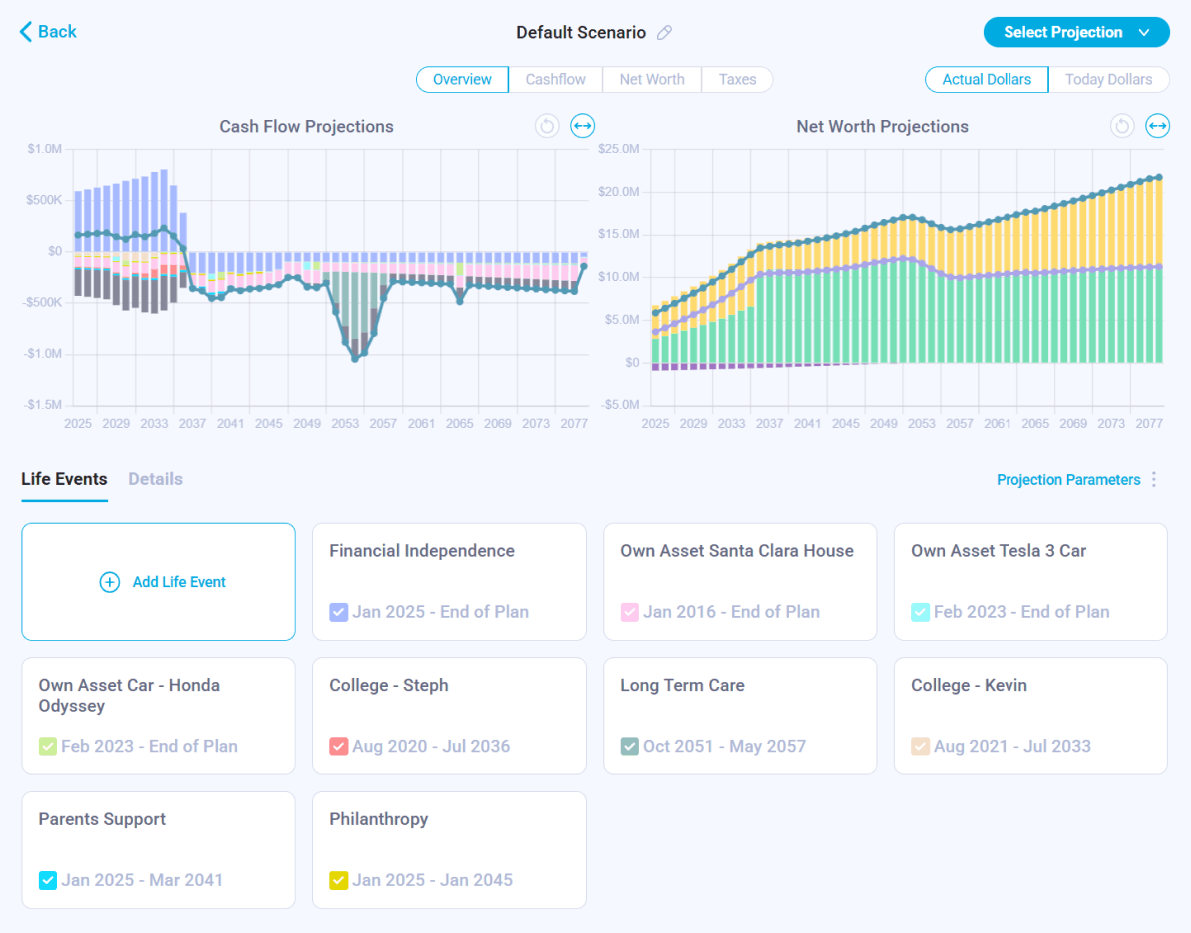
Nauma models your Social Security income, portfolio withdrawals, and life events together — so you can see how different claiming decisions and income sources interact across your full retirement timeline.
Get Started for Free