'%3e%3cpath%20d='M136%2043.0521C135.893%2043.4991%20131.298%2041.3697%20123.51%2041.5186C120.787%2041.5712%20109.626%2040.8001%20104.06%2049.4228C101.316%2053.664%20102.266%2056.2491%20100.601%2061.5769C95.2065%2078.8661%2087.7394%2075.1856%2062.5302%2088.5228C54.5058%2092.764%2045.1595%20101.562%2043.5589%20103.087C31.9403%20114.163%2025.1664%20123.189%2025.1521%20123.171C25.1378%20123.162%2034.1912%20104.357%2047.7676%2082.7655C60.6795%2062.2429%2063.8235%2070.0769%2079.7722%2049.1336C81.7015%2046.6011%2084.8526%2037.6805%2089.683%2036.1032C93.6345%2034.815%2098.6148%2036.6114%20100.065%2038.5568C101.044%2039.8712%20101.459%2040.765%20103.831%2040.4408C110.048%2039.5996%20113.613%2039.8625%20115.492%2039.7748C116.95%2039.7047%20119.751%2039.915%20120.509%2039.9939C130.419%2040.9753%20136.15%2042.4563%20136.007%2043.0434L136%2043.0521Z'%20fill='%23127398'/%3e%3cpath%20d='M22.1867%2043.6392C30.3968%2055.0923%2031.5544%2062.348%2040.6506%2068.6923C45.9954%2072.4253%2053.4839%2075.4134%2058.2928%2075.5361C61.9084%2075.6325%2063.7305%2075.2557%2064.6023%2074.949C64.8524%2074.8614%2065.1025%2074.8351%2065.3597%2074.8263L76.0636%2070.6727C76.8068%2066.8871%2076.1637%2063.4784%2076.1065%2063.1892C75.0561%2058.0103%2072.3337%2053.3835%2070.5402%2051.2542C55.4561%2033.3428%2055.8062%2034.298%2046.5814%2028.0237C26.7884%2014.5902%20-1.22192%2021.3464%200.0428309%2022.0562C0.55016%2022.3454%2010.2394%2026.9634%2022.1867%2043.6392Z'%20fill='%23127398'/%3e%3cpath%20d='M79.8366%2044.0161C81.33%2046.4784%2083.4093%2051.5784%2083.7666%2056.8975C83.7952%2057.3094%2084.1667%2064.0393%2080.4654%2068.4733C78.5004%2070.8217%2076.2281%2071.5403%2075.585%2071.7506C61.487%2076.5264%2028.4319%20116.196%2023.3515%20133.494C23.2229%20133.941%2022.6227%20136.026%2022.5655%20136C22.3797%20135.921%2023.5373%20120.753%2028.925%20106.303C28.925%20106.303%2033.7196%2090.5295%2046.7387%2073.9326C49.1896%2070.8042%2052.8052%2067.0362%2052.8052%2067.0362C54.2414%2065.1434%2059.8006%2068.3068%2066.1887%2068.482C69.9401%2068.5872%2073.2198%2067.6846%2073.2055%2067.3604C73.2055%2067.2377%2073.0698%2067.0712%2072.8911%2066.9047C72.3195%2066.3702%2071.5907%2066.1423%2070.8761%2066.2475C69.9758%2066.379%2068.1323%2066.3877%2064.5738%2065.5903C59.8435%2064.5212%2052.8481%2060.096%2048.0534%2055.364C39.9076%2047.3109%2039.7147%2039.9238%2033.1051%2026.9985C23.4944%208.17586%2014.0767%201.32328%2014.0767%201.32328C17.285%20-1.64734%2041.451%20-0.788575%2059.229%2016.3692C67.5177%2024.3697%2067.2962%2023.3619%2079.8366%2044.0073V44.0161Z'%20fill='%23EF9920'/%3e%3c/g%3e%3cdefs%3e%3cclipPath%20id='clip0_882_3310'%3e%3crect%20width='136'%20height='136'%20fill='white'/%3e%3c/clipPath%3e%3c/defs%3e%3c/svg%3e)
What Are Financial Goals?
How to Turn Vague Intentions into Measurable Targets Your Financial Plan Can Actually Use
A financial goal is a specific, quantifiable outcome you intend to achieve by a defined point in time, using financial resources. That definition sounds simple — but in practice, most people do not have financial goals. They have financial wishes.
The difference between a wish and a goal is not motivation or ambition. It is precision. A wish is directional: "I want to retire comfortably" or "I want to help my kids with college." A goal is operational: it has a dollar amount, a deadline, and a defined level of flexibility. Without those three components, a financial plan has no target to optimize toward — and no way to measure whether you are on track.
Why Vague Goals Produce Wrong Plans
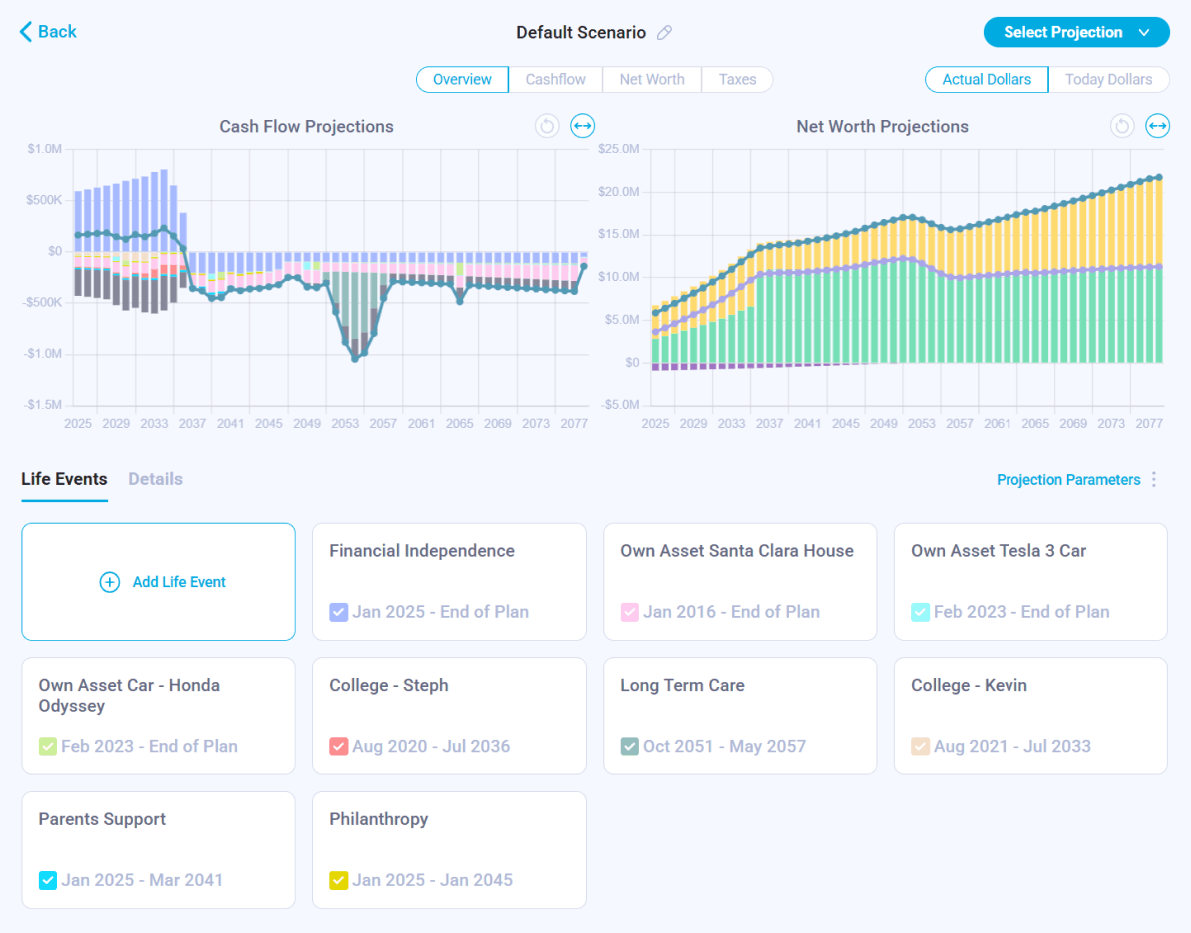
Financial planning software, including Nauma, projects the future state of your assets under thousands of simulated market scenarios. To do that accurately, it needs to know what the assets are for.
"I want to retire comfortably" could mean $4,000 per month or $20,000 per month. It could mean retirement at 55 or 70. It could be completely non-negotiable or something you would defer by five years if markets underperform. Each combination produces a fundamentally different plan — different savings rate, different asset allocation, different risk tolerance.
A financial plan built on a vague goal will be precise about the wrong thing. It will optimize toward an assumed outcome that may not match what you actually need. The goal definition step is not a formality. It is the highest-leverage input in the entire planning process.
The 3 Components of a Real Financial Goal
Every well-formed financial goal requires exactly three inputs.
1. A Dollar Amount
How much money do you need, in today's dollars, for this goal to be satisfied? For a retirement goal, this typically means your target annual spending — the amount you need the portfolio to generate each year, adjusted for inflation over time. For a one-time goal like a home purchase or college funding, it is the lump sum required at the time of the expenditure.
The dollar amount does not need to be precise to the last thousand. But it needs to be within the right order of magnitude. "Enough to maintain my current lifestyle" is not a dollar amount. "$12,000 per month in today's dollars" is.
2. A Timeline
When does this goal need to be funded? The timeline determines the time horizon — the single most important driver of appropriate asset allocation for a specific goal. A goal with a 25-year timeline tolerates more short-term volatility in the assets funding it. A goal with a 3-year timeline does not.
Timeline is not just a single end date. It also determines the duration of spending. A retirement goal that starts at age 60 and needs to last until age 90 has a 30-year funding window, not a single point in time. Planning for the starting date without planning for the full duration systematically underestimates how much capital you need.
3. A Flexibility Flag
Is this goal fixed or adjustable? Can it be deferred, scaled down, or partially funded if circumstances require it? Or does it need to happen regardless of market conditions?
This is what separates non-discretionary goals from discretionary goals. A non-discretionary goal — maintaining basic housing, healthcare, and minimum living expenses in retirement — is typically treated as one that cannot be reduced without materially affecting wellbeing. A discretionary goal — a second home, extended travel, a luxury spending level — can generally be reduced or deferred if necessary.
The flexibility flag directly affects how a plan treats that goal under stress scenarios. Non-discretionary goals are typically modeled with a higher probability of success in a Monte Carlo simulation. Discretionary goals are commonly modeled with more tolerance for uncertainty. Monte Carlo results represent statistical probabilities, not predictions or guarantees of future performance.
See What Is a Discretionary vs. Non-Discretionary Goal? for a full treatment of how to classify your goals and what the distinction means for your plan.
Vague vs. Specific: Examples
| Wish (vague) | Goal (specific) | What changed |
|---|---|---|
| Retire comfortably | Retire at 62 with $10,000/month (today's dollars) until age 95 — non-discretionary | Amount + timeline + flexibility flag |
| Help my kids with college | Fund $120,000 per child (today's dollars) for two children — first in 9 years — discretionary above 50% funded | Amount + timeline + flexibility |
| Pay off the house | Pay off $380,000 mortgage balance within 7 years — discretionary | Amount + timeline + flexibility |
| Build a legacy | Leave $500,000 (today's dollars) to heirs at death — generally classified as discretionary for modeling purposes | Amount + timeline + flexibility |
| Have an emergency fund | $60,000 in liquid savings maintained at all times — non-discretionary | Amount + ongoing timeline + flexibility |
How Financial Goals Connect to Your Plan
Once a goal is properly defined — dollar amount, timeline, flexibility flag — it becomes the input that drives everything else in your financial plan.
Asset allocation. The timeline determines how aggressively or conservatively the assets funding this goal should be invested. A 20-year retirement goal supports a high equity allocation. A 2-year home purchase goal does not. See What Is an Investment Time Horizon? for how time horizon maps to allocation.
Savings rate. The gap between where you are today and the present value of your goal determines how much you need to save. Without a defined dollar amount and timeline, there is no way to calculate whether your current savings rate is sufficient.
Risk tolerance. Your flexibility flag determines how your plan responds to stress — how much underperformance is tolerable before the goal itself needs to be reconsidered. Non-discretionary goals require more conservative planning assumptions than discretionary ones.
Goal funding ratio. How funded is this goal right now? Are you on track, underfunded, or overfunded? This metric makes progress visible and comparable across multiple goals. See What Is a Goal Funding Ratio? for how to calculate it.
The relationship between goals and projections runs in both directions. Clear goals make projections meaningful — your plan is optimizing toward something real. And projections test your goals — they reveal when the numbers do not work at the level you have defined, and give you the information to adjust before you have run out of time.
This article is for educational purposes only and does not constitute legal, tax, or financial advice. All examples are hypothetical and for illustrative purposes only. All investments involve risk, including the possible loss of principal. Always consult a qualified financial planner before making decisions about your financial plan.
Frequently Asked Questions
Model Your Goals in Nauma
Nauma lets you set specific, measurable financial goals and tracks exactly how funded each one is — in real time, across thousands of simulated market scenarios.
Get Started for Free