'%3e%3cpath%20d='M136%2043.0521C135.893%2043.4991%20131.298%2041.3697%20123.51%2041.5186C120.787%2041.5712%20109.626%2040.8001%20104.06%2049.4228C101.316%2053.664%20102.266%2056.2491%20100.601%2061.5769C95.2065%2078.8661%2087.7394%2075.1856%2062.5302%2088.5228C54.5058%2092.764%2045.1595%20101.562%2043.5589%20103.087C31.9403%20114.163%2025.1664%20123.189%2025.1521%20123.171C25.1378%20123.162%2034.1912%20104.357%2047.7676%2082.7655C60.6795%2062.2429%2063.8235%2070.0769%2079.7722%2049.1336C81.7015%2046.6011%2084.8526%2037.6805%2089.683%2036.1032C93.6345%2034.815%2098.6148%2036.6114%20100.065%2038.5568C101.044%2039.8712%20101.459%2040.765%20103.831%2040.4408C110.048%2039.5996%20113.613%2039.8625%20115.492%2039.7748C116.95%2039.7047%20119.751%2039.915%20120.509%2039.9939C130.419%2040.9753%20136.15%2042.4563%20136.007%2043.0434L136%2043.0521Z'%20fill='%23127398'/%3e%3cpath%20d='M22.1867%2043.6392C30.3968%2055.0923%2031.5544%2062.348%2040.6506%2068.6923C45.9954%2072.4253%2053.4839%2075.4134%2058.2928%2075.5361C61.9084%2075.6325%2063.7305%2075.2557%2064.6023%2074.949C64.8524%2074.8614%2065.1025%2074.8351%2065.3597%2074.8263L76.0636%2070.6727C76.8068%2066.8871%2076.1637%2063.4784%2076.1065%2063.1892C75.0561%2058.0103%2072.3337%2053.3835%2070.5402%2051.2542C55.4561%2033.3428%2055.8062%2034.298%2046.5814%2028.0237C26.7884%2014.5902%20-1.22192%2021.3464%200.0428309%2022.0562C0.55016%2022.3454%2010.2394%2026.9634%2022.1867%2043.6392Z'%20fill='%23127398'/%3e%3cpath%20d='M79.8366%2044.0161C81.33%2046.4784%2083.4093%2051.5784%2083.7666%2056.8975C83.7952%2057.3094%2084.1667%2064.0393%2080.4654%2068.4733C78.5004%2070.8217%2076.2281%2071.5403%2075.585%2071.7506C61.487%2076.5264%2028.4319%20116.196%2023.3515%20133.494C23.2229%20133.941%2022.6227%20136.026%2022.5655%20136C22.3797%20135.921%2023.5373%20120.753%2028.925%20106.303C28.925%20106.303%2033.7196%2090.5295%2046.7387%2073.9326C49.1896%2070.8042%2052.8052%2067.0362%2052.8052%2067.0362C54.2414%2065.1434%2059.8006%2068.3068%2066.1887%2068.482C69.9401%2068.5872%2073.2198%2067.6846%2073.2055%2067.3604C73.2055%2067.2377%2073.0698%2067.0712%2072.8911%2066.9047C72.3195%2066.3702%2071.5907%2066.1423%2070.8761%2066.2475C69.9758%2066.379%2068.1323%2066.3877%2064.5738%2065.5903C59.8435%2064.5212%2052.8481%2060.096%2048.0534%2055.364C39.9076%2047.3109%2039.7147%2039.9238%2033.1051%2026.9985C23.4944%208.17586%2014.0767%201.32328%2014.0767%201.32328C17.285%20-1.64734%2041.451%20-0.788575%2059.229%2016.3692C67.5177%2024.3697%2067.2962%2023.3619%2079.8366%2044.0073V44.0161Z'%20fill='%23EF9920'/%3e%3c/g%3e%3cdefs%3e%3cclipPath%20id='clip0_882_3310'%3e%3crect%20width='136'%20height='136'%20fill='white'/%3e%3c/clipPath%3e%3c/defs%3e%3c/svg%3e)
How to Prioritize Competing Financial Goals
Why High Income Does Not Eliminate Trade-offs — and How to Decide Which Goals Get Funded First
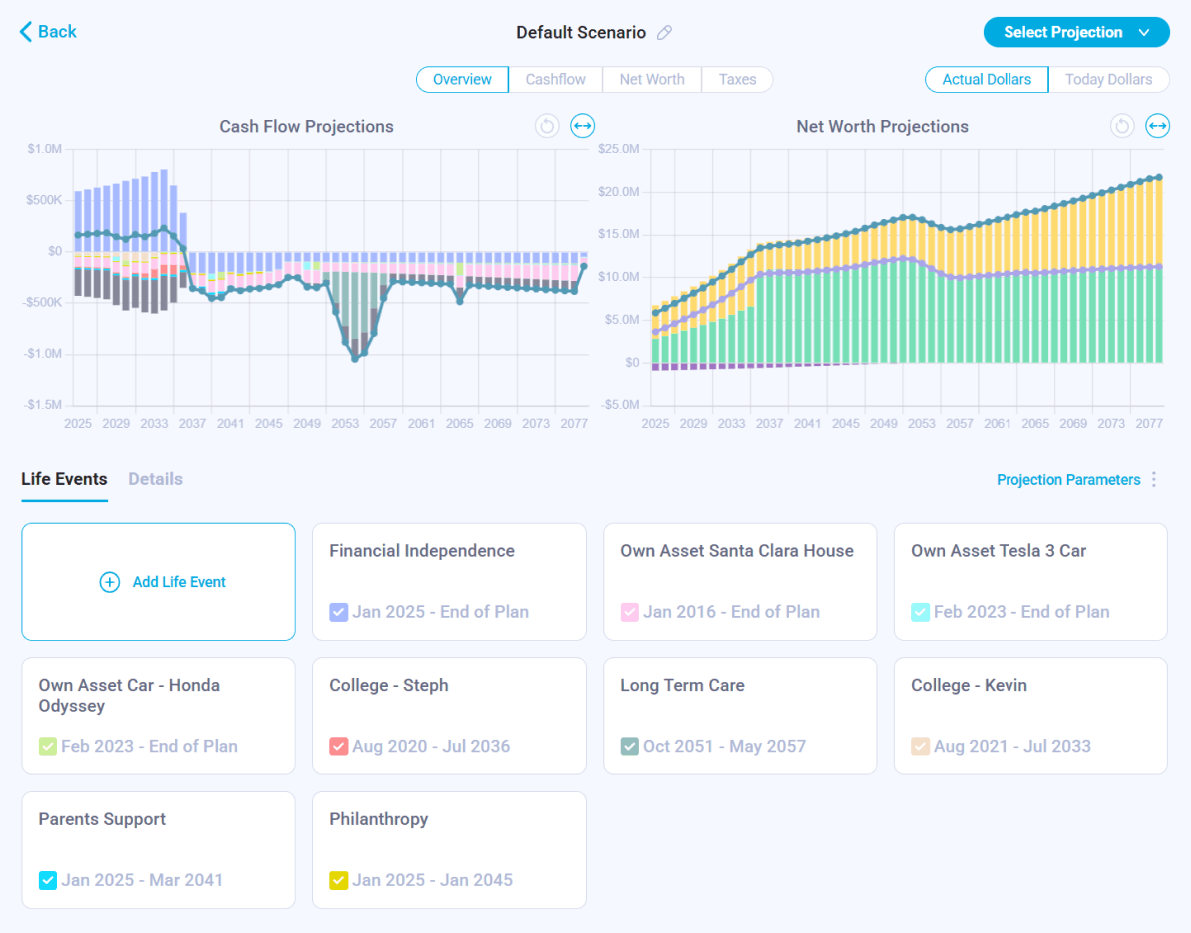
High income does not solve the goal prioritization problem. It postpones it.
A software engineer earning $350,000 per year, saving aggressively, and holding substantial equity compensation can easily feel like there is enough money to fund everything — early retirement, college for two children, a mortgage payoff, a second home, a meaningful legacy. Until you put numbers on all of it.
When you do, the math almost always reveals a conflict. Not because the income is insufficient, but because multiple large goals are competing for the same finite pool of capital — and the timing of equity vests, market performance, and life events creates constraints that income alone cannot fully resolve.
This article provides a framework for making those conflicts explicit and resolving them deliberately. It is not about cutting goals. It is about knowing which goals get priority, and making that choice consciously rather than by default.
For a full treatment of how to define and structure retirement goals in the first place, see How to Set Financial Goals for Retirement.
The Priority Stack: A Framework for Goal Ordering
Goal prioritization is not arbitrary. There is a logical hierarchy based on three principles.
Principle 1: Needs Before Wants
Non-discretionary goals — spending that cannot be meaningfully reduced without affecting health, housing, or security — are typically prioritized before discretionary goals in goal-based planning frameworks. This is the funded floor principle: the minimum level of retirement income needed to maintain a stable life is generally treated as the first funding priority before legacy or lifestyle goals receive capital.
Principle 2: Certain Before Uncertain
Goals with fixed, non-negotiable deadlines rank higher than goals with flexible timing. A child entering college in four years has a deadline that cannot move. A legacy goal has no deadline at all. A target early retirement date is negotiable in a way that the college enrollment date is not.
Time-constrained goals require earlier capital commitment — which means they need to be funded, or explicitly underfunded with a deliberate plan, before time runs out.
Principle 3: Time-Constrained Before Flexible
Even within discretionary goals, the ones with earlier deadlines rank higher. The money for a home renovation in three years needs to be in low-risk assets now. The money for a legacy goal 30 years from now can still be in equities. Time horizon creates a natural priority ordering within the discretionary tier.
The 3 Most Common Goal Conflicts for Tech Workers
Conflict 1: Retire Early vs. Fully Fund College for Two Children
This is the most common conflict among Nauma users. A couple targeting retirement at 55 or 58 with two children in elementary school is facing a direct capital competition. The assets needed to fund 30–35 years of retirement starting at 55 are substantially larger than the assets needed if retirement starts at 62 or 65. College funding adds $200,000–$400,000 in near-term capital requirements on top of an already ambitious retirement target.
How to think through it:
First, calculate your non-discretionary retirement floor. What is the minimum capital needed to retire at your target age and maintain essential spending? What is your goal funding ratio for that floor goal right now?
Second, recognize that college funding is time-constrained and non-fungible. Once the college window closes, unspent 529 funds can be rolled to a Roth IRA (up to $35,000 lifetime, subject to 15-year account age and annual Roth IRA contribution limits) or used for another family member. But underfunded college cannot be retroactively fixed.
Third, reframe the trade-off. The question is rarely "retirement or college" — it is "early retirement or on-time retirement." In most cases, the practical trade-off is 2–4 years on the retirement timeline, not a binary choice between the two goals. A 4-year retirement delay for a 50-year-old typically improves retirement funding ratio meaningfully while significantly reducing the college funding shortfall. These figures are illustrative; actual outcomes depend on individual circumstances.
Model both scenarios explicitly. The numbers provide a clearer basis for comparing trade-offs and often make the direction of the decision more apparent.
Conflict 2: Maximize Retirement Accounts vs. Pay Off Mortgage Early
This conflict is less about capital competition and more about the math of interest rates versus expected returns — but it also has behavioral and risk management dimensions that pure math ignores.
The standard financial planning reference point: if your mortgage rate is below your expected after-tax investment return, investing may produce better outcomes in expectation. A 6.5% mortgage rate versus a 7–8% long-term equity return historically suggests investing produces better expected outcomes — though past performance does not guarantee future results, and the margin between these rates can vary significantly.
But several factors push back against the pure arbitrage argument:
A paid-off mortgage eliminates a fixed non-discretionary obligation. Lower fixed obligations reduce your retirement spending floor, which may improve your Monte Carlo probability at any given wealth level. A couple that retires with no mortgage payment has significantly more flexibility to cut spending in a bad market than a couple with a $4,000 monthly payment.
Mortgage payoff is a guaranteed 6.5% return. Expected equity returns at 7–8% are not guaranteed. For someone within 5–10 years of retirement, the certainty premium from eliminating a fixed obligation becomes more meaningful.
Sequence of returns risk. High fixed obligations in early retirement create forced withdrawals in down markets, which is exactly the scenario that most damages long-term plan outcomes. Lower obligations reduce this risk.
One illustrative approach among many: retirement accounts are contributed to at least the level required to capture the full tax benefit — 401(k) match, HSA maximum ($8,750 for family coverage in 2026), Roth IRA where income limits permit. The mortgage paydown versus taxable investing decision is then evaluated based on the specific rate, timeline to retirement, and risk tolerance. There is no universal answer — it depends on the individual numbers.
Conflict 3: Build Legacy vs. Fund Own Retirement
Legacy goals — leaving wealth to children, grandchildren, or charitable causes — are generally classified as discretionary for modeling purposes. No one's retirement security depends on what they leave behind. But for many Nauma users with a family wealth mindset, the legacy goal feels non-negotiable even when the math does not support treating it that way.
In goal-based planning frameworks, the non-discretionary retirement floor is typically capitalized first. Discretionary retirement spending is addressed next. The legacy goal receives what remains.
The reasoning is not that legacy is unimportant. It is that underfunding your own retirement creates a financial burden for the very people you are trying to benefit. A parent who retires underfunded and runs out of money in their late 70s creates a financial emergency for their children. The most effective legacy strategy is to secure your own retirement first.
The good news for high-income tech workers: the legacy goal often resolves itself once retirement is well-funded. Once the retirement floor and discretionary spending reach acceptable probability levels, surplus capital naturally accumulates in taxable accounts, estate planning structures, and residual portfolio value. Retirees also frequently spend less than projected in later years, leaving more behind than planned.
The Funded Floor Principle
The funded floor is the minimum capital needed to cover non-discretionary retirement spending for life. Once it is fully capitalized, more risk can be taken with remaining assets — every dollar above the floor is funding discretionary and legacy goals that can tolerate more volatility. In goal-based planning, the floor is typically addressed before the surplus is invested aggressively.
For a full breakdown of how to calculate your funded floor and classify which spending belongs in it, see Discretionary vs. Non-Discretionary Goals.
Using Goal Funding Ratio to Diagnose Which Goal Is Most Underfunded
The goal funding ratio is the most direct tool for identifying which goal deserves priority attention right now. Calculate it for each goal and look for the goal with the lowest ratio and the shortest timeline.
A 47-year-old tech worker who runs the numbers might find:
| Goal | Funding Ratio | Urgency |
|---|---|---|
| Retirement (non-discretionary floor, target age 60) | 0.71 | High — 13 years, large gap |
| Retirement (discretionary spending, target age 60) | 0.55 | High — same timeline, large gap |
| College funding (child 1, 6 years) | 0.82 | Medium-high — short timeline |
| College funding (child 2, 9 years) | 0.91 | Medium — reasonable timeline |
| Mortgage payoff (7 years) | 0.96 | Low — nearly funded |
| Legacy goal | 0.40 | Low urgency — no deadline |
The retirement non-discretionary floor and college funding for child 1 are the most underfunded goals with the tightest timelines. The legacy goal is also severely underfunded, but has no deadline — it can wait. The mortgage is nearly funded regardless. This ordering indicates where the next savings dollar may have the highest impact.
When It Is Okay to Intentionally Underfund a Goal
Not every goal needs to reach a 100% funding ratio simultaneously. Discretionary goals with long, flexible timelines are legitimate candidates for intentional underfunding — allocating less capital to them now, in the knowledge that you will top them up later or adjust the target down if necessary.
Intentional underfunding is generally acceptable when:
- The goal is fully discretionary — no one's wellbeing depends on it being fully funded
- The timeline is long and flexible — there is time to course-correct
- The underfunding is planned and tracked — you know exactly how underfunded the goal is and have a specific plan to address it (such as directing future RSU vest proceeds toward it)
- The capital being withheld from this goal is going to a higher-priority underfunded goal
Intentional underfunding is a tool. Accidental underfunding — not knowing which goals are underfunded because you have not calculated it — is a risk.
The Role of Equity Compensation in Resolving Goal Conflicts
For tech workers with substantial RSU or option grants, equity compensation creates periodic funding events — concentrated injections of capital that can resolve goal conflicts that regular salary savings alone cannot bridge.
The strategic use of equity vests for goal funding requires a pre-made decision framework. When a vest arrives, the question "what should I do with this?" should already have an answer. Without that framework, the money disperses into general consumption or accumulates in cash with no purposeful allocation.
One illustrative equity vest allocation approach, in priority order:
- First: fund the most underfunded time-constrained goal. Typically this means near-term college savings, or retirement catch-up contributions (backdoor Roth IRA, mega backdoor Roth if your plan allows, or taxable retirement accounts) if your retirement floor is significantly underfunded.
- Second: pay down high-rate debt that exceeds your expected investment return. In a higher mortgage rate environment, this threshold is closer than it was several years ago.
- Third: invest in taxable accounts toward the next priority goal in your funding stack — typically the goal just below the ones addressed in step one.
- Fourth: any surplus goes to discretionary goals — legacy, second home, lifestyle upgrades — or to a cash buffer for the next vest cycle.
This approach is not universal — it depends on your specific goal funding ratios, tax situation, expected future vesting schedule, and timeline. But having a pre-established framework is far better than making the allocation decision fresh at each vest event, which produces inconsistent and often suboptimal outcomes.
Decision Framework: 5 Questions to Rank Your Goals
Use this framework to build a prioritized goal list and identify where to focus your next savings dollar:
Question 1: Which of my goals are non-discretionary? List them. These form the funded floor. They rank first regardless of their current funding status. If any non-discretionary goal is significantly underfunded, that is the top priority.
Question 2: What is the goal funding ratio for each non-discretionary goal? The most underfunded non-discretionary goal with the shortest timeline gets the most urgent attention. Calculate the gap and work backward to the required monthly contribution to close it.
Question 3: Which of my remaining goals have fixed deadlines? Time-constrained discretionary goals — college funding, near-term home purchase, a business investment with a window — rank above open-ended discretionary goals. List them in timeline order.
Question 4: For the open-ended discretionary goals, which produces the highest personal value? This is a values judgment, not a math problem. Rank them by what matters most to you and your family.
Question 5: What are the three most underfunded goals on this prioritized list? Those are the focus of your next savings and allocation decisions.
This framework is commonly revisited once a year, or whenever a significant financial event occurs: a major equity vest, a bonus, a job change, a new child, a divorce, or a market correction that materially changes funding ratios.
This article is for educational purposes only and does not constitute legal, tax, or financial advice. All examples and figures are hypothetical and for illustrative purposes only. All investments involve risk, including the possible loss of principal. Past performance does not guarantee future results. Monte Carlo simulations represent statistical probabilities, not predictions or guarantees of any specific outcome. Always consult a qualified financial planner before making decisions about goal prioritization, retirement planning, or investment strategy.
Frequently Asked Questions
Model Your Goal Conflicts in Nauma
Set up all your goals, see your funding ratios side by side, and find out exactly which goal is most underfunded — and what it takes to fix it.
Get Started for Free