'%3e%3cpath%20d='M136%2043.0521C135.893%2043.4991%20131.298%2041.3697%20123.51%2041.5186C120.787%2041.5712%20109.626%2040.8001%20104.06%2049.4228C101.316%2053.664%20102.266%2056.2491%20100.601%2061.5769C95.2065%2078.8661%2087.7394%2075.1856%2062.5302%2088.5228C54.5058%2092.764%2045.1595%20101.562%2043.5589%20103.087C31.9403%20114.163%2025.1664%20123.189%2025.1521%20123.171C25.1378%20123.162%2034.1912%20104.357%2047.7676%2082.7655C60.6795%2062.2429%2063.8235%2070.0769%2079.7722%2049.1336C81.7015%2046.6011%2084.8526%2037.6805%2089.683%2036.1032C93.6345%2034.815%2098.6148%2036.6114%20100.065%2038.5568C101.044%2039.8712%20101.459%2040.765%20103.831%2040.4408C110.048%2039.5996%20113.613%2039.8625%20115.492%2039.7748C116.95%2039.7047%20119.751%2039.915%20120.509%2039.9939C130.419%2040.9753%20136.15%2042.4563%20136.007%2043.0434L136%2043.0521Z'%20fill='%23127398'/%3e%3cpath%20d='M22.1867%2043.6392C30.3968%2055.0923%2031.5544%2062.348%2040.6506%2068.6923C45.9954%2072.4253%2053.4839%2075.4134%2058.2928%2075.5361C61.9084%2075.6325%2063.7305%2075.2557%2064.6023%2074.949C64.8524%2074.8614%2065.1025%2074.8351%2065.3597%2074.8263L76.0636%2070.6727C76.8068%2066.8871%2076.1637%2063.4784%2076.1065%2063.1892C75.0561%2058.0103%2072.3337%2053.3835%2070.5402%2051.2542C55.4561%2033.3428%2055.8062%2034.298%2046.5814%2028.0237C26.7884%2014.5902%20-1.22192%2021.3464%200.0428309%2022.0562C0.55016%2022.3454%2010.2394%2026.9634%2022.1867%2043.6392Z'%20fill='%23127398'/%3e%3cpath%20d='M79.8366%2044.0161C81.33%2046.4784%2083.4093%2051.5784%2083.7666%2056.8975C83.7952%2057.3094%2084.1667%2064.0393%2080.4654%2068.4733C78.5004%2070.8217%2076.2281%2071.5403%2075.585%2071.7506C61.487%2076.5264%2028.4319%20116.196%2023.3515%20133.494C23.2229%20133.941%2022.6227%20136.026%2022.5655%20136C22.3797%20135.921%2023.5373%20120.753%2028.925%20106.303C28.925%20106.303%2033.7196%2090.5295%2046.7387%2073.9326C49.1896%2070.8042%2052.8052%2067.0362%2052.8052%2067.0362C54.2414%2065.1434%2059.8006%2068.3068%2066.1887%2068.482C69.9401%2068.5872%2073.2198%2067.6846%2073.2055%2067.3604C73.2055%2067.2377%2073.0698%2067.0712%2072.8911%2066.9047C72.3195%2066.3702%2071.5907%2066.1423%2070.8761%2066.2475C69.9758%2066.379%2068.1323%2066.3877%2064.5738%2065.5903C59.8435%2064.5212%2052.8481%2060.096%2048.0534%2055.364C39.9076%2047.3109%2039.7147%2039.9238%2033.1051%2026.9985C23.4944%208.17586%2014.0767%201.32328%2014.0767%201.32328C17.285%20-1.64734%2041.451%20-0.788575%2059.229%2016.3692C67.5177%2024.3697%2067.2962%2023.3619%2079.8366%2044.0073V44.0161Z'%20fill='%23EF9920'/%3e%3c/g%3e%3cdefs%3e%3cclipPath%20id='clip0_882_3310'%3e%3crect%20width='136'%20height='136'%20fill='white'/%3e%3c/clipPath%3e%3c/defs%3e%3c/svg%3e)
Retirement Income Strategy: How to Turn Your Portfolio Into a Paycheck
The Accumulation-to-Decumulation Shift, the Three Frameworks for Sustainable Income, and a Decision Guide for High-Income Early Retirees
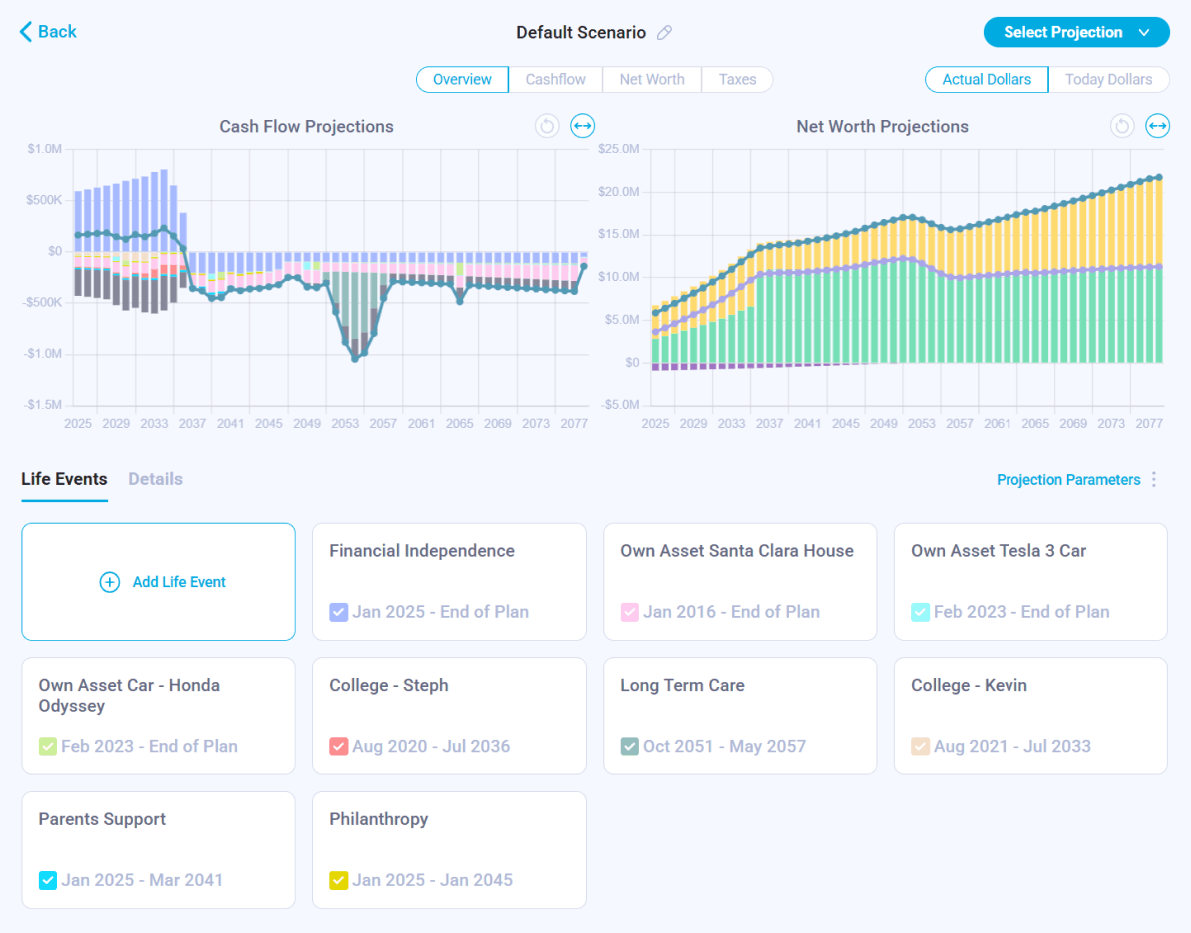
For most of your working life, the financial task is accumulation: save regularly, invest in growth assets, stay the course through volatility, and let compounding work over decades. The questions are relatively tractable — how much to save, where to put it, how to allocate across accounts.
Retirement changes the question entirely. Instead of building a portfolio, you are converting one into a reliable income stream that must last 25, 30, or potentially 40+ years. Instead of adding money regularly, you are withdrawing it — and the interaction between those withdrawals and market performance creates risks that simply do not exist during accumulation. Instead of having time to recover from mistakes, you may have limited opportunities to course-correct.
This guide presents the main frameworks for retirement income strategy — how to think about withdrawals, what the research says about sustainable rates, how to structure a portfolio for spending rather than saving, and how the key decisions interact. It is aimed at high-income professionals approaching or in early retirement, where the planning horizon is often longer, the portfolios are larger and more complex, and the stakes of the key decisions are proportionally higher.
The Core Problem: Withdrawals Change Everything
During accumulation, portfolio volatility is largely irrelevant to your financial outcomes. If markets fall 30% when you are 35 and contributing $3,000 per month, you are buying assets at a 30% discount. The recovery, which historically comes, benefits you. Time absorbs the damage.
The moment withdrawals begin, the same volatility becomes dangerous. Not because the long-run returns have changed, but because you are now selling assets to fund living expenses — and selling during a decline locks in losses. A portfolio that falls from $2,000,000 to $1,400,000 while you are withdrawing $80,000 per year has been impaired in a way that a simple price recovery cannot fully reverse. You have sold shares at the bottom that cannot participate in the recovery.
This is sequence of return risk: the danger that poor returns early in retirement permanently damage the portfolio even if long-run average returns are adequate. Two retirees with identical 30-year average returns can end up in dramatically different financial positions depending on whether the bad years arrived at the beginning or end of retirement. Early bad years are dangerous. Late bad years, when the portfolio has had time to compound and withdrawals have already consumed much of the early balance, are far less so. See What Is Sequence of Return Risk? for the full mechanics of why sequence matters more than averages.
A retirement income strategy is, at its core, a framework for managing this specific risk while still sustaining adequate spending. The frameworks differ in how they manage it — through asset structure, spending rules, or guaranteed income sources — but all of them are responses to the same underlying problem.
The Three Frameworks
Framework 1: Systematic Withdrawal
The systematic withdrawal approach establishes a starting withdrawal rate — expressed as a percentage of the initial portfolio — and maintains that dollar amount in real (inflation-adjusted) terms year over year, regardless of portfolio performance.
The 4% rule, derived from William Bengen's 1994 research and the 1998 Trinity Study, found that a 4% starting rate, adjusted annually for inflation, survived every historical 30-year period when invested in a diversified equity-bond portfolio. Withdraw $80,000 in year 1 from a $2,000,000 portfolio; in year 2, withdraw $80,000 plus that year's inflation rate; continue indefinitely. Past performance is not indicative of future results; historical survival rates do not guarantee the same outcomes in future market environments.
The appeal of systematic withdrawal is simplicity and transparency. The limitation is rigidity: continuing to withdraw the same real dollar amount during a major market decline is the behavior that makes sequence of return risk destructive. The fixed withdrawal forces selling at exactly the wrong time. Additionally, in periods of elevated or persistent inflation — as seen in the early-to-mid 2020s — the inflation-adjusted dollar withdrawal can rise faster than expected, increasing portfolio stress beyond what historical averages suggest.
Dynamic withdrawal strategies are the practical refinement that preserves systematic withdrawal's simplicity while adding spending flexibility. Rather than maintaining a fixed dollar withdrawal, dynamic strategies adjust spending based on portfolio conditions: a modest reduction in bad years, a modest increase when portfolio growth has outpaced expectations. Research by Guyton and Klinger, and subsequent work by Kitces and Morningstar researchers, shows that even small spending adjustments — as little as a 10% reduction in a severe bear market year — significantly improve portfolio survival rates and can support a meaningfully higher starting withdrawal rate than the rigid 4% rule allows. See What Is Dynamic Withdrawal? for how these rules work in detail, and What Is a Sustainable Withdrawal Rate? for the research behind the starting rate concept.
Framework 2: Time Segmentation (Bucket Strategy)
The bucket strategy organizes the portfolio into time-based pools, each holding assets appropriate for when that money will be needed. A near-term bucket (1–3 years of expenses) in cash or near-cash. A medium-term bucket (3–10 years) in bonds or fixed income. A long-term bucket (10+ years) in equities and growth assets.
Monthly living expenses draw from the near-term bucket — which holds only stable assets unaffected by equity market swings. When equity markets fall, the retiree continues to spend from the near-term bucket without selling equities. The equities in the long-term bucket are left to recover. When equity markets recover, gains are harvested to refill the medium-term bucket, which in turn refills the near-term bucket.
The bucket strategy does not, in most research, produce better mathematical outcomes than a single balanced portfolio with equivalent overall allocation and the same withdrawal rate. What it produces is a behavioral and psychological benefit that may be worth more than any incremental mathematical advantage: a clear, rule-based answer to "what do I do when markets fall?" The answer is always: look at Bucket 1. If it's funded, do nothing. This clarity prevents the behavioral errors — selling equities during downturns, reducing equity exposure at the worst time — that have a far more negative impact on outcomes than the strategy's mathematical properties.
See What Is the Bucket Strategy? for a full treatment of bucket sizing, refilling mechanics, and implementation across account types.
Framework 3: Floor-and-Upside
The floor-and-upside framework takes a different approach: rather than managing how the portfolio handles withdrawals, it separates the income into two layers — a guaranteed floor for essential expenses, and a growth-oriented portfolio for discretionary spending.
The floor consists of income sources that do not depend on portfolio performance: Social Security, any defined benefit pension, and potentially a simple income annuity. Once essential expenses — housing, food, healthcare, utilities — are covered by guaranteed income sources, the remaining portfolio can be invested more aggressively, because its losses affect only discretionary spending.
This has a counterintuitive implication: securing the floor can enable a higher equity allocation in the upside portfolio, not a lower one. A retiree whose essential expenses are covered by Social Security and a small pension has no forced selling obligation on the portfolio side. The portfolio can decline 40%, and the essential bills are still paid. The retiree can hold through the decline without financial crisis. This eliminates sequence of return risk on the essential expense layer entirely.
For many retirees, Social Security timing can be one of the highest-leverage floor-building decisions available — and it does not require purchasing an insurance product. Delaying from full retirement age to 70 increases the monthly benefit by approximately 24% permanently (8% per year for up to three years of delay). For couples, the higher earner's benefit amount becomes the surviving spouse's benefit for life, which means the claiming decision has implications beyond the individual retiree's lifespan.
Sustainable Withdrawal: What the Research Says
The historical research on withdrawal rates provides useful reference points, with important caveats. All of the following figures are drawn from historical back-testing on US market data and do not guarantee future results.
A starting rate of 4% has historically survived 95%+ of 30-year periods in research using diversified equity-bond portfolios. For a 35-year horizon, the historical success rate at 4% declines meaningfully, with many researchers suggesting 3.5–3.75% as a more conservative baseline. For a 40-year horizon, which applies to early retirees in their mid-to-late 50s, research increasingly points to 3.0–3.5% as a prudent starting point.
Morningstar's 2024 retirement research set the starting safe withdrawal rate for a moderate portfolio success probability at approximately 3.7–4.0% for a 30-year horizon at current market conditions, noting that high starting equity valuations and the current interest rate environment create some headwinds relative to long historical averages.
These figures apply to portfolio-only withdrawal scenarios. A retiree receiving $50,000 in annual Social Security income who needs $120,000 per year total is withdrawing only $70,000 from the portfolio — a 3.5% rate on a $2,000,000 portfolio. The withdrawal rate concept applies to the portfolio withdrawal, not total income.
What matters more than the specific starting rate is consistency of strategy and willingness to adjust. A retiree who applies a dynamic withdrawal framework — maintaining a 4% starting rate but accepting modest spending adjustments in severe downturns — can achieve similar or better outcomes than one who applies a more conservative static rate with perfect rigidity.
The Early Retirement Dimension
For tech workers who retire in their late 40s or 50s — a common trajectory for this audience — retirement income planning involves challenges that conventional 65-year-old retirement planning does not address.
A longer horizon changes the sustainable rate substantially. A 48-year-old retiree faces a potential 45-year horizon. At that time horizon, the 4% rule has materially lower historical success rates than it does at 30 years. A starting rate of 2.75–3.25% is more commonly cited for this horizon in research literature. The portfolio must work harder for longer.
The gap years before Social Security and Medicare. An early retiree faces years — often decades — before Social Security income begins and before Medicare provides healthcare coverage at age 65. Healthcare costs from the ACA marketplace during these years can be significant, and ACA subsidy eligibility depends on MAGI. Large Roth conversions during the early retirement years — which reduce the future tax burden from RMDs — count as MAGI and can reduce ACA subsidies. This creates a planning trade-off that requires explicit modeling.
The Roth conversion opportunity. The years between early retirement and Social Security claiming are typically the most favorable window for Roth conversions: income is low (no employment income, no Social Security yet), the tax bracket is at its lifetime minimum, and converting pre-tax assets to Roth permanently reduces future RMDs and the downstream tax consequences. For a high-income tech worker with a $1.5M–$3M traditional 401(k), strategic Roth conversions in the early retirement years can materially improve the lifetime tax outcome. Note that under current law (SECURE 2.0 Act), Required Minimum Distributions begin at age 73 for those born between 1951 and 1959, and at age 75 for those born in 1960 or later. See Retirement Withdrawal Order for how conversion strategy integrates with the withdrawal sequence.
Sequence of return risk is most acute at the start. The first 5–10 years of retirement are the period of maximum sequence of return risk exposure. A significant market decline in year 2 of a 45-year retirement is more damaging than the same decline in year 22. For early retirees, maintaining more conservative withdrawal rates, larger cash buffers (Bucket 1), or a more explicit floor through delayed Social Security is particularly valuable in the early years.
The Social Security Claiming Decision as an Income Strategy Lever
Social Security timing is often treated as a separate decision — a healthcare and longevity question. In the context of retirement income strategy, it is better understood as an income architecture decision.
A larger Social Security benefit is a larger, permanent, inflation-adjusted, guaranteed income floor. Delay from age 67 to 70 increases the monthly benefit by 24% permanently. For a couple, the higher earner's maximized delayed benefit is also the survivor benefit — the guaranteed income the surviving spouse will receive for the rest of their life.
The portfolio implications of this decision are significant. A retiree who delays Social Security to 70 withdraws more from the portfolio during the delay years — creating higher sequence of return risk during that period — but then faces a permanently lower required portfolio withdrawal rate after 70. Whether this trade-off is favorable depends on the specific numbers, but for retirees with adequate portfolio assets to sustain the delay period, the post-70 withdrawal rate reduction is often substantial enough to make delay an attractive option for many people.
Modeling the Social Security timing decision alongside the portfolio and withdrawal strategy — rather than in isolation — is the only way to evaluate it accurately. See When Should You Claim Social Security? for the full framework.
Longevity: The Risk That Outlasts the Strategy
Any retirement income strategy must be stress-tested against a scenario many retirees underweight: living significantly longer than expected. The average life expectancy for a healthy 65-year-old American is approximately 84–87 depending on gender. But average life expectancy is not the right planning horizon — it means roughly half the population lives longer. For a married couple age 65, there is approximately a 50% probability that at least one spouse lives past 90.
The financial consequence of longevity is cumulative: each additional year requires additional portfolio withdrawals, additional healthcare spending (which rises sharply in the later years), and additional exposure to inflation eroding purchasing power. A plan that looks sustainable to age 88 may face serious stress at 95.
The most commonly cited structural responses to longevity risk include: maximizing guaranteed lifetime income through Social Security delay and potentially floor-building instruments, maintaining a lower portfolio withdrawal rate during the early years to preserve capital for later, and stress-testing the plan to age 95 or 100 to understand what the late-retirement picture actually looks like under different market scenarios. See What Is Longevity Risk? for a full treatment.
Putting It Together: A Decision Framework
The retirement income strategy question is not a single choice between three competing frameworks. Many retirees find that a hybrid approach — drawing on elements of each framework where it is strongest — fits their situation better than any single method applied uniformly.
One way to think about this layering:
Floor layer: Guaranteed income sources — Social Security, any pension, and potentially an income annuity — can cover essential expenses and reduce the portfolio's burden in ways that also address sequence of return risk and longevity risk. The Social Security claiming decision is a key lever here, with delay generally producing a larger permanent floor at the cost of higher portfolio withdrawals during the gap years.
Portfolio structure: Organizing the portfolio into time-segmented buckets provides a behavioral framework for managing withdrawals through market volatility — a clear rule for what to do when markets fall, rather than a decision made under stress.
Spending rules: A defined withdrawal rate, combined with explicit rules for modest adjustments when portfolio conditions warrant, adds a layer of responsiveness that pure fixed withdrawal lacks. Whether this takes the form of the Guyton-Klinger rules, a guardrails approach, or a more informal annual review depends on the individual's preferences and complexity tolerance.
Tax layer: The withdrawal strategy sits on top of an account-sequencing and tax-efficiency framework — which accounts to draw from in which years, when to convert pre-tax assets to Roth, and how to manage RMDs. See Retirement Withdrawal Order for the detailed account-sequencing framework.
How these elements are combined, and which receive the most emphasis, depends on individual circumstances that a qualified financial advisor is best positioned to evaluate.
This article is for educational purposes only and does not constitute investment, tax, or financial advice. Historical research on sustainable withdrawal rates uses past market data and does not guarantee future results. Social Security projections are subject to legislative change. RMD age thresholds are based on current law (SECURE 2.0 Act) and may be subject to future legislative changes. Individual circumstances — including time horizon, portfolio composition, other income sources, spending needs, and risk tolerance — significantly affect which strategies may be appropriate. Always consult a qualified financial advisor before making retirement income decisions.
Frequently Asked Questions
See How Your Retirement Income Strategy Holds Up
Nauma projects your full retirement plan — income sources, portfolio withdrawals, taxes, and spending — across your actual timeline, with Monte Carlo simulation showing how the plan performs across thousands of market scenarios.
Get Started for Free